

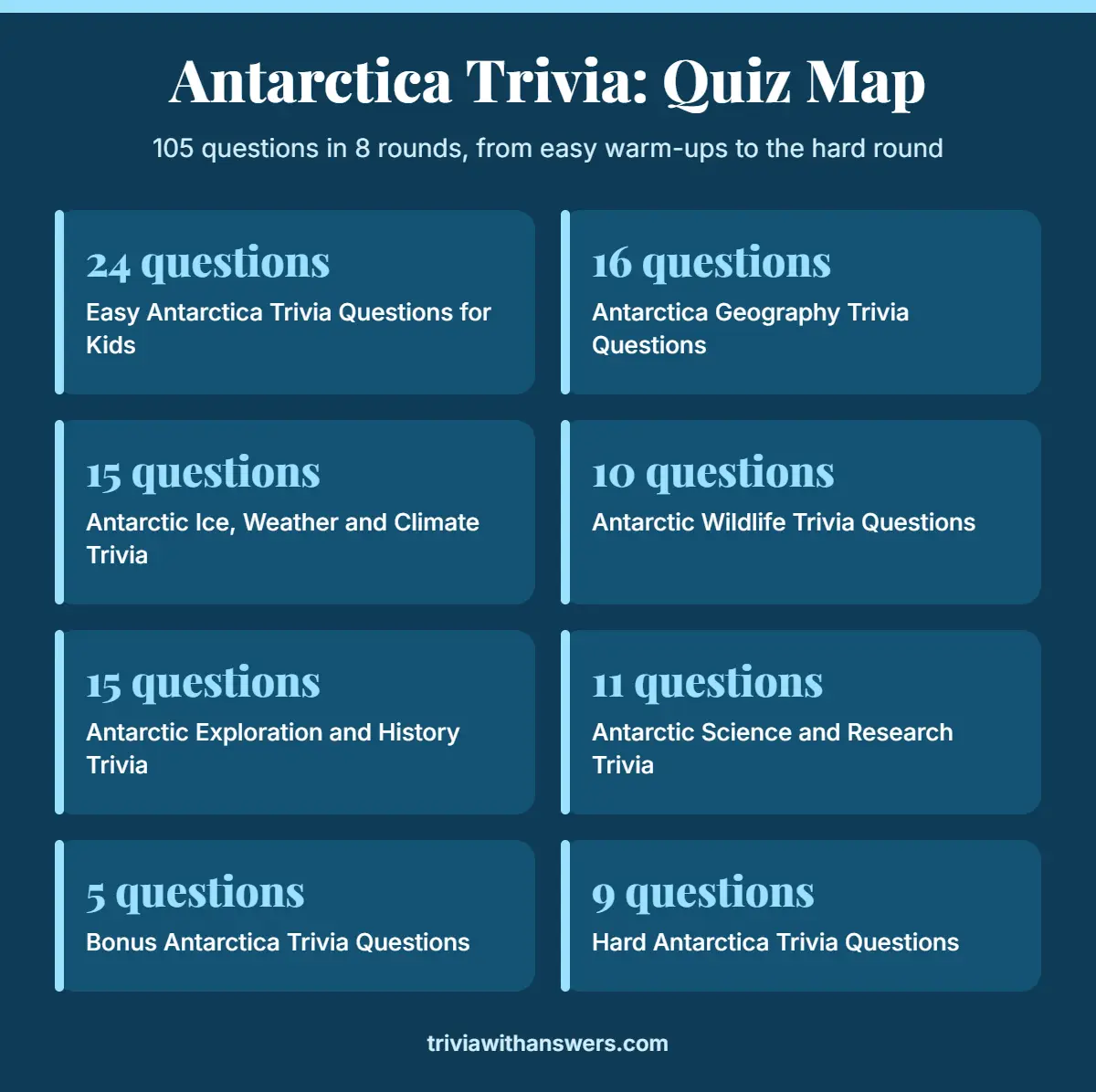
Looking for Antarctica trivia questions and answers that go beyond the basics? This quiz has 105 Antarctica trivia questions about the coldest, windiest and driest continent on Earth, from penguins and icebergs to the race to the South Pole.
The questions start with an easy round for kids and students, then move through geography, ice and weather, wildlife, exploration history and science, before a hard round for true polar experts. Every question has four choices, a hidden answer and a short explanation, so you learn something new even when you guess wrong.
Use it for a classroom lesson, a family quiz night or just to test yourself. When you finish, try the practice exercise at the end to see how much you remember.
Quick Antarctica Facts
- Antarctica covers about 14 million square kilometers, bigger than Europe or Australia.
- About 98 percent of the continent is covered by ice, holding most of the world’s fresh water.
- The coldest temperature measured at a weather station, minus 89.2°C, was recorded at Vostok Station in 1983.
- No one lives in Antarctica permanently. Up to around 5,000 researchers stay there in summer.
- Roald Amundsen’s team was the first to reach the South Pole, in December 1911.
For more background, see Antarctica on Wikipedia.
Table of Contents
Easy Antarctica Trivia Questions for Kids
Start here. These easier questions are great for kids, classrooms and first-time players.
1. What is Antarctica?
- A) A country
- B) A continent
- C) An island
- D) An ocean
Show answer
Answer: B) A continent. Antarctica is the fifth-largest continent on Earth and is covered mostly by thick ice.
2. Which animal is famous for living in Antarctica?
- A) Lion
- B) Penguin
- C) Elephant
- D) Monkey
Show answer
Answer: B) Penguin. Penguins are among the most recognizable animals found in Antarctica. They are excellent swimmers and cannot fly.
3. What covers most of Antarctica?
- A) Sand
- B) Forests
- C) Ice
- D) Grass
Show answer
Answer: C) Ice. Almost all of Antarctica is covered by a huge ice sheet that contains most of Earth’s freshwater ice.
4. Do polar bears live in Antarctica?
- A) Yes, everywhere
- B) Only in winter
- C) No, they live in the Arctic
- D) Only near penguins
Show answer
Answer: C) No, they live in the Arctic. Polar bears live in the Arctic region, not Antarctica. Penguins and polar bears do not naturally live together.
5. What is the South Pole located in?
- A) Africa
- B) Antarctica
- C) Australia
- D) South America
Show answer
Answer: B) Antarctica. The geographic South Pole is located on the icy continent of Antarctica.
6. What is the main reason Antarctica is so cold?
- A) It receives very little direct sunlight
- B) It has many volcanoes
- C) It is close to the ocean
- D) It has too many mountains
Show answer
Answer: A) It receives very little direct sunlight. Antarctica receives weak sunlight because of its location near the South Pole, making it extremely cold.
7. What is the largest penguin species?
- A) Little penguin
- B) King penguin
- C) Emperor penguin
- D) Rockhopper penguin
Show answer
Answer: C) Emperor penguin. Emperor penguins can grow to around 1.2 meters tall and are specially adapted to survive freezing temperatures.
8. What do penguins mainly eat?
- A) Grass and leaves
- B) Fish, krill, and squid
- C) Fruits and nuts
- D) Seeds and flowers
Show answer
Answer: B) Fish, krill, and squid. Penguins are carnivores that catch small sea animals while swimming underwater.
9. What is krill?
- A) A type of tiny sea animal
- B) A mountain
- C) A frozen lake
- D) A kind of bird
Show answer
Answer: A) A type of tiny sea animal. Krill are small shrimp-like animals that are an important food source for whales, penguins, and seals.
10. Does Antarctica have permanent human residents?
- A) Yes, millions
- B) Yes, thousands of families
- C) No, only temporary researchers and visitors
- D) Only children live there
Show answer
Answer: C) No, only temporary researchers and visitors. Antarctica has no permanent native population. Scientists and support workers stay there temporarily at research stations.
11. What is the weather like in Antarctica during winter?
- A) Hot and rainy
- B) Warm and sunny
- C) Extremely cold and dark
- D) Humid and tropical
Show answer
Answer: C) Extremely cold and dark. During Antarctic winter, many areas experience months without sunrise and temperatures can become incredibly low.
12. Which ocean surrounds Antarctica?
- A) Indian Ocean only
- B) Southern Ocean
- C) Atlantic Ocean only
- D) Arctic Ocean
Show answer
Answer: B) Southern Ocean. The Southern Ocean surrounds Antarctica and connects with the Atlantic, Pacific, and Indian Oceans.
13. What is the main job of scientists visiting Antarctica?
- A) Building shopping malls
- B) Studying nature, climate, and wildlife
- C) Growing tropical fruits
- D) Opening restaurants
Show answer
Answer: B) Studying nature, climate, and wildlife. Scientists travel to Antarctica to study climate change, glaciers, animals, and the environment.
14. Which powerful, spotted Antarctic seal is known for hunting penguins?
- A) Leopard seal
- B) Harbor seal
- C) Elephant seal
- D) Ringed seal
Show answer
Answer: A) Leopard seal. Leopard seals are powerful Antarctic predators known for their spotted bodies and strong jaws.
15. Can plants grow in Antarctica?
- A) No plants can grow anywhere
- B) Yes, but only a few types
- C) Yes, tropical trees grow everywhere
- D) Only large fruit trees grow
Show answer
Answer: B) Yes, but only a few types. Antarctica has very limited plant life. Small plants such as mosses, lichens, and two flowering plant species grow in some areas.
16. What happens to the sun in some parts of Antarctica during summer?
- A) It never rises
- B) It shines for months without setting
- C) It disappears forever
- D) It becomes twice as large
Show answer
Answer: B) It shines for months without setting. During Antarctic summer, some places experience the midnight sun, when daylight continues for 24 hours.
17. Why is Antarctica important to our planet?
- A) It controls all earthquakes
- B) It helps regulate Earth’s climate
- C) It produces all the world’s food
- D) It stops every storm
Show answer
Answer: B) It helps regulate Earth’s climate. Antarctica’s ice and surrounding ocean play an important role in Earth’s climate system and influence global sea levels.
18. What is the capital city of Antarctica?
- A) McMurdo
- B) Palmer
- C) Casey
- D) There is no capital city
Show answer
Answer: D) There is no capital city. Antarctica is not a country and has no capital city.
19. What is a common Antarctic animal besides penguins?
- A) Camel
- B) Tiger
- C) Seal
- D) Elephant
Show answer
Answer: C) Seal. Many seal species live in Antarctic waters and on the ice.
20. What colour is the Antarctic ice most commonly seen as?
- A) Red
- B) Green
- C) White
- D) Black
Show answer
Answer: C) White. Snow and ice reflect sunlight, giving Antarctica its white appearance.
21. Antarctica is located in which hemisphere?
- A) Northern Hemisphere
- B) Eastern Hemisphere
- C) Western Hemisphere
- D) Southern Hemisphere
Show answer
Answer: D) Southern Hemisphere. Antarctica surrounds the South Pole in the Southern Hemisphere.
22. What is a large floating piece of ice called?
- A) Glacier
- B) Volcano
- C) Iceberg
- D) Canyon
Show answer
Answer: C) Iceberg. Icebergs break off from glaciers and ice shelves into the sea.
23. What is the main source of fresh water stored in Antarctica?
- A) Rivers
- B) Lakes
- C) Rain
- D) Ice Sheets
Show answer
Answer: D) Ice Sheets. Antarctica contains most of the world’s frozen fresh water.
24. What is an Antarctic research station used for?
- A) Shopping
- B) Tourism only
- C) Sports events
- D) Scientific research
Show answer
Answer: D) Scientific research. Research stations help scientists study weather, wildlife, and ice.
Antarctica Geography Trivia Questions
25. What is the highest peak in Antarctica?
- A) Mount Erebus
- B) Mount Kirkpatrick
- C) Vinson Massif
- D) Mount Sidley
Show answer
Answer: C) Vinson Massif. Located in the Sentinel Range of the Ellsworth Mountains, Vinson Massif reaches an elevation of 4,892 meters (16,050 feet), making it the highest point on the continent. Fun Trivia
26. Which active volcano in Antarctica is the southernmost active volcano on Earth?
- A) Mount Terror
- B) Mount Erebus
- C) Deception Island
- D) Mount Melbourne
Show answer
Answer: B) Mount Erebus. Mount Erebus, situated on Ross Island, is the southernmost active volcano on Earth and is famous for its persistent lava lake. Fun Trivia
27. What is the largest glacier in Antarctica—and the world?
- A) Beardmore Glacier
- B) Lambert Glacier
- C) Pine Island Glacier
- D) Thwaites Glacier
Show answer
Answer: B) Lambert Glacier. The Lambert Glacier in East Antarctica holds the Guinness World Record for the largest glacier in the world, spanning over 400 km in length and up to 105 km in width. Fun Trivia
28. What is the name of the body of water known for having some of the roughest seas on Earth, located between Cape Horn and the Antarctic Peninsula?
- A) Ross Sea
- B) Weddell Sea
- C) Drake Passage
- D) Davis Strait
Show answer
Answer: C) Drake Passage. The Drake Passage connects the Atlantic and Pacific oceans between South America’s southern tip and Antarctica, where cold polar waters meet warmer currents.
29. What geographic feature makes up the northernmost region of the Antarctic mainland?
- A) Victoria Land
- B) Marie Byrd Land
- C) The Antarctic Peninsula
- D) Queen Maud Land
Show answer
Answer: C) The Antarctic Peninsula. The Antarctic Peninsula extends northward toward South America and is the mildest and most accessible part of the continent.
30. What rank does Antarctica hold among the world’s seven continents in terms of total land area?
- A) 3rd largest
- B) 4th largest
- C) 5th largest
- D) 6th largest
Show answer
Answer: C) 5th largest. Antarctica covers approximately 14 million square kilometers, making it larger than Europe and Australia, positioning it as the 5th largest continent.
31. What geographic region of Antarctica remains the largest land area on Earth not claimed by any nation?
- A) Palmer Land
- B) Marie Byrd Land
- C) Wilkes Land
- D) Enderby Land
Show answer
Answer: B) Marie Byrd Land. Due to its extreme remoteness and rugged conditions, Marie Byrd Land (between 158°W and 103°24’W) remains completely unclaimed by any country.
32. What unique geographical phenomenon causes the “Blood Falls” feature on the Taylor Glacier?
- A) Red algae blooms under the surface
- B) Volcanic ash mixing with melting water
- C) Iron oxide-rich brine leaking from a subglacial reservoir
- D) Copper mineral deposits reacting with ice
Show answer
Answer: C) Iron oxide-rich brine leaking from a subglacial reservoir. Blood Falls bleeds crimson water due to hyper-saline subglacial water containing high amounts of iron, which oxidizes upon contact with atmospheric oxygen.
33. What is the approximate size of Antarctica compared to other continents?
- A) Smaller than Australia
- B) About the size of Europe
- C) Larger than Europe and Australia combined
- D) The smallest continent
Show answer
Answer: C) Larger than Europe and Australia combined. Antarctica is the fifth-largest continent and bigger than Europe and Australia put together.
34. What is the name of the extremely salty body of water in the McMurdo Dry Valleys that almost never freezes?
- A) Lake Vostok
- B) Don Juan Pond
- C) Lake Fryxell
- D) Blood Falls Lake
Show answer
Answer: B) Don Juan Pond. Don Juan Pond has one of the highest salinities on Earth (mostly calcium chloride). Its extreme salt content keeps it liquid even at temperatures well below 0°C.
35. How many countries have made territorial claims in Antarctica?
- A) Three
- B) Seven
- C) Twelve
- D) Twenty
Show answer
Answer: B) Seven. Seven countries claim parts of the continent, though the treaty sets those claims aside.
36. Which country claims the largest share of Antarctica?
- A) Australia
- B) Norway
- C) Argentina
- D) United Kingdom
Show answer
Answer: A) Australia. Australia claims about 42 percent of the continent.
37. What unusual feature does Mount Erebus have at its summit?
- A) A long-lasting lava lake
- B) A frozen waterfall
- C) A hot spring resort
- D) A glacier cave
Show answer
Answer: A) A long-lasting lava lake. It is one of the few volcanoes with a persistent lava lake.
38. Which powerful ocean current flows all the way around Antarctica?
- A) The Antarctic Circumpolar Current
- B) The Gulf Stream
- C) The Kuroshio Current
- D) The Humboldt Current
Show answer
Answer: A) The Antarctic Circumpolar Current. It moves more water than any other ocean current.
39. In which year did National Geographic recognize the Southern Ocean as the world’s fifth ocean?
- A) 1990
- B) 2005
- C) 2021
- D) 2024
Show answer
Answer: C) 2021. It made the change on World Oceans Day in 2021.
40. Antarctica was once part of which ancient supercontinent?
- A) Gondwana
- B) Laurasia
- C) Atlantis
- D) Avalonia
Show answer
Answer: A) Gondwana. It was joined to South America, Africa, India and Australia.
Antarctic Ice, Weather and Climate Trivia
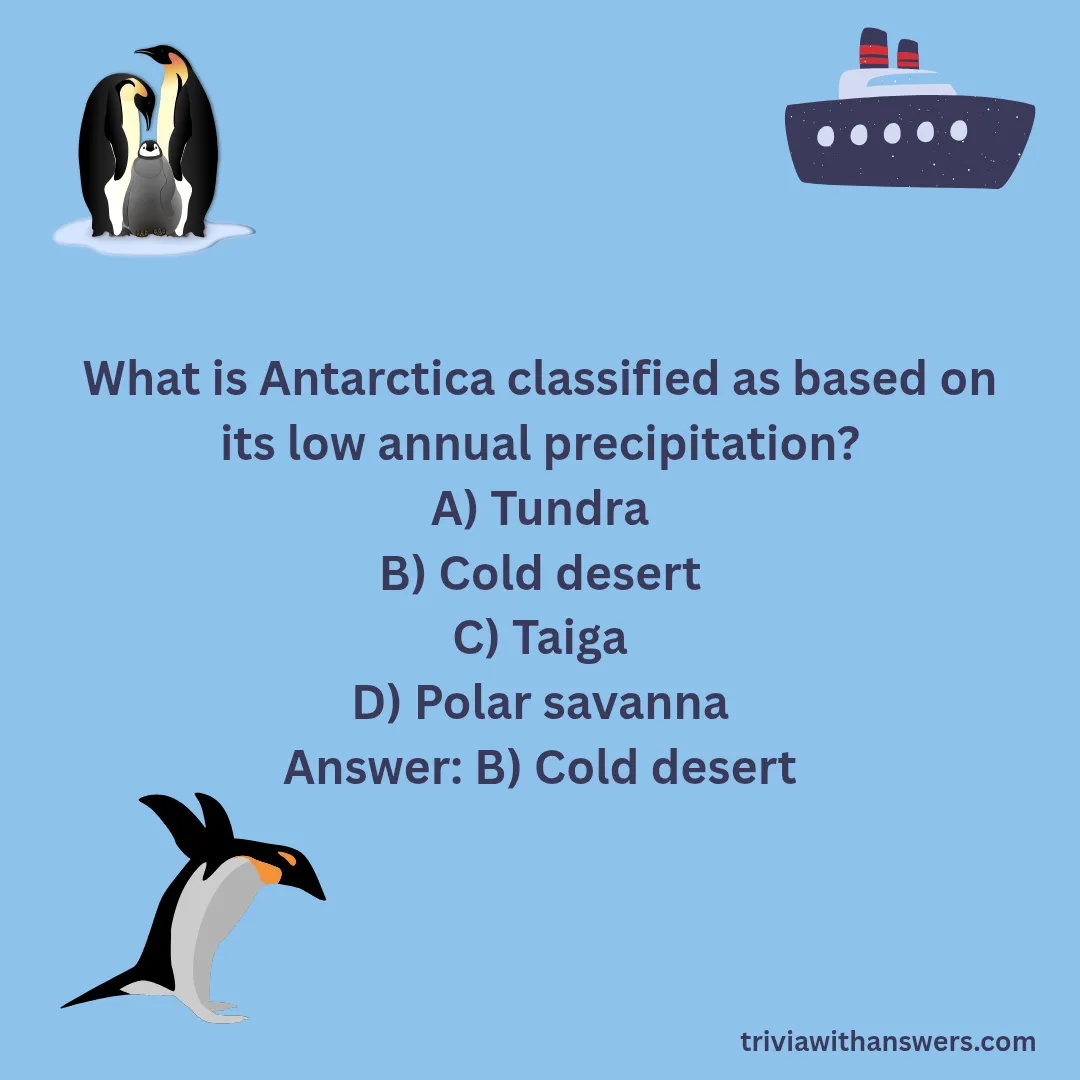
41. What is Antarctica classified as based on its low annual precipitation?
- A) Tundra
- B) Cold desert
- C) Taiga
- D) Polar savanna
Show answer
Answer: B) Cold desert. Antarctica is technically the largest desert in the world because it receives an average of less than 2 inches (50 mm) of precipitation annually in the interior, making it drier than many hot sand deserts.
42. Approximately what percentage of Antarctica is covered by ice?
- A) 85%
- B) 90%
- C) 98%
- D) 100%
Show answer
Answer: C) 98%. Roughly 98% of Antarctica’s landmass is covered by the Antarctic ice sheet, which contains around 90% of the world’s ice and 70% of its fresh water.
43. What type of strong, high-velocity wind is responsible for blowing cold air down Antarctic slopes toward the coast?
- A) Chinook winds
- B) Katabatic winds
- C) Sirocco winds
- D) Trade winds
Show answer
Answer: B) Katabatic winds. Katabatic winds occur when dense, cold air flows down steep ice slopes under the force of gravity, reaching hurricane-force speeds along coastal zones.
44. Which subglacial lake beneath the Antarctic ice sheet is the largest known liquid water lake on the continent?
- A) Lake Mercer
- B) Lake Ellsworth
- C) Lake Vostok
- D) Lake Hodgson
Show answer
Answer: C) Lake Vostok. Located beneath the Russian Vostok Station under nearly 4 kilometers of ice, Lake Vostok is Antarctica’s largest subglacial lake.
45. What is the term for ice formations that extend from glaciers onto the ocean surface while remaining attached to the land?
- A) Icebergs
- B) Pack ice
- C) Ice shelves
- D) Moraines
Show answer
Answer: C) Ice shelves. Ice shelves are thick floating platforms of ice formed where glaciers flow down to the coastline; the Ross Ice Shelf is the largest in Antarctica.
46. What is the coldest temperature ever recorded in Antarctica?
- A) –50°C
- B) –89.2°C
- C) –30°C
- D) –120°C
Show answer
Answer: B) –89.2°C. The coldest temperature ever recorded on Earth was –89.2°C at Vostok Station in Antarctica in 1983.
47. Antarctica is considered a desert. Why?
- A) Because it is very hot
- B) Because it gets very little precipitation
- C) Because it has sand dunes
- D) Because no animals live there
Show answer
Answer: B) Because it gets very little precipitation. Antarctica receives so little rain or snow each year that it is classified as a polar desert.
48. What is the thickest ice ever measured in Antarctica?
- A) 1 kilometer
- B) 2 kilometers
- C) Almost 5 kilometers
- D) 10 kilometers
Show answer
Answer: C) Almost 5 kilometers. The ice sheet in some places is nearly 4.8 kilometers (about 3 miles) thick.
49. When does Antarctica experience 24 hours of daylight?
- A) In winter
- B) In summer
- C) All year
- D) Only in spring
Show answer
Answer: B) In summer. During the Antarctic summer (November–February), the sun does not set for months at the South Pole.
50. What is the name of the vast mountain range completely buried under the East Antarctic Ice Sheet?
- A) Transantarctic Mountains
- B) Ellsworth Mountains
- C) Gamburtsev Subglacial Mountains
- D) Prince Charles Mountains
Show answer
Answer: C) Gamburtsev Subglacial Mountains. Often called the “ghost mountains,” the Gamburtsev range is roughly the size of the European Alps but lies entirely hidden beneath kilometres of ice.
51. What is the long period of winter darkness in Antarctica called?
- A) The polar night
- B) The dark season
- C) The long dusk
- D) The midnight sun
Show answer
Answer: A) The polar night. Near the pole, the sun stays below the horizon for months.
52. What are the southern lights called?
- A) Aurora australis
- B) Aurora borealis
- C) Saint Elmo’s fire
- D) Zodiacal light
Show answer
Answer: A) Aurora australis. They glow over Antarctica during the dark months.
53. Which region of Antarctica is famous for being almost free of snow and ice?
- A) The McMurdo Dry Valleys
- B) The Weddell Sea
- C) The Ross Ice Shelf
- D) The Polar Plateau
Show answer
Answer: A) The McMurdo Dry Valleys. Fierce winds keep the valleys bare, making them like Mars on Earth.
54. What is the largest ice shelf in Antarctica?
- A) The Ross Ice Shelf
- B) The Larsen Ice Shelf
- C) The Amery Ice Shelf
- D) The Filchner Ice Shelf
Show answer
Answer: A) The Ross Ice Shelf. It is roughly the size of France.
55. About what share of the world’s ice is in Antarctica?
- A) About 30 percent
- B) About 50 percent
- C) About 90 percent
- D) All of it
Show answer
Answer: C) About 90 percent. The Antarctic ice sheet is by far the largest on Earth.
Antarctic Wildlife Trivia Questions
56. Which terrestrial native animal is the largest purely land-dwelling animal in Antarctica?
- A) Emperor Penguin
- B) Antarctic Midge (Belgica antarctica)
- C) Leopard Seal
- D) Snow Petrel
Show answer
Answer: B) Antarctic Midge (Belgica antarctica). Penguins and seals are marine-dependent; the wingless midge Belgica antarctica, measuring only 2 to 6 millimeters in length, is the largest purely terrestrial land animal on the continent.
57. What color is the blood of the Antarctic icefish?
- A) Red
- B) Blue
- C) Clear / white
- D) Green
Show answer
Answer: C) Clear / white. Icefish have clear blood because they lack hemoglobin, which helps them survive in freezing water.
58. Which penguin species was named after a French explorer’s wife?
- A) Adélie penguin
- B) Gentoo penguin
- C) Chinstrap penguin
- D) Macaroni penguin
Show answer
Answer: A) Adélie penguin. Jules Dumont d’Urville named it after his wife, Adèle.
59. Which emperor penguin parent keeps the egg warm through the winter?
- A) The father
- B) The mother
- C) Both take turns daily
- D) Neither, it is buried
Show answer
Answer: A) The father. Males balance the egg on their feet for about two months while females feed at sea.
60. Which seal is the southernmost breeding mammal in the world?
- A) Weddell seal
- B) Harbor seal
- C) Fur seal
- D) Elephant seal
Show answer
Answer: A) Weddell seal. Weddell seals live and breed on the fast ice around Antarctica.
61. Which seabird around Antarctica has the largest wingspan of any living bird?
- A) Wandering albatross
- B) Emperor penguin
- C) Snow petrel
- D) Skua
Show answer
Answer: A) Wandering albatross. Its wings can stretch about 3.5 meters.
62. How many native flowering plants grow in Antarctica?
- A) None
- B) Two
- C) Twenty
- D) Two hundred
Show answer
Answer: B) Two. Antarctic hair grass and Antarctic pearlwort are the only two.
63. Which simple organisms make up most of Antarctica’s plant life?
- A) Mosses and lichens
- B) Ferns
- C) Cacti
- D) Palms
Show answer
Answer: A) Mosses and lichens. They survive on rocks along the coast and the peninsula.
64. How many native trees grow in Antarctica today?
- A) None
- B) Five
- C) Fifty
- D) Hundreds
Show answer
Answer: A) None. Antarctica is far too cold and dry for trees, though fossil forests show it was once warmer.
65. How many native land mammals live in Antarctica?
- A) None
- B) One
- C) Ten
- D) Fifty
Show answer
Answer: A) None. All of Antarctica’s mammals, like seals and whales, depend on the sea.
Antarctic Exploration and History Trivia
66. How many permanent sovereign countries are located on Antarctica?
- A) 0
- B) 7
- C) 12
- D) 53
Show answer
Answer: A) 0. Antarctica has no native human population and no sovereign nations. Seven nations have historical territorial claims, but these are frozen under the Antarctic Treaty System. Cool Antarctica+ 1
67. Which international agreement, signed in 1959, set aside Antarctica purely for scientific study and banned military activity?
- A) The Arctic Accord
- B) The Antarctic Treaty
- C) The Geneva Convention
- D) The Polar Preservation Pact
Show answer
Answer: B) The Antarctic Treaty. Entered into force in 1961, the Antarctic Treaty preserves the continent for peaceful scientific endeavors and prohibits military bases, weapons testing, and nuclear waste disposal. GKToday
68. Who was the first person to reach the South Pole?
- A) Robert Falcon Scott
- B) Roald Amundsen
- C) Ernest Shackleton
- D) James Cook
Show answer
Answer: B) Roald Amundsen. Norwegian explorer Roald Amundsen reached the South Pole on December 14, 1911, beating Scott’s team.
69. Which famous explorer’s ship was crushed by ice in Antarctica?
- A) Mayflower
- B) Endurance
- C) Titanic
- D) Beagle
Show answer
Answer: B) Endurance. Ernest Shackleton’s ship Endurance was trapped and crushed by pack ice in 1915.
70. Who was the first person confirmed to have been born in Antarctica?
- A) A Norwegian scientist’s child
- B) Emilio Marcos Palma
- C) A British research station baby
- D) No one has ever been born there
Show answer
Answer: B) Emilio Marcos Palma. Emilio Marcos Palma was born on 7 January 1978 at Argentina’s Esperanza Base. A small number of other births have occurred since, mostly for territorial-claim reasons.
71. Which British explorer reached the South Pole about a month after Roald Amundsen?
- A) Robert Falcon Scott
- B) Ernest Shackleton
- C) James Cook
- D) Edmund Hillary
Show answer
Answer: A) Robert Falcon Scott. Scott’s team arrived in January 1912 and died on the return journey.
72. In which year did Roald Amundsen’s team reach the South Pole?
- A) 1901
- B) 1911
- C) 1921
- D) 1931
Show answer
Answer: B) 1911. They arrived on December 14, 1911.
73. What was the name of Ernest Shackleton’s 1914 expedition?
- A) The Imperial Trans-Antarctic Expedition
- B) The Discovery Expedition
- C) The Terra Nova Expedition
- D) The Fram Expedition
Show answer
Answer: A) The Imperial Trans-Antarctic Expedition. Its goal was to cross Antarctica on foot.
74. In which small lifeboat did Shackleton sail to South Georgia to get help?
- A) The James Caird
- B) The Nimrod
- C) The Fram
- D) The Aurora
Show answer
Answer: A) The James Caird. The 800-mile voyage is one of the greatest small-boat journeys in history.
75. In which year was the wreck of Shackleton’s ship Endurance found?
- A) 1998
- B) 2010
- C) 2022
- D) 2024
Show answer
Answer: C) 2022. It was found in 2022 nearly 3,000 meters deep in the Weddell Sea.
76. Around which year was Antarctica first sighted by explorers?
- A) 1520
- B) 1720
- C) 1820
- D) 1920
Show answer
Answer: C) 1820. Several expeditions reported sighting the continent in 1820.
77. Who led the first flight over the South Pole in 1929?
- A) Richard Byrd
- B) Charles Lindbergh
- C) Amelia Earhart
- D) Roald Amundsen
Show answer
Answer: A) Richard Byrd. American aviator Richard Byrd flew over the pole in November 1929.
78. How many countries originally signed the Antarctic Treaty?
- A) 5
- B) 12
- C) 25
- D) 50
Show answer
Answer: B) 12. Twelve nations signed it in 1959.
79. In which year did the Antarctic Treaty come into force?
- A) 1949
- B) 1961
- C) 1979
- D) 1991
Show answer
Answer: B) 1961. It took effect in 1961.
80. Which meat-eating dinosaur was discovered in Antarctica?
- A) Cryolophosaurus
- B) Tyrannosaurus rex
- C) Velociraptor
- D) Spinosaurus
Show answer
Answer: A) Cryolophosaurus. Its fossils were found on Mount Kirkpatrick.
Antarctic Science and Research Trivia
81. In terms of global sea level rise, approximately how much would ocean levels rise worldwide if all of Antarctica’s ice melted?
- A) About 5 meters (16 feet)
- B) About 20 meters (65 feet)
- C) About 60 meters (200 feet)
- D) About 100 meters (330 feet)
Show answer
Answer: C) About 60 meters (200 feet). Antarctica holds over 26 million cubic kilometers of ice; if completely melted, global sea levels would rise by approximately 58 to 60 meters (nearly 200 feet).
82. What percentage of the world’s fresh water is locked in Antarctica’s ice?
- A) 10%
- B) 30%
- C) 70%
- D) 90%
Show answer
Answer: C) 70%. About 70% of Earth’s fresh water is stored in the Antarctic ice sheet.
83. What is the name of the largest research station in Antarctica?
- A) Vostok Station
- B) McMurdo Station
- C) Amundsen-Scott Station
- D) Halley Station
Show answer
Answer: B) McMurdo Station. McMurdo Station, run by the United States, is the largest research base in Antarctica.
84. What is the approximate population of people living in Antarctica at any one time?
- A) Permanent residents of several thousand
- B) 1,000–5,000 seasonal researchers (higher in summer)
- C) Over 50,000
- D) Fewer than 100
Show answer
Answer: B) 1,000–5,000 seasonal researchers (higher in summer). There are no permanent residents or indigenous people. Numbers rise to around 4,000–5,000 in the austral summer and drop to about 1,000 in winter across dozens of research stations.
85. Which Antarctic ice shelf famously collapsed in 2002?
- A) Larsen B
- B) Ross
- C) Amery
- D) Ronne
Show answer
Answer: A) Larsen B. Larsen B broke apart in just a few weeks.
86. From which city do most Antarctic cruise ships depart?
- A) Ushuaia, Argentina
- B) Cape Town, South Africa
- C) Sydney, Australia
- D) Oslo, Norway
Show answer
Answer: A) Ushuaia, Argentina. Ushuaia sits close to the Antarctic Peninsula across the Drake Passage.
87. About how old is the oldest continuous ice core drilled in Antarctica?
- A) 8,000 years
- B) 80,000 years
- C) 800,000 years
- D) 8 million years
Show answer
Answer: C) 800,000 years. The EPICA Dome C core records about 800,000 years of climate.
88. Which country operates Vostok Station?
- A) Russia
- B) United States
- C) China
- D) France
Show answer
Answer: A) Russia. Vostok is famous for the coldest measured air temperature on Earth.
89. Which two countries jointly run Concordia Station?
- A) France and Italy
- B) Norway and Sweden
- C) Chile and Argentina
- D) Japan and Korea
Show answer
Answer: A) France and Italy. Concordia sits high on the polar plateau at Dome C.
90. Which part of Antarctica has been one of the fastest-warming places on Earth?
- A) The Antarctic Peninsula
- B) The South Pole
- C) Dome A
- D) The Transantarctic Mountains
Show answer
Answer: A) The Antarctic Peninsula. Rising temperatures there have affected ice shelves and penguins.
91. In which month do Antarctic research stations celebrate Midwinter Day?
- A) December
- B) March
- C) June
- D) September
Show answer
Answer: C) June. June 21 is the shortest day of the year in Antarctica.
Bonus Antarctica Trivia Questions
92. On which date is Antarctica Day celebrated, marking the signing of the Antarctic Treaty?
- A) December 1
- B) June 21
- C) January 17
- D) March 20
Show answer
Answer: A) December 1. The treaty was signed on December 1, 1959.
93. Which penguin is named for the thin black band under its chin?
- A) Chinstrap penguin
- B) Gentoo penguin
- C) Adélie penguin
- D) King penguin
Show answer
Answer: A) Chinstrap penguin. The narrow band looks like a helmet strap.
94. Which penguin has a white stripe across its head and a bright orange beak?
- A) Gentoo penguin
- B) Chinstrap penguin
- C) Emperor penguin
- D) Macaroni penguin
Show answer
Answer: A) Gentoo penguin. Gentoos are also the fastest swimming penguins.
95. Which famous Antarctic cruise ship sank after hitting ice in 2007?
- A) MS Explorer
- B) Endurance
- C) Titanic
- D) Aurora
Show answer
Answer: A) MS Explorer. All passengers and crew were rescued.
96. What tool do scientists use from aircraft to measure how thick the ice is?
- A) Ice-penetrating radar
- B) A thermometer
- C) A compass
- D) A barometer
Show answer
Answer: A) Ice-penetrating radar. Radar waves pass through the ice and bounce off the rock below.
Hard Antarctica Trivia Questions
Ready for a challenge? These harder questions will test even polar experts.
97. Where was Earth’s lowest recorded surface temperature measured?
- A) McMurdo Station
- B) Amundsen–Scott South Pole Station
- C) Vostok Station
- D) Palmer Station
Show answer
Answer: C) Vostok Station. Russia’s Vostok Station recorded a surface temperature of about −89.2°C in July 1983, the lowest reliably recorded at ground level.
98. What is the approximate average thickness of the Antarctic ice sheet?
- A) 500 meters
- B) 1.9 kilometers
- C) 5 kilometers
- D) 10 kilometers
Show answer
Answer: B) 1.9 kilometers. The ice sheet averages about 1.9 km thick, with some areas far deeper.
99. What is Antarctica’s approximate rank among Earth’s continents by average elevation?
- A) First
- B) Second
- C) Third
- D) Fifth
Show answer
Answer: A) First. Its enormous ice sheet makes Antarctica the highest continent by average elevation.
100. What is the Antarctic Circle’s latitude?
- A) 23.5°S
- B) 45°S
- C) 60°S
- D) 66.5°S
Show answer
Answer: D) 66.5°S. South of this line, the Sun does not set for at least one full day in summer or rise for at least one full day in winter.
101. What does the Antarctic Treaty prohibit signatory countries from doing?
- A) Conducting scientific research
- B) Establishing military bases
- C) Visiting the continent
- D) Studying wildlife
Show answer
Answer: B) Establishing military bases. The treaty bans military activity, nuclear explosions, and radioactive-waste disposal while encouraging peaceful research.
102. What is the largest single mass of ice on Earth?
- A) Greenland ice sheet
- B) Antarctic ice sheet
- C) Ross Ice Shelf
- D) Arctic sea ice
Show answer
Answer: B) Antarctic ice sheet. It contains about 30 million cubic kilometers of ice and covers nearly the entire continent.
103. What happens to Antarctica’s sea-ice extent between summer and winter?
- A) It stays the same
- B) It shrinks in winter
- C) It expands dramatically in winter
- D) It disappears completely in winter
Show answer
Answer: C) It expands dramatically in winter. Sea ice grows from about 3 million square kilometers at the end of summer to about 19 million square kilometers by winter.
104. What is the Antarctic ozone hole?
- A) A hole in the ice sheet
- B) A seasonal reduction of ozone in the stratosphere
- C) A volcanic crater
- D) An area with no gravity
Show answer
Answer: B) A seasonal reduction of ozone in the stratosphere. It forms mainly during Southern Hemisphere spring and is monitored because ozone shields Earth from harmful ultraviolet radiation.
105. What is the main reason Antarctica has no permanent indigenous human population?
- A) It is too far from other continents
- B) Its extreme cold, isolation, and lack of year-round food production
- C) International law bans all people
- D) It has no fresh water
Show answer
Answer: B) Its extreme cold, isolation, and lack of year-round food production. People live there temporarily at research stations, but no indigenous population has historically settled the continent.
How Did You Score?
- 0 to 26: Lost on the ice. Read the answers and try again.
- 27 to 53: Polar tourist. You know the basics.
- 54 to 79: Expedition member. Your Antarctica knowledge is strong.
- 80 to 105: Polar explorer. Amundsen would be proud.
Playing in teams? Give one point per answer and double points in the hard round.
Antarctica Trivia FAQs
How many Antarctica trivia questions are in this quiz?
There are 105 Antarctica trivia questions and answers, split into seven rounds from easy to hard.
Are these Antarctica trivia questions good for kids?
Yes. The first round is written for kids and students, and every answer comes with a short explanation.
What is Antarctica famous for?
Antarctica is famous for its freezing temperatures, enormous ice sheets, penguins, and unique wildlife.
Do people live in Antarctica?
No one lives there permanently, but scientists and researchers stay at research stations throughout the year.
How cold does Antarctica get?
Temperatures can drop below -80°C (-112°F) in the interior during winter.
Who discovered Antarctica?
The first confirmed sighting of the Antarctic mainland is generally credited to an expedition in 1820, involving several explorers.
Can tourists visit Antarctica?
Yes, tourists can visit Antarctica through organized expeditions, usually by ship. Most trips leave from Ushuaia in Argentina.
Can you see the northern lights in Antarctica?
No. Antarctica has its own version, the southern lights or aurora australis.
More Trivia Quizzes You Will Enjoy
- 105 snow and ice trivia questions
- Winter Olympics trivia questions
- Reindeer trivia questions about Arctic animals
- Did you know trivia with amazing facts
- Christmas quiz questions and answers
Practice Exercise: Quiz Yourself
Ready to see how much you remember? This practice exercise picks 10 random questions from this article. Choose an answer to get instant feedback, then try again with a fresh set.
Practice Exercise: Test Yourself
Final Thoughts
Antarctica is a place of extremes, from record-breaking cold to emperor penguins raising chicks in the dark of winter. We hope these 105 Antarctica trivia questions and answers taught you something new about the frozen continent.
Share the quiz with friends or a class, keep score, and see who becomes the group’s polar expert. Then try our snow and ice trivia for more winter science.
2 thoughts on “105 Antarctica Trivia Questions and Answers (Easy to Hard)”