
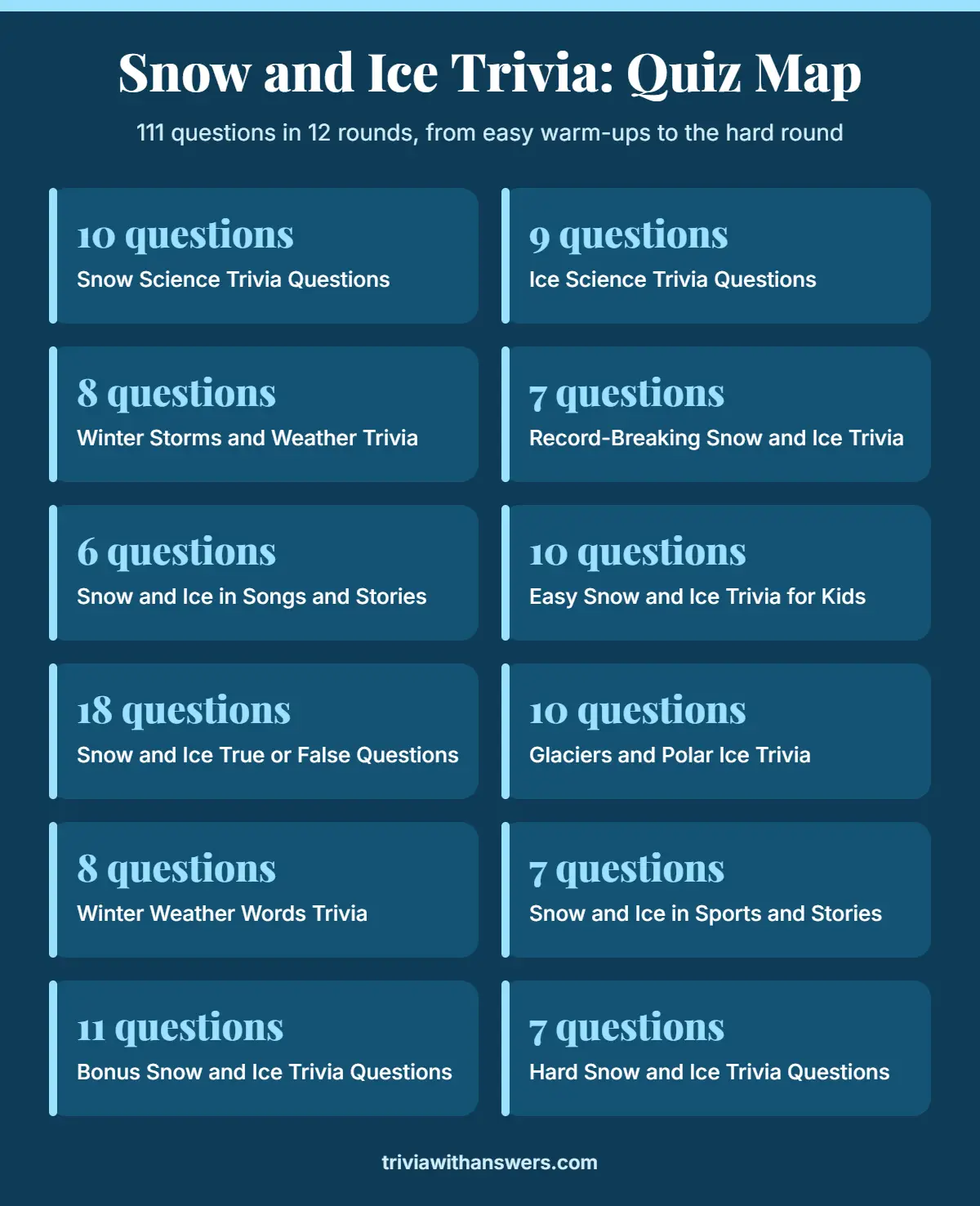
Bundle up for these 111 snow and ice trivia questions and answers, covering how snowflakes form, why ice floats, winter storms, record-breaking snowfalls and the snow and ice that show up in songs and stories.
Snow is mostly air, a snowflake almost always has six sides and most of an iceberg is hidden underwater. From blizzards and black ice to giant ice festivals in China and Japan, winter is full of surprising facts.
The rounds begin with snow science and ice science, then cover winter weather, world records and pop culture. A hard round for weather experts comes last, so save it for the strongest players.
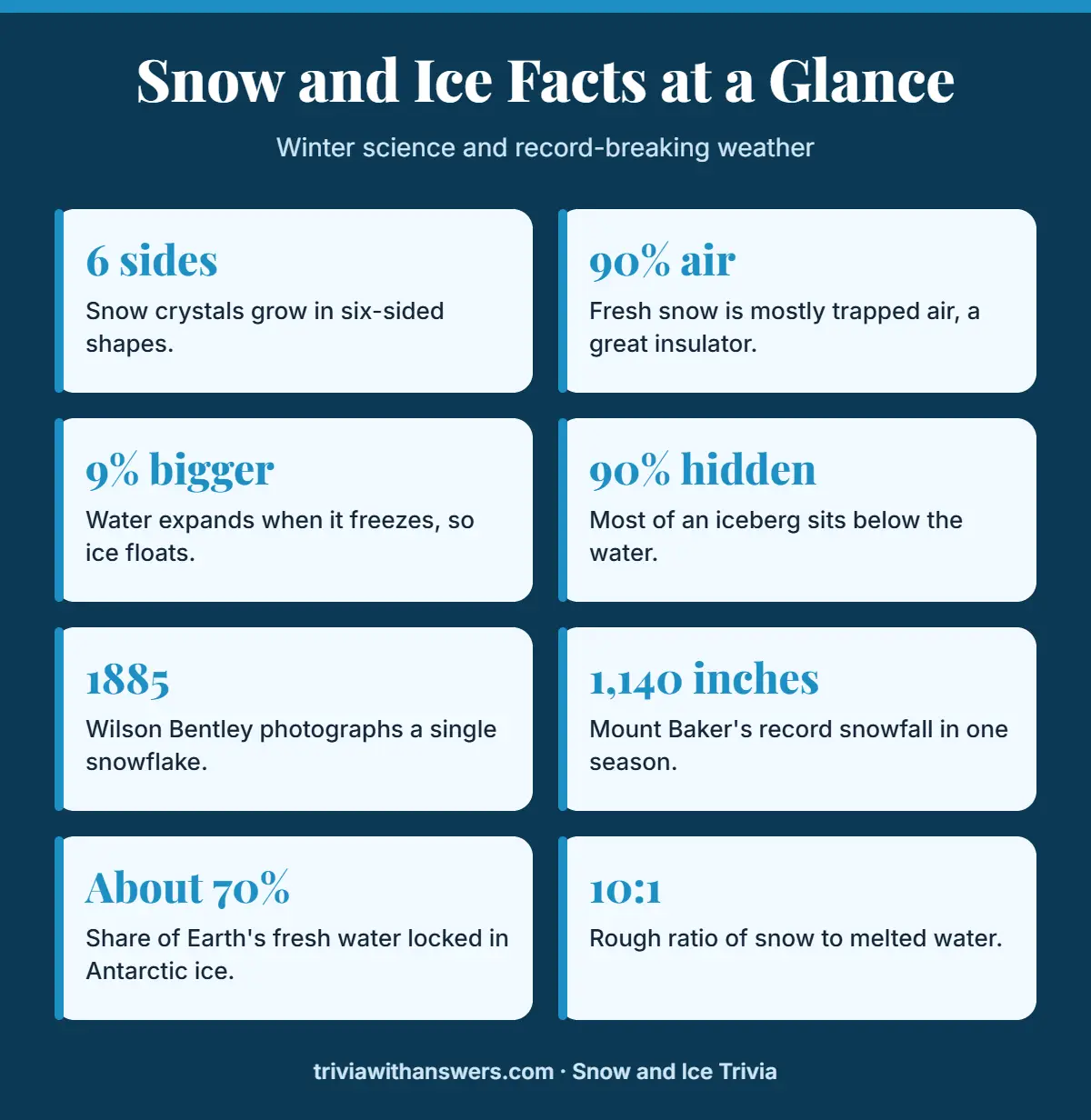
Quick Snow and Ice Facts
- Freezing point of water: 32°F (0°C)
- Snowflake shape: six-sided, because of how water molecules bond
- Why ice floats: water expands about 9 percent as it freezes
- Biggest ice sheet: Antarctica, holding about 90 percent of Earth’s ice
- US seasonal snow record: about 1,140 inches at Mount Baker, Washington
🖨️ Free printable: print this quiz for your table. Choose a questions-only sheet for players or the full answer sheet for the host.
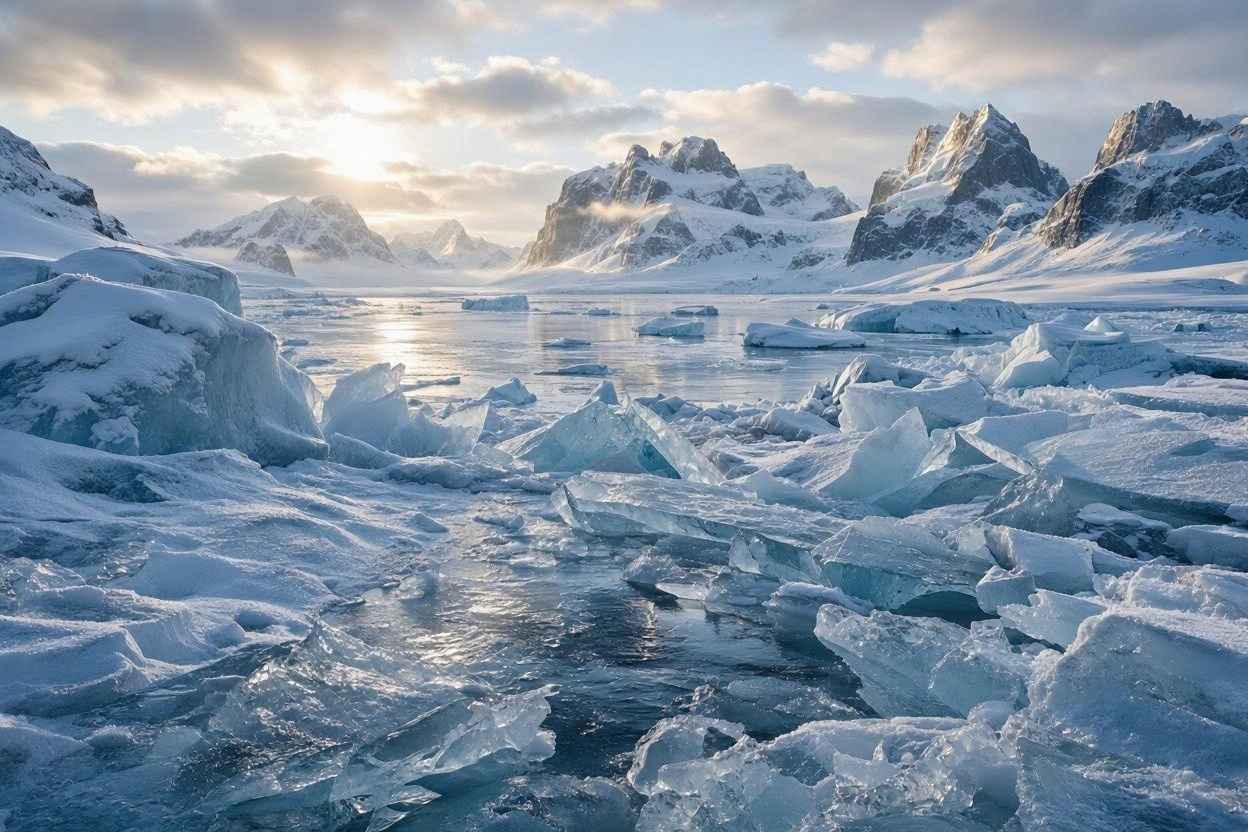
For more background, see snow on Wikipedia.
Table of Contents
Snow Science Trivia Questions
Every snowflake starts high in a cloud. Begin with how snow forms and why it looks the way it does.
1. How many sides or arms does a typical snowflake have?
- A) Four
- B) Five
- C) Six
- D) Eight
Show answer
Answer: C) Six. Water molecules bond in a hexagonal pattern, so snow crystals usually have six sides or arms.
2. How does snow form in clouds?
- A) Rain freezes as it falls
- B) Water vapor freezes directly into ice crystals
- C) Hail melts and refreezes
- D) Dust turns into ice
Show answer
Answer: B) Water vapor freezes directly into ice crystals. Snow crystals grow when water vapor turns straight into ice around tiny particles in the cloud.
3. Why does snow look white?
- A) It contains salt
- B) Light bounces off its many crystal surfaces
- C) It is mixed with air pollution
- D) Snow is naturally white like milk
Show answer
Answer: B) Light bounces off its many crystal surfaces. Each snow crystal is clear ice, but all the surfaces scatter light so a snowbank looks white.
4. Who took the first known photograph of a single snowflake, in 1885?
- A) Ansel Adams
- B) Wilson Bentley
- C) Thomas Edison
- D) Alexander Graham Bell
Show answer
Answer: B) Wilson Bentley. Vermont farmer Wilson “Snowflake” Bentley photographed thousands of snowflakes.
5. Roughly how much snow melts down to 1 inch of water?
- A) 1 inch
- B) About 10 inches
- C) About 50 inches
- D) About 100 inches
Show answer
Answer: B) About 10 inches. A common rule of thumb is 10 inches of snow to 1 inch of water, though wet and dry snow vary a lot.
6. What is the fear of snow called?
- A) Chionophobia
- B) Cryophobia
- C) Nivophobia
- D) Hydrophobia
Show answer
Answer: A) Chionophobia. Chionophobia comes from the Greek word for snow, chion.
7. What are soft pellets formed when supercooled droplets freeze onto snowflakes called?
- A) Sleet
- B) Graupel
- C) Hail
- D) Rime ice
Show answer
Answer: B) Graupel. Graupel looks like tiny foam balls and often falls in winter showers.
8. Why is fresh snow a good insulator?
- A) It is very heavy
- B) It is full of trapped air
- C) It contains salt
- D) It reflects heat inward
Show answer
Answer: B) It is full of trapped air. Fresh snow can be over 90 percent air, which is why animals and igloo builders use it to stay warm.
9. What is snow that falls during a thunderstorm called?
- A) Thundersnow
- B) Stormflake
- C) Lightning snow
- D) Snowbolt
Show answer
Answer: A) Thundersnow. Thundersnow is rare but brings thunder, lightning and heavy snowfall together.
10. What causes lake-effect snow around the Great Lakes?
- A) Cold air passing over warmer lake water
- B) Snow blowing off the lake surface
- C) Melting icebergs
- D) Wind from the ocean
Show answer
Answer: A) Cold air passing over warmer lake water. Cold air picks up moisture from the warmer lakes and drops it as heavy snow downwind.
Ice Science Trivia Questions
11. At what temperature does fresh water freeze?
- A) -10°F
- B) 0°F
- C) 32°F
- D) 40°F
Show answer
Answer: C) 32°F. Fresh water freezes at 32°F, or 0°C.
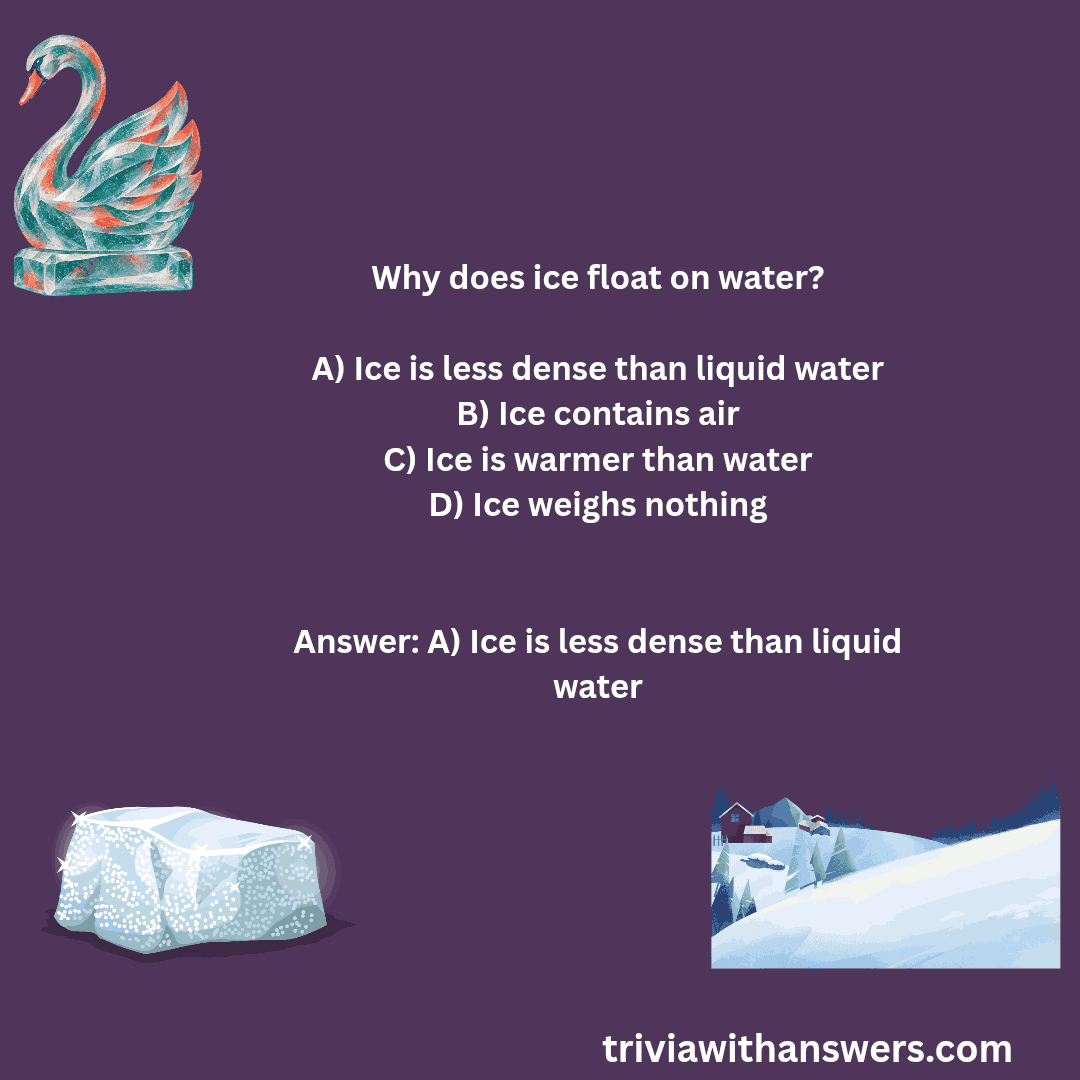
12. Why does ice float on water?
- A) Ice is less dense than liquid water
- B) Ice contains air
- C) Ice is warmer than water
- D) Ice weighs nothing
Show answer
Answer: A) Ice is less dense than liquid water. Water expands by about 9 percent as it freezes, so ice is lighter than the same volume of liquid water.
13. What forms when water vapor freezes directly onto a surface?
- A) Frost
- B) Fog
- C) Steam
- D) Dew
Show answer
Answer: A) Frost. Frost forms when vapor turns straight to ice on cold surfaces like grass and windows.
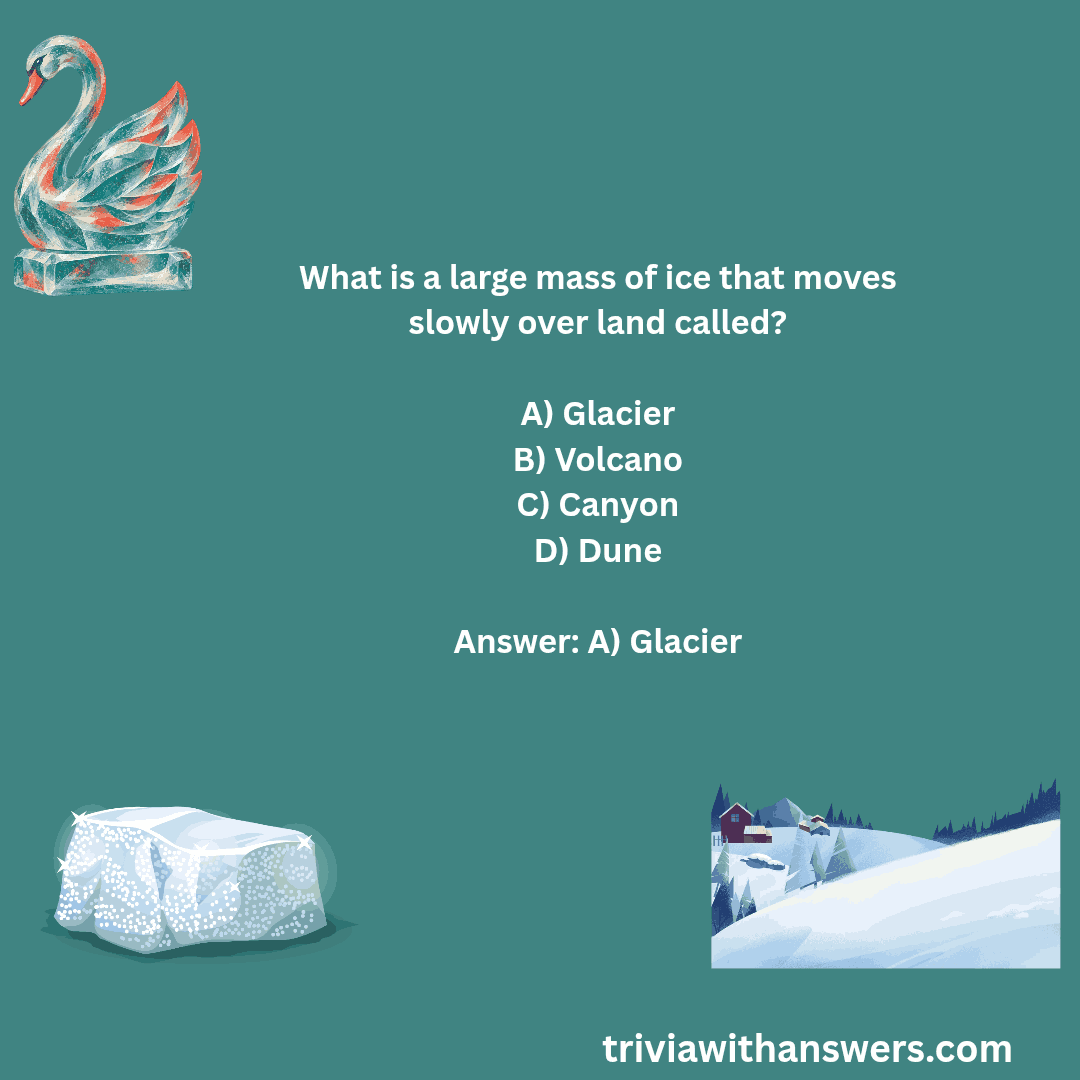
14. What is a large mass of ice that moves slowly over land called?
- A) Glacier
- B) Volcano
- C) Canyon
- D) Dune
Show answer
Answer: A) Glacier. Glaciers flow very slowly under their own weight.
15. About how much of an iceberg is hidden below the water?
- A) 10 percent
- B) 50 percent
- C) About 90 percent
- D) 100 percent
Show answer
Answer: C) About 90 percent. Most of an iceberg sits underwater, which is where the phrase “tip of the iceberg” comes from.
16. What is dry ice made of?
- A) Frozen salt water
- B) Frozen carbon dioxide
- C) Frozen nitrogen
- D) Frozen alcohol
Show answer
Answer: B) Frozen carbon dioxide. Dry ice is solid carbon dioxide. It turns straight into gas at about -109°F.
17. What is “black ice”?
- A) Ice mixed with soot
- B) A thin, clear layer of ice on roads
- C) Ice from volcanoes
- D) Ice at the bottom of the sea
Show answer
Answer: B) A thin, clear layer of ice on roads. It is so clear that the dark road shows through, making it very hard to see.
18. What is ground that stays frozen for at least two years in a row called?
- A) Tundra
- B) Permafrost
- C) Glacier
- D) Ice cap
Show answer
Answer: B) Permafrost. Permafrost covers large parts of Alaska, Canada, Siberia and the Tibetan Plateau.
19. Which continent holds about 90 percent of the ice on Earth?
- A) North America
- B) Asia
- C) Antarctica
- D) Europe
Show answer
Answer: C) Antarctica. The Antarctic ice sheet is the largest single mass of ice on the planet.
Winter Storms and Weather Trivia
20. What are small ice pellets that freeze before reaching the ground called in the US?
- A) Sleet
- B) Graupel
- C) Freezing rain
- D) Flurries
Show answer
Answer: A) Sleet. Sleet starts as snow, melts in a warm layer and refreezes into pellets before landing.
21. What is freezing rain?
- A) Rain that freezes on contact with cold surfaces
- B) Rain mixed with snow
- C) Hail in winter
- D) Snow that melts in the air
Show answer
Answer: A) Rain that freezes on contact with cold surfaces. Freezing rain falls as liquid and turns to ice on roads, trees and power lines.
22. In the US, a blizzard means strong winds and low visibility lasting at least how long?
- A) 15 minutes
- B) 1 hour
- C) 3 hours
- D) 12 hours
Show answer
Answer: C) 3 hours. The National Weather Service requires winds of 35 mph or more and visibility under a quarter mile for 3 hours or longer.
23. What do we call a sudden slide of snow down a mountain?
- A) A mudslide
- B) An avalanche
- C) A landslide
- D) A glacier
Show answer
Answer: B) An avalanche. Avalanches can reach speeds of more than 80 mph.
24. What are light, brief periods of snowfall called?
- A) Flurries
- B) Squalls
- C) Drifts
- D) Sleet
Show answer
Answer: A) Flurries. Flurries rarely leave more than a light dusting.
25. What forms when wind piles snow up against walls and fences?
- A) Snowdrifts
- B) Snowbanks
- C) Cornices only
- D) Moraines
Show answer
Answer: A) Snowdrifts. Snowdrifts can be many feet deep even after a modest snowfall.
26. Hailstones form inside which kind of cloud?
- A) Cirrus
- B) Thunderstorm clouds
- C) Fog
- D) Stratus
Show answer
Answer: B) Thunderstorm clouds. Strong updrafts in thunderstorms carry droplets up again and again, building layers of ice.
27. Has snow ever fallen in the Sahara Desert?
- A) Never
- B) Yes, in parts of Algeria
- C) Only in the 1800s
- D) Only on its beaches
Show answer
Answer: B) Yes, in parts of Algeria. Snow has dusted the dunes near Aïn Séfra, Algeria, several times, including in 1979 and 2018.
Record-Breaking Snow and Ice Trivia
28. Which US mountain holds the record for the most snow in a single season?
- A) Mount Rainier
- B) Mount Baker
- C) Mount Washington
- D) Pikes Peak
Show answer
Answer: B) Mount Baker. Mount Baker in Washington received about 1,140 inches of snow in the 1998–99 season.
29. How wide was the largest snowflake ever reported, at Fort Keogh, Montana, in 1887?
- A) 2 inches
- B) 6 inches
- C) 15 inches
- D) 30 inches
Show answer
Answer: C) 15 inches. A rancher reported flakes 15 inches wide, which Guinness lists as the record, though it was never photographed.
30. How wide was the largest hailstone ever recorded in the US, in Vivian, South Dakota, in 2010?
- A) 2 inches
- B) 5 inches
- C) 8 inches
- D) 12 inches
Show answer
Answer: C) 8 inches. The Vivian hailstone measured about 8 inches across.
31. In which Swedish village is an ICEHOTEL rebuilt from snow and ice every winter?
- A) Kiruna
- B) Jukkasjärvi
- C) Abisko
- D) Luleå
Show answer
Answer: B) Jukkasjärvi. The ICEHOTEL in Jukkasjärvi has been rebuilt every winter since the early 1990s.
32. Which Chinese city hosts one of the world’s largest ice and snow festivals?
- A) Beijing
- B) Harbin
- C) Shanghai
- D) Chengdu
Show answer
Answer: B) Harbin. The Harbin International Ice and Snow Sculpture Festival features giant buildings carved from ice.
33. Which Japanese city is famous for its winter snow festival with huge snow sculptures?
- A) Osaka
- B) Sapporo
- C) Kyoto
- D) Fukuoka
Show answer
Answer: B) Sapporo. The Sapporo Snow Festival draws millions of visitors every February.
34. Roughly how tall was the record-breaking snowwoman built in Bethel, Maine, in 2008?
- A) 22 feet
- B) 62 feet
- C) 122 feet
- D) 222 feet
Show answer
Answer: C) 122 feet. Named Olympia, she stood about 122 feet tall.
Snow and Ice in Songs and Stories
35. What brings Frosty the Snowman to life in the famous song?
- A) A magic scarf
- B) An old silk hat
- C) A carrot nose
- D) A snow globe
Show answer
Answer: B) An old silk hat. In the 1950 song, the children find an old silk hat, and it brings their snowman to life.
36. In Frozen, which character has icy powers?
- A) Anna
- B) Elsa
- C) Olaf
- D) Hans
Show answer
Answer: B) Elsa. Elsa can create ice and snow, which she shows off in “Let It Go”.
37. The song “Let It Snow! Let It Snow! Let It Snow!” was written during what kind of weather?
- A) A blizzard
- B) A summer heat wave
- C) A spring rainstorm
- D) A foggy autumn
Show answer
Answer: B) A summer heat wave. Sammy Cahn and Jule Styne wrote it in July 1945, dreaming of cooler weather.
38. What do people make by lying in the snow and moving their arms and legs?
- A) A snowman
- B) A snow angel
- C) A snow fort
- D) An igloo
Show answer
Answer: B) A snow angel. Snow angels are a classic winter activity for kids of all ages.
39. Which traditional Arctic shelter is built from blocks of packed snow?
- A) Teepee
- B) Igloo
- C) Yurt
- D) Hogan
Show answer
Answer: B) Igloo. Igloos stay surprisingly warm inside because snow is such a good insulator.
40. Which Hans Christian Andersen fairy tale features a queen made of ice?
- A) The Little Mermaid
- B) The Snow Queen
- C) The Ugly Duckling
- D) Thumbelina
Show answer
Answer: B) The Snow Queen. The Snow Queen later helped inspire Disney’s Frozen.
Easy Snow and Ice Trivia for Kids
Easy winter questions for younger players.
41. What is snow made of?
- A) Tiny ice crystals
- B) Cotton
- C) Sugar
- D) Salt
Show answer
Answer: A) Tiny ice crystals. Snowflakes are crystals of frozen water.
42. What is frozen water called?
- A) Steam
- B) Ice
- C) Fog
- D) Dew
Show answer
Answer: B) Ice. Water turns to ice when it freezes.
43. What happens to ice when it gets warm?
- A) It melts
- B) It grows
- C) It turns blue
- D) It bounces
Show answer
Answer: A) It melts. Warm ice melts back into water.
44. In which season does it usually snow the most?
- A) Summer
- B) Spring
- C) Winter
- D) Autumn
Show answer
Answer: C) Winter. Winter brings the coldest weather and the most snow.
45. What do you call a ball of snow you can throw?
- A) A snowball
- B) A snowcone
- C) A snowdrop
- D) A snowcap
Show answer
Answer: A) A snowball. Snowball fights are a classic winter game.
46. What are the long, pointed pieces of ice that hang from roofs?
- A) Icicles
- B) Iceberg
- C) Snowflakes
- D) Hailstones
Show answer
Answer: A) Icicles. Icicles form when melting snow drips and freezes again.
47. What tool do people use to clear snow from a path?
- A) A shovel
- B) A rake
- C) A broom only
- D) A hammer
Show answer
Answer: A) A shovel. A snow shovel moves snow out of the way.
48. What do people wear to walk on deep snow without sinking?
- A) Snowshoes
- B) Flip-flops
- C) Roller skates
- D) Slippers
Show answer
Answer: A) Snowshoes. Snowshoes spread your weight over a bigger area.
49. What do people wear on their feet to glide down snowy mountains?
- A) Skis
- B) Sandals
- C) Stilts
- D) Flippers
Show answer
Answer: A) Skis. Skiers glide downhill on two long skis.
50. What do you need to build a snowman?
- A) Sand
- B) Snow
- C) Leaves
- D) Mud
Show answer
Answer: B) Snow. Packing snow works best for rolling big snowballs.
Snow and Ice True or False Questions
True or false? Test your winter science knowledge.
51. Scientists say it is extremely unlikely that two complex snowflakes are exactly alike.
- A) True
- B) False
Show answer
Answer: A) True. True. Each crystal takes its own path through the cloud.
52. Snow can fall even when the air at the ground is a little above freezing.
- A) True
- B) False
Show answer
Answer: A) True. True. Flakes can survive a short fall through slightly warmer air.
53. Ice is denser than liquid water.
- A) True
- B) False
Show answer
Answer: B) False. False. Ice is less dense, which is why it floats.
54. Salt lowers the temperature at which water freezes.
- A) True
- B) False
Show answer
Answer: A) True. True. That is why salt helps melt icy roads.
55. Antarctica is the coldest continent on Earth.
- A) True
- B) False
Show answer
Answer: A) True. True. It holds the record for the lowest temperatures.
56. The coldest natural temperature ever measured at a weather station was recorded at Vostok Station in Antarctica.
- A) True
- B) False
Show answer
Answer: A) True. True. It reached about minus 89 degrees Celsius in 1983.
57. It can be too cold to snow.
- A) True
- B) False
Show answer
Answer: B) False. False. Very cold air holds little moisture, but snow can still fall.
58. A single snow crystal is actually clear, not white.
- A) True
- B) False
Show answer
Answer: A) True. True. Snow looks white because many crystals scatter light.
59. Pink “watermelon snow” is caused by algae.
- A) True
- B) False
Show answer
Answer: A) True. True. Cold-loving algae tint the snow pink or red.
60. Hail only falls in winter.
- A) True
- B) False
Show answer
Answer: B) False. False. Hail is most common in spring and summer thunderstorms.
61. Sea ice is less salty than the seawater it forms from.
- A) True
- B) False
Show answer
Answer: A) True. True. Much of the salt drains out as the ice forms.
62. Fresh snow can be more than 90 percent air.
- A) True
- B) False
Show answer
Answer: A) True. True. That trapped air makes it a good insulator.
63. Most of Greenland is covered by ice.
- A) True
- B) False
Show answer
Answer: A) True. True. Its ice sheet covers about 80 percent of the island.
64. The Arctic is a continent like Antarctica.
- A) True
- B) False
Show answer
Answer: B) False. False. The Arctic is mostly a frozen ocean surrounded by land.
65. Geologists consider ice to be a mineral.
- A) True
- B) False
Show answer
Answer: A) True. True. Natural ice is a solid crystal with a fixed chemistry.
66. Snow rollers are natural snowballs made by the wind.
- A) True
- B) False
Show answer
Answer: A) True. True. Wind rolls wet snow into hollow cylinders.
67. Wood frogs can survive being partly frozen in winter.
- A) True
- B) False
Show answer
Answer: A) True. True. They thaw and hop away in spring.
68. Lakes freeze from the bottom up.
- A) True
- B) False
Show answer
Answer: B) False. False. They freeze from the top down, which protects fish below.
Glaciers and Polar Ice Trivia
69. What was the name of the giant iceberg that broke off Antarctica in 2000?
- A) B-15
- B) A-1
- C) Titan
- D) Polar Star
Show answer
Answer: A) B-15. B-15 was one of the largest icebergs ever recorded.
70. In which year did an iceberg sink the Titanic?
- A) 1898
- B) 1912
- C) 1925
- D) 1939
Show answer
Answer: B) 1912. The ship sank in April 1912.
71. What is the floating edge of an ice sheet called?
- A) An ice shelf
- B) A snowfield
- C) A fjord
- D) A tundra
Show answer
Answer: A) An ice shelf. Ice shelves extend from the land over the sea.
72. What is it called when chunks of ice break off a glacier?
- A) Calving
- B) Thawing
- C) Drifting
- D) Melting
Show answer
Answer: A) Calving. Calving creates new icebergs.
73. What is a deep crack in a glacier called?
- A) A crevasse
- B) A canyon
- C) A cave
- D) A fault
Show answer
Answer: A) A crevasse. Crevasses can be hidden under snow bridges.
74. Which US national park in Montana is named after its ice?
- A) Glacier National Park
- B) Yellowstone
- C) Yosemite
- D) Denali
Show answer
Answer: A) Glacier National Park. Its glaciers have been shrinking for more than a century.
75. What is the ridge of rock and soil left behind by a glacier called?
- A) A moraine
- B) A delta
- C) A mesa
- D) A dune
Show answer
Answer: A) A moraine. Moraines mark where glaciers once reached.
76. What are long periods when ice covers much of the Earth called?
- A) Ice ages
- B) Snow eras
- C) Frost times
- D) Cold snaps
Show answer
Answer: A) Ice ages. The last ice age ended about 11,700 years ago.
77. Is the North Pole on land or on floating sea ice?
- A) Floating sea ice
- B) Solid land
- C) A mountain
- D) An island
Show answer
Answer: A) Floating sea ice. The North Pole sits on ice over the Arctic Ocean.
78. What do scientists study ice cores to learn about?
- A) Past climate
- B) Volcano heights
- C) Ocean depth
- D) Bird songs
Show answer
Answer: A) Past climate. Air bubbles trapped in the ice record ancient atmospheres.
Winter Weather Words Trivia
79. What is a whiteout?
- A) When blowing snow makes it almost impossible to see
- B) A very sunny winter day
- C) A snow-white bird
- D) Frozen fog on a lake
Show answer
Answer: A) When blowing snow makes it almost impossible to see. In a whiteout, the ground and sky look the same.
80. What does wind chill measure?
- A) How cold it feels on skin with the wind
- B) How fast snow falls
- C) How deep the snow is
- D) How thick the ice is
Show answer
Answer: A) How cold it feels on skin with the wind. Wind makes cold air feel even colder.
81. What is a nor’easter?
- A) A strong storm along the US East Coast
- B) A warm desert wind
- C) A type of iceberg
- D) A Canadian holiday
Show answer
Answer: A) A strong storm along the US East Coast. Its winds blow in from the northeast.
82. What is rime ice?
- A) Ice formed when supercooled droplets freeze on contact
- B) Ice on a river
- C) Ice inside a freezer
- D) Hailstones
Show answer
Answer: A) Ice formed when supercooled droplets freeze on contact. Rime builds up on trees and fences in freezing fog.
83. What is the polar vortex?
- A) A large area of cold air around a pole
- B) A spinning iceberg
- C) A ski jump
- D) A snow tornado
Show answer
Answer: A) A large area of cold air around a pole. When it weakens, cold air can spill south.
84. What is freezing fog?
- A) Fog whose droplets freeze on surfaces
- B) Fog made of snow
- C) Fog that never lifts
- D) Smoke from ice
Show answer
Answer: A) Fog whose droplets freeze on surfaces. It can coat roads and trees in ice.
85. What is diamond dust?
- A) Tiny ice crystals falling from a clear sky
- B) Crushed diamonds
- C) Sand on ice
- D) Snow mixed with glitter
Show answer
Answer: A) Tiny ice crystals falling from a clear sky. It sparkles in sunlight on very cold days.
86. What is firn?
- A) Old, packed snow turning into glacier ice
- B) A type of sled
- C) Snow that falls in spring
- D) A frozen waterfall
Show answer
Answer: A) Old, packed snow turning into glacier ice. Over years, firn is squeezed into solid ice.
Snow and Ice in Sports and Stories
87. Where were the first Winter Olympics held in 1924?
- A) Chamonix, France
- B) Oslo, Norway
- C) St. Moritz, Switzerland
- D) Lake Placid, USA
Show answer
Answer: A) Chamonix, France. Chamonix hosted the first Winter Games.
88. In which sport do players slide stones across the ice toward a target?
- A) Curling
- B) Bobsled
- C) Biathlon
- D) Luge
Show answer
Answer: A) Curling. Teammates sweep the ice to guide the stone.
89. Which sport is played on ice with sticks and a puck?
- A) Ice hockey
- B) Lacrosse
- C) Polo
- D) Cricket
Show answer
Answer: A) Ice hockey. Ice hockey is hugely popular in Canada.
90. In which sled sport do riders go down the track headfirst on their stomachs?
- A) Skeleton
- B) Luge
- C) Bobsled
- D) Toboggan
Show answer
Answer: A) Skeleton. Luge riders go feet first on their backs.
91. Which 2013 Disney film stars Elsa, a queen with icy powers?
- A) Frozen
- B) Moana
- C) Tangled
- D) Brave
Show answer
Answer: A) Frozen. Frozen became one of the biggest animated films ever.
92. Which C.S. Lewis land is trapped in endless winter?
- A) Narnia
- B) Middle-earth
- C) Neverland
- D) Oz
Show answer
Answer: A) Narnia. The White Witch’s spell keeps Narnia frozen, with no Christmas ever arriving.
93. Which Jack London novel follows a dog in the snowy Yukon?
- A) The Call of the Wild
- B) Old Yeller
- C) Lassie Come-Home
- D) Where the Red Fern Grows
Show answer
Answer: A) The Call of the Wild. Buck becomes a sled dog during the Klondike Gold Rush.
Bonus Snow and Ice Trivia Questions
94. Which Japanese scientist made the first artificial snow crystals in a lab?
- A) Ukichiro Nakaya
- B) Hideki Yukawa
- C) Shuji Nakamura
- D) Kiyoshi Shiga
Show answer
Answer: A) Ukichiro Nakaya. Nakaya grew snow crystals in the 1930s.
95. What are tall spikes of snow and ice found high in the Andes called?
- A) Penitentes
- B) Seracs
- C) Moraines
- D) Drumlins
Show answer
Answer: A) Penitentes. They can grow taller than a person.
96. What are the wind-carved ridges on a snowy surface called?
- A) Sastrugi
- B) Crevasses
- C) Dunes
- D) Cirques
Show answer
Answer: A) Sastrugi. Strong winds sculpt the snow into sharp waves.
97. What is an overhanging lip of snow on a mountain ridge called?
- A) A cornice
- B) A crevasse
- C) A serac
- D) A col
Show answer
Answer: A) A cornice. Cornices can break off and trigger avalanches.
98. In which Canadian territory do trucks famously drive on ice roads over frozen lakes?
- A) Northwest Territories
- B) Nunavut only
- C) Ontario
- D) British Columbia
Show answer
Answer: A) Northwest Territories. The Tibbitt to Contwoyto road is one of the longest.
99. Which moon of Jupiter is covered by a thick shell of ice?
- A) Europa
- B) Io
- C) Titan
- D) Phobos
Show answer
Answer: A) Europa. Scientists think a salty ocean lies beneath it.
100. What is the snow line?
- A) The height above which snow stays all year
- B) A line of people waiting to ski
- C) The edge of a snowstorm
- D) A ski trail marker
Show answer
Answer: A) The height above which snow stays all year. It is higher near the equator and lower near the poles.
101. Why does thick glacier ice often look blue?
- A) It absorbs red light
- B) It contains blue minerals
- C) It reflects the sky only
- D) It is very salty
Show answer
Answer: A) It absorbs red light. Dense ice soaks up red light, leaving blue.
102. Who invented the snowmobile company Ski-Doo?
- A) Joseph-Armand Bombardier
- B) Henry Ford
- C) Karl Benz
- D) Ole Evinrude
Show answer
Answer: A) Joseph-Armand Bombardier. Bombardier was a Canadian inventor.
103. Which toy invented in 1965 led to the modern snowboard?
- A) The Snurfer
- B) The Frisbee
- C) The Hula Hoop
- D) The Slinky
Show answer
Answer: A) The Snurfer. Sherman Poppen made it for his daughters.
104. In which country are the oldest known ice skates, made from animal bones, believed to come from?
- A) Finland
- B) Canada
- C) Netherlands
- D) Japan
Show answer
Answer: A) Finland. Bone skates in Finland may be about 4,000 years old.
Hard Snow and Ice Trivia Questions
This final round is for winter weather experts.
105. What is the process of water vapor turning straight into ice called?
- A) Sublimation
- B) Deposition
- C) Condensation
- D) Evaporation
Show answer
Answer: B) Deposition. Deposition is how snow and frost form. The reverse, ice turning straight to vapor, is sublimation.
106. About what percentage of the world’s fresh water is stored in Antarctic ice?
- A) 10 percent
- B) 30 percent
- C) About 70 percent
- D) 99 percent
Show answer
Answer: C) About 70 percent. Antarctica’s ice holds roughly 70 percent of Earth’s fresh water.
107. What is the second-largest ice sheet on Earth?
- A) The Alaska ice sheet
- B) The Greenland ice sheet
- C) The Siberian ice sheet
- D) The Himalayan ice sheet
Show answer
Answer: B) The Greenland ice sheet. Only the Antarctic ice sheet is larger than Greenland’s.
108. By roughly how much does water expand when it freezes?
- A) 1 percent
- B) About 9 percent
- C) 25 percent
- D) 50 percent
Show answer
Answer: B) About 9 percent. This expansion is why frozen pipes can burst.
109. What is the name for snow crystals shaped like flat six-sided plates or branching stars?
- A) Dendrites and plates
- B) Columns and needles
- C) Graupel and hail
- D) Rime and frost
Show answer
Answer: A) Dendrites and plates. Star-shaped dendrites are the classic “snowflake” shape, while plates are flat hexagons.
110. Which US state recorded about 76 inches of snow in 24 hours at Silver Lake in 1921?
- A) Alaska
- B) Colorado
- C) New York
- D) Montana
Show answer
Answer: B) Colorado. Silver Lake, Colorado, holds one of the biggest one-day snowfall totals in US history.
111. Roughly what fraction of Earth’s land is covered by glaciers and ice sheets?
- A) 1 percent
- B) About 10 percent
- C) 30 percent
- D) 50 percent
Show answer
Answer: B) About 10 percent. About a tenth of the land surface is covered in ice, most of it in Antarctica and Greenland.
How Did You Score?
- 0 to 28: Melting fast. Read up and try again.
- 29 to 56: Snowball thrower. You know the basics.
- 57 to 83: Ice explorer. Your winter science is strong.
- 84 to 111: Snow scientist. You could forecast a blizzard.
Playing in teams? Give one point per answer and double points in the hard round.
How to Host a Snow and Ice Trivia Game
- Play on a snow day: the quiz is perfect for kids stuck inside during a storm.
- Use it in science class: the snow and ice science rounds fit lessons on states of matter and weather.
- Add a hands-on bonus: drop an ice cube in water and ask players to explain why it floats.
- Serve hot cocoa between rounds: it keeps everyone warm and focused.
- Keep the winter theme going: try our winter trivia questions for another round.
More Holiday Trivia Quizzes
Planning a full holiday quiz night? Mix in rounds from our other seasonal quizzes. Each one has at least 100 questions with hidden answers.
- Christmas quiz questions
- Polar Express trivia
- Grinch trivia
- Christmas Vacation trivia
- Miracle on 34th Street trivia
- Nightmare Before Christmas trivia
- The Santa Clause trivia
- Reindeer trivia
- New Year traditions trivia
- Kwanzaa trivia
- Winter Olympics trivia
- Did you know trivia
Snow and Ice Trivia FAQs
Why do snowflakes have six sides?
Water molecules join together in a hexagonal pattern when they freeze, so ice crystals naturally grow with six sides or arms.
Are any two snowflakes alike?
Snowflakes form under slightly different conditions as they fall, so complex flakes are almost certainly unique. Very simple, tiny crystals can look nearly identical.
Why is snow white if ice is clear?
Snow is made of countless tiny crystals. Their many surfaces scatter all colors of light equally, so a snowbank looks white.
What is the difference between sleet and freezing rain?
Sleet freezes into ice pellets before it hits the ground. Freezing rain falls as liquid and freezes on contact with cold surfaces.
Why does ice float?
Water expands by about 9 percent when it freezes, so ice is less dense than liquid water and floats on top.
Where does it snow the most in the United States?
Mountain areas of the Pacific Northwest and the Rockies get the most snow. Mount Baker in Washington holds the record for a single season.
Practice Exercise: Quiz Yourself
Ready to see how much you remember? This practice exercise picks 10 random questions from this article. Choose an answer to get instant feedback, then try again with a fresh set.
Practice Exercise: Test Yourself
Final Thoughts
From six-sided snowflakes to icebergs that hide most of their bulk underwater, these snow and ice trivia questions and answers show just how fascinating winter really is. Whether you scored like an ice expert or melted halfway through, you will never look at a snowfall the same way again.
Keep the quiz ready for the next snow day, and if you want more winter fun, try our reindeer trivia questions and answers.
7 thoughts on “111 Snow and Ice Trivia Questions and Answers (Winter Science Quiz)”