

Turkeys are the most famous bird of Thanksgiving, but most people know very little about them. Did you know that a turkey’s head changes color with its mood, that wild turkeys sleep in trees, or that they can swim?
Here are 101 fun facts about turkeys, grouped by topic: names and species, feathers and bodies, senses, sounds, speed, diet, baby turkeys, the wild turkey comeback, farm turkeys and Thanksgiving, history, and a section of easy turkey facts for kids. Each fact has a short explanation, and there’s a 10-question quiz at the end.
Quick answer: some of the most surprising turkey facts are that only males gobble, wild turkeys can fly at up to about 55 mph, a turkey’s head can turn red, white or blue, and a baby turkey is called a poult.
What’s in This Article
- Turkey Basics: Names and Species
- Fun Facts About Turkey Feathers, Heads and Bodies
- Turkey Senses: Vision, Hearing and Smarts
- Turkey Sounds: Gobbles, Purrs and Yelps
- How Fast Can Turkeys Run and Fly?
- What Do Turkeys Eat?
- Baby Turkey Facts
- The Wild Turkey Comeback
- Farm Turkeys and Thanksgiving
- Turkey History and Culture
- Turkey Facts for Kids
- Turkey Facts Quiz
- FAQs
Turkey Basics: Names and Species
Before the strange stuff, here are the names and basic facts every turkey fan should know.
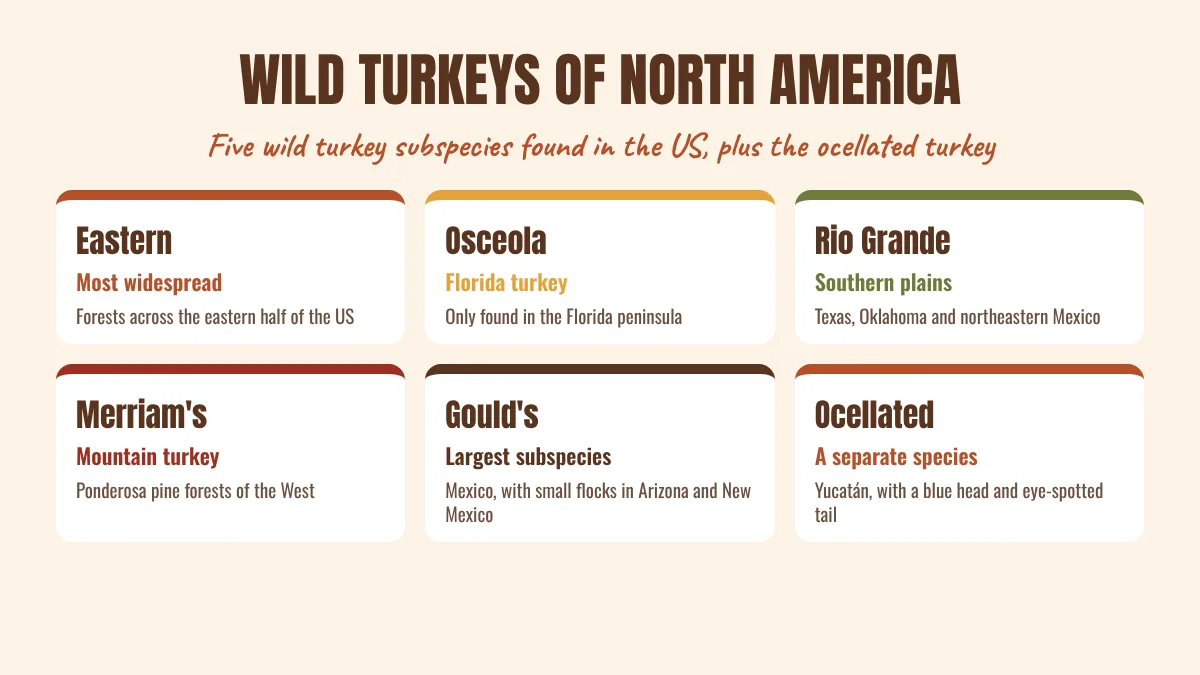
- There are only two species of turkey. The wild turkey lives across North America, and the ocellated turkey lives in Mexico's Yucatán Peninsula and parts of Central America.
- Every farm turkey is descended from the wild turkey. Domestic turkeys all come from Meleagris gallopavo, the same species you might see crossing a country road.
- North America has six subspecies of wild turkey. They are the Eastern, Osceola (Florida), Rio Grande, Merriam's, Gould's and South Mexican turkeys.
- An adult male turkey is called a tom or a gobbler. Females are called hens. Both names are used by hunters, farmers and wildlife biologists.
- Young males are called jakes and young females are jennies. Jakes are usually males under a year old. You can often spot them by their short beards and uneven tail fans.
- A group of turkeys is called a rafter. They can also be called a flock or a gang. Wild turkeys often gather in large flocks in winter.
- Wild toms usually weigh about 16 to 24 pounds. Hens are much smaller, usually around 8 to 12 pounds.
- The heaviest turkey on record weighed 86 pounds. A British turkey named Tyson set the Guinness World Record in 1989. That's about as heavy as a large dog.
- Wild turkeys live in every US state except Alaska. They were also brought to Hawaii, and they live in parts of Canada and Mexico.
- Most wild turkeys live only three to five years. Predators, weather and hunting keep the average short, although some wild birds live more than 10 years.
Fun Facts About Turkey Feathers, Heads and Bodies
Turkeys look a little odd up close, and almost every strange part has a purpose.
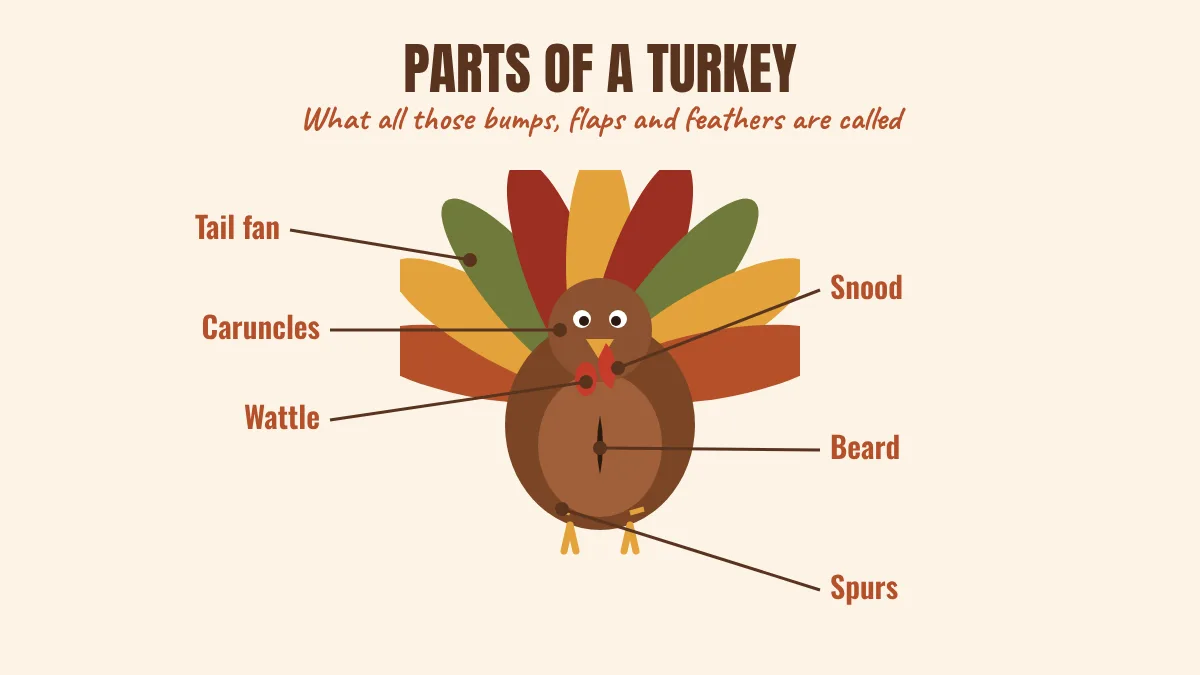
- An adult turkey has about 5,000 to 6,000 feathers. Those feathers include the big tail fan and the shiny bronze and copper feathers on the body.
- A wild turkey's feathers shine like metal. In sunlight, the body feathers flash bronze, green, copper and gold because of the way their structure reflects light.
- The flap of skin that hangs over the beak is called a snood. A tom's snood can stretch long and red when he's showing off, then shrink to a small bump when he relaxes.
- The skin that hangs under the chin is called a wattle. Both males and females have one, but it's much bigger and brighter on toms.
- The bumps on a turkey's head and neck are called caruncles. They fill with blood and change color during displays and fights.
- A turkey's head can turn red, white or blue. The color changes with blood flow, so a tom's head shows if he's calm, excited or stressed.
- Turkeys have bare heads for a reason. Without feathers, the color changes on the head and neck are easy for other turkeys to see.
- Toms grow a 'beard' on their chest. The beard is a tuft of thin, hair-like feathers. It can grow more than 10 inches long and keeps growing for life.
- Some hens grow beards too. Roughly one in ten hens has a beard, though it's usually thinner and shorter than a tom's.
- Male turkeys have spurs on their legs. These sharp, bony points on the back of the leg are used to fight rival toms in spring.
- You can tell a tom from a hen by its breast feathers. A tom's breast feathers have black tips, while a hen's have brown or buff tips, so hens look duller.
- The ocellated turkey looks like a peacock. It has a bright blue head with orange bumps and tail feathers with eye-like spots, which is what 'ocellated' means.
For a tougher test of what you’ve learned, try our turkey trivia questions and answers, or keep it light with our fun turkey trivia quiz.
Turkey Senses: Vision, Hearing and Smarts
Turkeys have a reputation for being dim, but their senses make them very hard to sneak up on.
- Turkeys can see about 270 degrees around them. Their eyes are on the sides of their heads, so they can watch almost everything without turning around.
- Turkeys see in color. Like most birds, they see color well, which helps them read the color changes on each other's heads.
- Their eyesight is much sharper than ours for spotting movement. Hunters say a turkey can spot the slightest movement from a long way off, which is why they wear full camouflage.
- Turkeys can't see well at night. That's one reason they fly up into trees to roost before dark.
- Turkeys have ears, but you can't see them. Small openings behind the eyes are covered by feathers, and their hearing is very good.
- Turkeys can pinpoint sounds from far away. Wild turkeys often answer a call from hundreds of yards away, which is why hunters use turkey calls.
- Turkeys recognize each other's voices. Research suggests that turkeys can tell individual flock members apart by their calls.
- Wild turkeys have a weak sense of smell. They rely mostly on their sight and hearing to stay safe.
- Turkeys are curious. Wild turkeys will often walk over to check out something new, as long as it doesn't move suddenly.
- Turkeys have a pecking order. Each flock has a clear ranking, decided by strutting, chasing and sometimes fighting.
Turkey Sounds: Gobbles, Purrs and Yelps
A gobble is only one of many sounds turkeys make. Wild turkeys use more than 30 different calls.
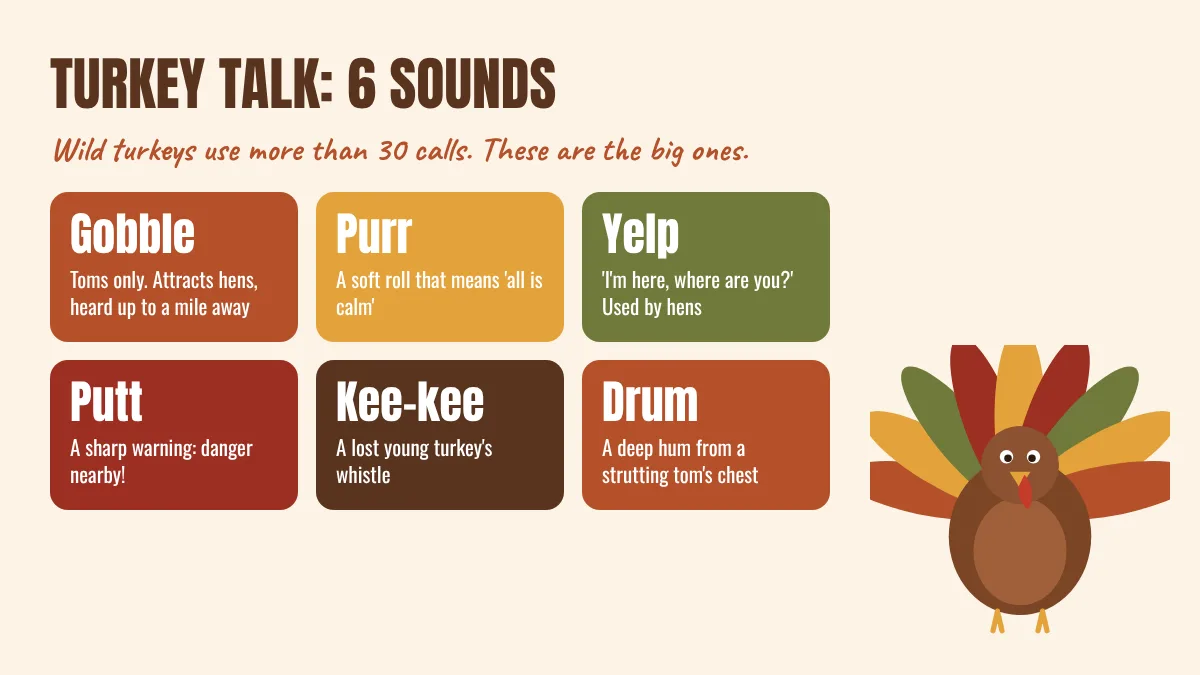
- Only male turkeys gobble. Toms gobble to attract hens and to tell other males where they are.
- A tom's gobble can be heard up to a mile away. Gobbling is loudest in spring, especially early in the morning.
- Toms sometimes gobble at loud noises. A sudden crack of thunder, a slammed door or an owl call can set off a 'shock gobble'.
- Turkeys purr. A soft, rolling purr usually means a turkey is content and feeding calmly.
- Hens yelp to find the flock. The yelp is a series of short notes that says 'I'm here, where are you?'
- A sharp 'putt' is a warning. When a turkey sees danger, it gives a loud putt, and the whole flock gets ready to run or fly.
- Young turkeys make a 'kee-kee' call. Lost poults and jakes whistle 'kee-kee' when they've been separated from the flock.
- Strutting toms make a drumming sound. Toms make a deep humming 'drum' noise from their chest while fanning their tails, and you can feel it more than hear it.
How Fast Can Turkeys Run and Fly?
Wild turkeys aren’t the slow birds most people picture.
- Wild turkeys can fly at up to about 55 mph. They burst into the air with powerful wingbeats, then glide.
- Most turkey flights are short. They usually fly less than a quarter of a mile at a time, often just to reach a tree or escape danger.
- Wild turkeys can run at about 25 mph. When they're scared, they would rather run than fly.
- Turkeys sleep in trees. At dusk, wild turkeys fly up to high branches to roost, out of reach of foxes and coyotes.
- Wild turkeys can swim. They tuck in their wings, spread their tails and kick their legs to paddle across a stream.
- Farm turkeys can't fly at all. Broad Breasted White turkeys have been bred to be so heavy that flying is impossible.
- Turkeys take dust baths. They flop in dry dirt and flap it into their feathers, which helps remove oil and pests.
- A strutting tom puffs up to twice his size. He fans his tail, drops his wings and fluffs his feathers to impress hens.
| Wild turkey | Farm turkey (Broad Breasted White) | |
|---|---|---|
| Can fly? | Yes, up to about 55 mph | No |
| Top running speed | About 25 mph | Much slower |
| Where it sleeps | In trees | On the ground or in barns |
| Typical weight (male) | 16 to 24 lb | Often 30 lb or more |
| Feather color | Bronze, copper and black | White |
What Do Turkeys Eat?
Turkeys aren’t picky eaters, and their diet changes with the seasons.
- Wild turkeys are omnivores. They eat plants and animals, including seeds, nuts, berries, insects and even small lizards and frogs.
- Acorns are a favorite fall food. Wild turkeys can swallow whole acorns and other nuts.
- Turkeys swallow small stones on purpose. The stones, called grit, sit in the gizzard and help grind up tough food.
- A turkey's gizzard is strong enough to crush nuts. The muscular gizzard grinds food with the grit because turkeys don't have teeth.
- Poults eat mostly insects at first. Baby turkeys need lots of protein to grow fast, so they snap up bugs.
- Turkeys scratch the ground to find food. They kick back leaves with their feet, which leaves telltale scratch marks in the woods.
- Turkeys feed in the morning and afternoon. They spend the middle of the day resting, preening and dust bathing.
- Turkeys preen every day. They use their beaks to clean and oil their feathers, which keeps them waterproof.
Baby Turkey Facts
Baby turkeys are called poults, and they grow up quickly.
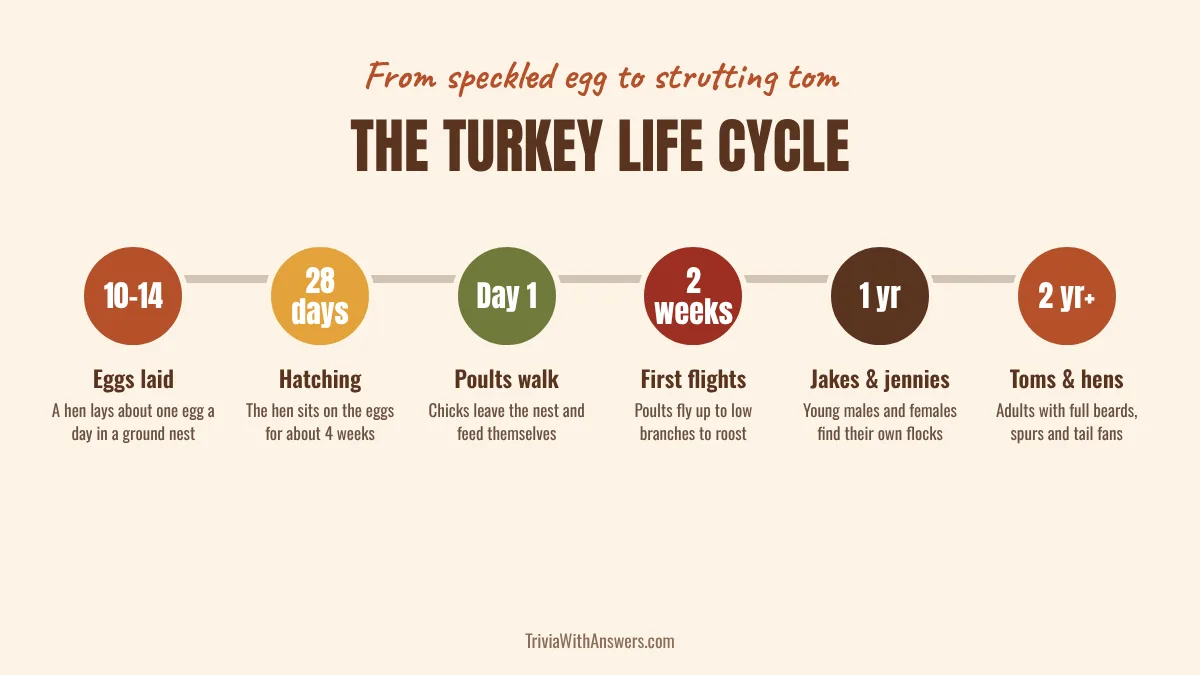
- A turkey hen usually lays 10 to 14 eggs. She lays about one egg a day in a shallow nest on the ground.
- Turkey eggs take about 28 days to hatch. The hen sits on the eggs and leaves the nest only briefly to eat.
- Turkey eggs are speckled. They're tan or cream with brown spots, which helps hide them on the forest floor.
- Poults can leave the nest within a day of hatching. They can walk and feed themselves almost right away.
- Poults can fly short distances at about two weeks old. That lets them roost in low branches with their mother.
- The hen raises the poults on her own. Toms play no part in nesting or raising the young.
- Many poults don't survive their first month. Predators such as foxes, raccoons, snakes, hawks and owls hunt eggs and poults.
- Young turkeys stay with their mother for months. Family groups often join with other hens and poults to form large flocks.
- Domestic turkeys can sometimes lay eggs that hatch without a male. This is called parthenogenesis, and the chicks that hatch are always male.
The Wild Turkey Comeback
The wild turkey is one of America’s biggest conservation success stories.
- By the early 1900s, wild turkeys were nearly wiped out. Overhunting and forest clearing left only about 30,000 wild turkeys in the United States.
- Today there are about 6 million wild turkeys in North America. Restoration efforts brought them back to almost every state.
- Biologists moved wild turkeys to new areas to help them recover. Wild birds were trapped where they were plentiful and released in places where they had disappeared.
- The National Wild Turkey Federation was founded in 1973. The group raised money and support to restore wild turkeys and their habitat.
- Wild turkeys now live in cities and suburbs. Some urban turkeys chase joggers and peck at their reflections in car doors.
- Turkey poop can show if a bird is male or female. Males leave J-shaped droppings, and females leave spiral-shaped ones.
- Hunters helped pay for the comeback. Since 1937, taxes on hunting gear have funded wildlife restoration, including turkey projects.
- Wild turkeys are hunted in spring and fall. Most states hold a spring season for toms and some hold a fall season, with strict limits to keep flocks healthy.
Turkeys are only one part of the holiday. Our Thanksgiving Day trivia questions and answers cover the Pilgrims, the parade and the food, and our fall nature and science trivia looks at other autumn wildlife.
Farm Turkeys and Thanksgiving
Most people only see turkeys on a plate. Here’s how the bird got from the farm to the Thanksgiving table.
- The US raises more than 200 million turkeys a year. Most of them are raised in Minnesota, North Carolina, Arkansas, Indiana, Missouri and Virginia.
- Minnesota raises the most turkeys of any state. It usually raises around 40 million a year.
- Americans eat about 46 million turkeys at Thanksgiving. That's according to estimates from the National Turkey Federation.
- Almost all farm turkeys are Broad Breasted Whites. They were bred for lots of white meat and white feathers that don't leave dark spots on the skin.
- Broad Breasted White turkeys can't mate naturally. Toms are so heavy that farmers use artificial insemination to breed them.
- Heritage turkeys are older breeds that can fly and mate. Breeds such as the Bourbon Red, Narragansett and Standard Bronze grow more slowly and taste richer.
- The White House turkey pardon became an official yearly event in 1989. President George H.W. Bush made it a ceremony, and the birds now retire to a farm or university.
- Astronauts ate turkey in space on Christmas Day 1968. The Apollo 8 crew had turkey with gravy and cranberry sauce while they orbited the Moon.
- Dark meat comes from the muscles turkeys use most. Legs and thighs work hard all day, so they hold more myoglobin, which makes the meat darker.
Turkey History and Culture
Turkeys were important to people in the Americas long before the first Thanksgiving.
- Turkeys were domesticated in Mexico more than 2,000 years ago. People in ancient Mesoamerica raised turkeys for meat, feathers and ceremonies.
- Ancestral Puebloans raised turkeys for feathers. In what's now the US Southwest, they made warm blankets from turkey feathers.
- The Aztecs had a turkey god. Chalchiuhtotolin, the 'jade turkey', was linked with disease and with forgiving sins.
- Spanish explorers took turkeys to Europe in the early 1500s. Within a few decades, turkeys were being raised and eaten in Spain, England and beyond.
- The bird got its name by mistake. Europeans confused it with guinea fowl imported through Turkish (Ottoman) traders, so they called it a 'turkey cock'.
- Benjamin Franklin praised the turkey over the bald eagle. In a 1784 letter to his daughter, he called the turkey a 'much more respectable bird', but he never formally proposed it as the national bird.
- The 'Turkey Trot' was a popular dance in the 1910s. The ragtime dance involved quick, jerky steps and was considered shocking at the time.
- Native Americans used turkey feathers on arrows. The stiff wing feathers made good fletching to help arrows fly straight.
- Farmers once walked turkeys to market. In the 1800s, 'turkey drives' moved flocks of hundreds of birds on foot, sometimes over long distances.
Turkey Facts for Kids
These short, simple facts are great for classrooms, preschool circle time and the kids’ table at Thanksgiving.
- A turkey's tail feathers open like a fan. Toms fan out their tails to look big and impressive.
- Turkeys have no teeth. Their gizzard does the chewing for them.
- Turkeys bob their heads when they walk. Bobbing helps them keep their view steady while they move.
- Turkeys have feathers on their bodies but not on their heads. That's why their heads look bumpy and colorful.
- Turkeys have strong feet with four toes. Three toes point forward and one points back, which helps them grip branches.
- A turkey's feather can be over a foot long. The longest feathers are in the tail fan.
- Turkeys love to explore. They walk several miles a day looking for food.
- Wild turkeys can be almost 4 feet long. That's measured from the tip of the beak to the end of the tail.
- A hen calls her poults with soft clucks. The poults follow her voice, which keeps the family together.
- Turkeys like to sleep in the same trees. A flock often returns to the same roost trees night after night.
Turkey Facts Quiz (10 Questions)
See how much you remember. Tap “Show answer” under each question to check yourself.
1. What is a baby turkey called?
- A) Chick
- B) Poult
- C) Kit
- D) Jake
Show answer
Answer: B) Poult. Baby turkeys are poults. A jake is a young male, usually under a year old.
2. Which turkeys gobble?
- A) Only males
- B) Only females
- C) Both
- D) Only poults
Show answer
Answer: A) Only males. Toms gobble. Hens cluck, purr and yelp.
3. What is the flap of skin over a turkey's beak called?
- A) Wattle
- B) Snood
- C) Beard
- D) Caruncle
Show answer
Answer: B) Snood. The snood hangs over the beak. The wattle hangs under the chin.
4. About how fast can a wild turkey fly?
- A) 15 mph
- B) 30 mph
- C) 55 mph
- D) 90 mph
Show answer
Answer: C) 55 mph. Wild turkeys can fly at up to about 55 mph in short bursts.
5. How long do turkey eggs take to hatch?
- A) About 10 days
- B) About 28 days
- C) About 45 days
- D) About 60 days
Show answer
Answer: B) About 28 days. The hen sits on her eggs for about 28 days.
6. Where do wild turkeys sleep?
- A) In burrows
- B) On the ground
- C) In trees
- D) In caves
Show answer
Answer: C) In trees. Wild turkeys roost high in trees to stay away from predators.
7. What is a group of turkeys called?
- A) A rafter
- B) A murder
- C) A parliament
- D) A pod
Show answer
Answer: A) A rafter. A group of turkeys is a rafter, also called a flock or a gang.
8. Which state raises the most turkeys?
- A) Texas
- B) Iowa
- C) Minnesota
- D) California
Show answer
Answer: C) Minnesota. Minnesota raises around 40 million turkeys a year.
9. What helps a turkey grind its food?
- A) Teeth
- B) Grit in its gizzard
- C) Stomach acid only
- D) Its beak
Show answer
Answer: B) Grit in its gizzard. Turkeys swallow small stones, called grit, that help the gizzard grind food.
10. How many species of turkey are there?
- A) One
- B) Two
- C) Five
- D) Twelve
Show answer
Answer: B) Two. There are two: the wild turkey and the ocellated turkey.
Fun Facts About Turkeys: FAQs
What are 5 fun facts about turkeys?
Only male turkeys gobble, wild turkeys can fly at up to about 55 mph, they sleep in trees, a turkey’s head can turn red, white or blue, and adult turkeys have about 5,000 to 6,000 feathers.
Can turkeys fly?
Wild turkeys can fly short distances very fast, up to about 55 mph, and they fly into trees to sleep. Farm turkeys are too heavy to fly.
Why do turkeys gobble?
Male turkeys gobble to attract hens and to let rival males know where they are. They gobble most in spring.
What is a baby turkey called?
A baby turkey is called a poult. Young males are jakes and young females are jennies.
How long do turkeys live?
Most wild turkeys live three to five years, although some live more than 10. Farm turkeys are usually raised for only a few months.
Can turkeys swim?
Yes. Wild turkeys can swim short distances by tucking in their wings, spreading their tails and kicking their legs.
Final Thoughts
Turkeys are fast, sharp-eyed, chatty and surprisingly tough, and the wild turkey’s comeback from about 30,000 birds to millions is a real success story. Share a few of these facts at the Thanksgiving table this year and give the bird a little more respect before the carving starts.