
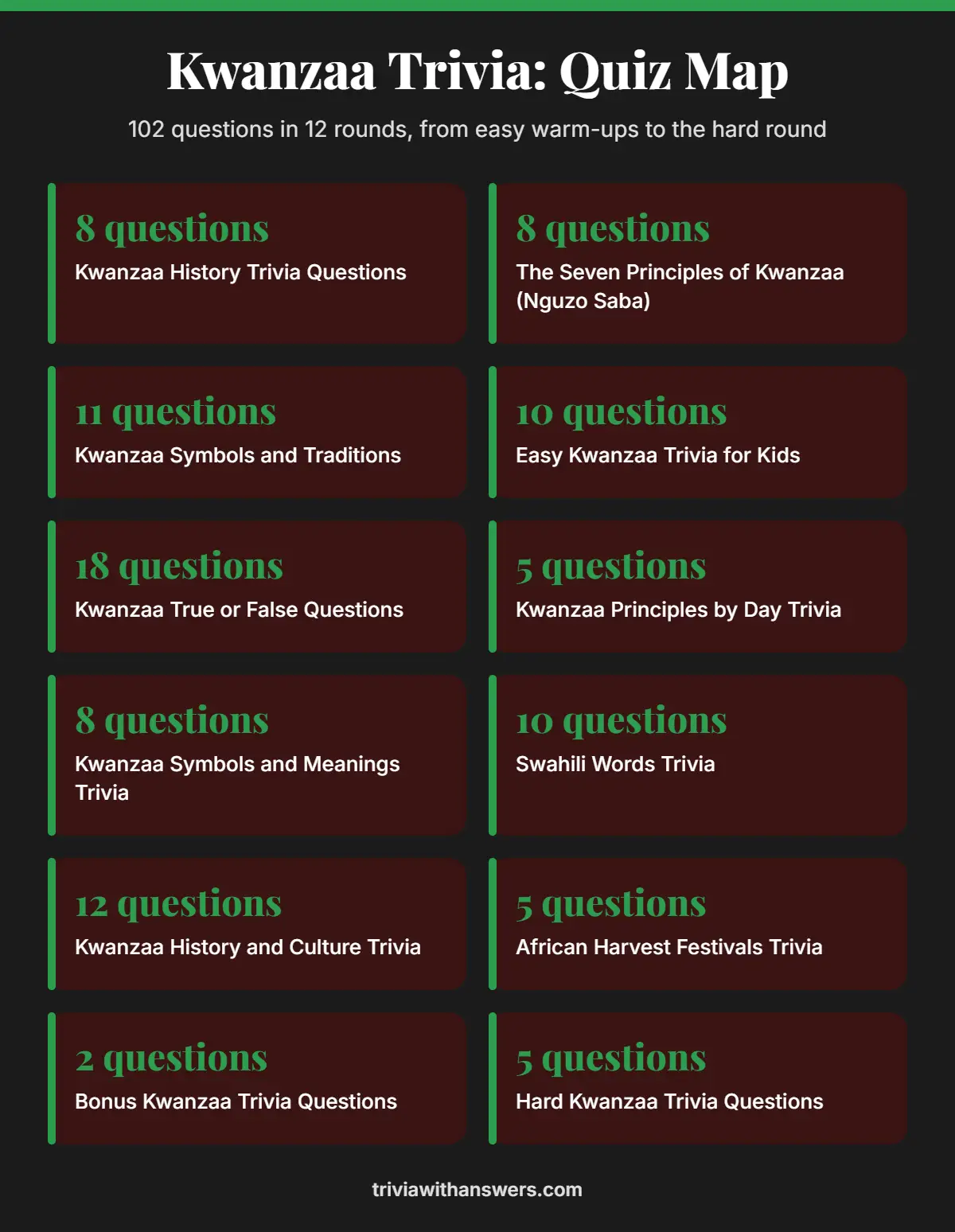
Celebrate culture and community with these 102 Kwanzaa trivia questions and answers. They cover the history of the holiday, the seven principles of the Nguzo Saba, the kinara and its candles, and the traditions families share from December 26 to January 1.
Kwanzaa was created in 1966 to honor African heritage and bring families and communities together. Each of its seven days focuses on a principle, from Umoja, or unity, to Imani, or faith, and many of its words come from Swahili.
The rounds start with Kwanzaa’s history, then cover the seven principles and the symbols and traditions of the celebration. A hard round for real experts comes last.
Quick Kwanzaa Facts
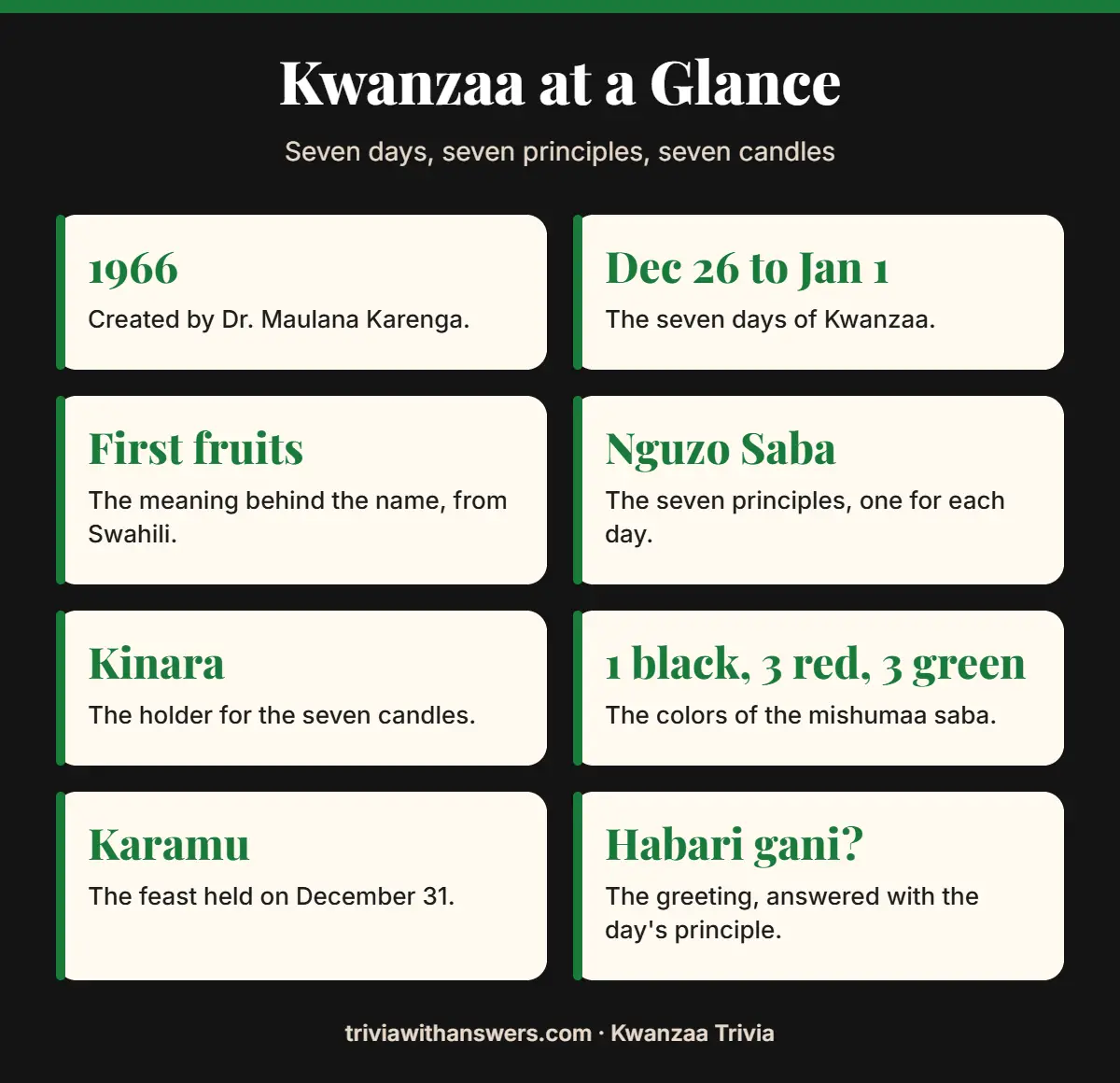
- Dates: December 26 to January 1
- Created: 1966, by Dr. Maulana Karenga
- Name: from the Swahili phrase for “first fruits”
- Principles: Umoja, Kujichagulia, Ujima, Ujamaa, Nia, Kuumba and Imani
- Candles: one black, three red and three green in a kinara
🖨️ Free printable: print this quiz for your table. Choose a questions-only sheet for players or the full answer sheet for the host.

For more background, see Kwanzaa on Wikipedia.
Table of Contents
Kwanzaa History Trivia Questions
Begin with how and why Kwanzaa was created.
1. Who created Kwanzaa?
- A) Martin Luther King Jr.
- B) Maulana Karenga
- C) Malcolm X
- D) Marcus Garvey
Show answer
Answer: B) Maulana Karenga. Dr. Maulana Karenga, a professor of Africana studies, created Kwanzaa in 1966.
2. In what year was Kwanzaa first celebrated?
- A) 1950
- B) 1966
- C) 1976
- D) 1986
Show answer
Answer: B) 1966. The first Kwanzaa was held from December 26, 1966, to January 1, 1967.
3. What does “Kwanzaa” come from?
- A) A phrase meaning “first fruits”
- B) A word meaning “family”
- C) A phrase meaning “winter celebration”
- D) A word meaning “harvest moon”
Show answer
Answer: A) A phrase meaning “first fruits”. It comes from the Swahili phrase matunda ya kwanza, meaning “first fruits” of the harvest.
4. Which language are Kwanzaa’s words and principles taken from?
- A) Zulu
- B) Swahili
- C) Yoruba
- D) Amharic
Show answer
Answer: B) Swahili. Swahili was chosen because it is widely spoken across East Africa and seen as a Pan-African language.
5. Why is there an extra “a” at the end of Kwanzaa?
- A) It is a spelling mistake
- B) To give the name seven letters
- C) It means “holiday”
- D) It honors Africa
Show answer
Answer: B) To give the name seven letters. The name was given seven letters to match the seven principles, according to the popular story about the first celebration.
6. What is the guiding philosophy of Kwanzaa called?
- A) Umoja
- B) Kawaida
- C) Kuumba
- D) Karamu
Show answer
Answer: B) Kawaida. Kawaida is the cultural philosophy developed by Maulana Karenga that underpins Kwanzaa.
7. Is Kwanzaa a religious holiday?
- A) Yes, it replaces Christmas
- B) No, it is a cultural celebration
- C) Only in Africa
- D) Only for one day
Show answer
Answer: B) No, it is a cultural celebration. Kwanzaa celebrates African heritage and community, and people of any faith can observe it.
8. In what year did the US Postal Service issue its first Kwanzaa stamp?
- A) 1977
- B) 1987
- C) 1997
- D) 2007
Show answer
Answer: C) 1997. The first Kwanzaa stamp was issued in 1997.
The Seven Principles of Kwanzaa (Nguzo Saba)
Each of the seven days honors one principle, called the Nguzo Saba.
9. What are the seven principles of Kwanzaa called?
- A) Nguzo Saba
- B) Mishumaa Saba
- C) Mazao
- D) Zawadi
Show answer
Answer: A) Nguzo Saba. Nguzo Saba means “seven principles” in Swahili.
10. What is the first principle of Kwanzaa?
- A) Ujima
- B) Imani
- C) Umoja
- D) Nia
Show answer
Answer: C) Umoja. Umoja means unity and is celebrated on December 26.
11. What does Kujichagulia mean?
- A) Creativity
- B) Self-determination
- C) Faith
- D) Purpose
Show answer
Answer: B) Self-determination. Kujichagulia, the second principle, means defining and speaking for yourself.
12. Which principle means collective work and responsibility?
- A) Ujima
- B) Ujamaa
- C) Umoja
- D) Kuumba
Show answer
Answer: A) Ujima. Ujima is about building and maintaining community together.
13. Which principle means cooperative economics?
- A) Nia
- B) Umoja
- C) Ujamaa
- D) Kujichagulia
Show answer
Answer: C) Ujamaa. Ujamaa encourages building and supporting community businesses.
14. What does Nia mean?
- A) Faith
- B) Purpose
- C) Unity
- D) Creativity
Show answer
Answer: B) Purpose. Nia, the fifth principle, is about working toward a shared purpose.
15. Which principle means creativity?
- A) Kuumba
- B) Imani
- C) Ujima
- D) Nia
Show answer
Answer: A) Kuumba. Kuumba is about leaving the community more beautiful than you found it.
16. What is the seventh and final principle, celebrated on January 1?
- A) Imani
- B) Umoja
- C) Ujamaa
- D) Kuumba
Show answer
Answer: A) Imani. Imani means faith.
Kwanzaa Symbols and Traditions
17. What is the candle holder used during Kwanzaa called?
- A) A menorah
- B) A kinara
- C) A mkeka
- D) A kikombe
Show answer
Answer: B) A kinara. The kinara holds seven candles, one for each principle.
18. How many candles are in the kinara?
- A) Five
- B) Seven
- C) Eight
- D) Nine
Show answer
Answer: B) Seven. There are seven candles, called the mishumaa saba.
19. What colors are the Kwanzaa candles?
- A) Red, white and blue
- B) Black, red and green
- C) Gold, green and white
- D) Purple, pink and white
Show answer
Answer: B) Black, red and green. There is one black candle, three red and three green.
20. What does the black candle stand for?
- A) The night
- B) The people
- C) Sadness
- D) The earth
Show answer
Answer: B) The people. Black represents the people, red their struggle and green their future and hope.
21. Which candle is lit first?
- A) A red one
- B) A green one
- C) The black one in the center
- D) The tallest one
Show answer
Answer: C) The black one in the center. The black candle for Umoja is lit on the first night.
22. What is the straw mat that the Kwanzaa symbols rest on called?
- A) Mkeka
- B) Mazao
- C) Kinara
- D) Zawadi
Show answer
Answer: A) Mkeka. The mkeka represents tradition and history, the foundation everything else rests on.
23. What is the unity cup called?
- A) Kikombe cha Umoja
- B) Mishumaa
- C) Muhindi
- D) Karamu
Show answer
Answer: A) Kikombe cha Umoja. Family members share the unity cup to honor their ancestors.
24. What do the ears of corn, or muhindi, represent?
- A) The harvest only
- B) Children
- C) Wealth
- D) The sun
Show answer
Answer: B) Children. One ear of corn is placed on the mat for each child in the family.
25. What are the gifts given during Kwanzaa called?
- A) Zawadi
- B) Mazao
- C) Habari
- D) Karamu
Show answer
Answer: A) Zawadi. Zawadi are often handmade or educational, and are usually given on the last day.
26. What is the big Kwanzaa feast held on December 31 called?
- A) The Karamu
- B) The Umoja
- C) The Kinara
- D) The Harambee
Show answer
Answer: A) The Karamu. The Karamu brings families and communities together for food, music and celebration.
27. What is the traditional Kwanzaa greeting?
- A) “Jambo”
- B) “Habari gani?”
- C) “Asante”
- D) “Karibu”
Show answer
Answer: B) “Habari gani?”. “Habari gani?” means “What’s the news?”, and the reply is the principle of the day.
Easy Kwanzaa Trivia for Kids
Simple questions for children learning about Kwanzaa.
28. How many days does Kwanzaa last?
- A) Three
- B) Five
- C) Seven
- D) Ten
Show answer
Answer: C) Seven. Kwanzaa lasts seven days, one for each principle.
29. In which month does Kwanzaa begin?
- A) November
- B) December
- C) January
- D) February
Show answer
Answer: B) December. It begins on December 26.
30. What do families light each night of Kwanzaa?
- A) A candle
- B) A bonfire
- C) Fireworks
- D) A lantern
Show answer
Answer: A) A candle. One more candle is lit on the kinara each night.
31. What kind of gifts are encouraged during Kwanzaa?
- A) Handmade or educational gifts
- B) Very expensive gifts
- C) Only toys
- D) No gifts at all
Show answer
Answer: A) Handmade or educational gifts. Books and handmade items reflect the holiday’s values.
32. Which continent inspires Kwanzaa’s traditions?
- A) Africa
- B) Europe
- C) Asia
- D) South America
Show answer
Answer: A) Africa. Kwanzaa draws on African harvest celebrations.
33. Besides family and community, what does Kwanzaa celebrate?
- A) African American culture and heritage
- B) Sports
- C) Space travel
- D) Summer
Show answer
Answer: A) African American culture and heritage. It honors African heritage and shared values.
34. Who usually receives Kwanzaa gifts?
- A) Children
- B) Only grandparents
- C) Pets
- D) Teachers only
Show answer
Answer: A) Children. Zawadi are given mainly to children.
35. Kwanzaa starts the day after which holiday?
- A) Thanksgiving
- B) Christmas
- C) Halloween
- D) Easter
Show answer
Answer: B) Christmas. Christmas is December 25 and Kwanzaa starts December 26.
36. On which day does Kwanzaa end?
- A) December 31
- B) January 1
- C) January 6
- D) February 1
Show answer
Answer: B) January 1. The last day is New Year’s Day.
37. What does the greeting “Habari gani?” mean?
- A) What’s the news?
- B) Good night
- C) Happy birthday
- D) Thank you
Show answer
Answer: A) What’s the news?. People reply with the principle of the day.
Kwanzaa True or False Questions
True or false? Test what you know about Kwanzaa.
38. People who celebrate Kwanzaa cannot celebrate Christmas.
- A) True
- B) False
Show answer
Answer: B) False. False. Many families celebrate both.
39. The black candle sits in the center of the kinara.
- A) True
- B) False
Show answer
Answer: A) True. True. It stands for the people.
40. The red candles go on the left and the green candles on the right.
- A) True
- B) False
Show answer
Answer: A) True. True. There are three of each.
41. Each day of Kwanzaa honors a different principle.
- A) True
- B) False
Show answer
Answer: A) True. True. The seven principles are the Nguzo Saba.
42. Zawadi are traditionally given on January 1.
- A) True
- B) False
Show answer
Answer: A) True. True. Gifts come on the last day of Kwanzaa.
43. “Harambee” is called out during the Karamu.
- A) True
- B) False
Show answer
Answer: A) True. True. It means “let’s all pull together.”
44. Kwanzaa is a US federal holiday.
- A) True
- B) False
Show answer
Answer: B) False. False. It is a cultural holiday, not a federal one.
45. The unity cup is used to pour a libation honoring the ancestors.
- A) True
- B) False
Show answer
Answer: A) True. True. The kikombe cha umoja is shared in remembrance.
46. Kwanzaa is celebrated only in the United States.
- A) True
- B) False
Show answer
Answer: B) False. False. It is also celebrated in Canada, the Caribbean and elsewhere.
47. Maulana Karenga became a professor of Africana studies.
- A) True
- B) False
Show answer
Answer: A) True. True. He taught at California State University, Long Beach.
48. Maya Angelou narrated a documentary about Kwanzaa called The Black Candle.
- A) True
- B) False
Show answer
Answer: A) True. True. It was released in 2008.
49. The red, black and green Pan-African flag dates back to 1920.
- A) True
- B) False
Show answer
Answer: A) True. True. It was adopted by Marcus Garvey’s organization.
50. Kwanzaa candles are lit in a straight line from left to right.
- A) True
- B) False
Show answer
Answer: B) False. False. The black candle comes first, then red and green candles alternate.
51. Families with no children still place at least one ear of corn for the children of the community.
- A) True
- B) False
Show answer
Answer: A) True. True. Every family honors the community’s children.
52. The fifth day of Kwanzaa celebrates Nia, or purpose.
- A) True
- B) False
Show answer
Answer: A) True. True. Nia is celebrated on December 30.
53. The Karamu feast is held on the sixth day of Kwanzaa.
- A) True
- B) False
Show answer
Answer: A) True. True. It falls on December 31.
54. Kwanzaa was inspired by African first-fruits harvest festivals.
- A) True
- B) False
Show answer
Answer: A) True. True. That is where its name comes from.
55. Swahili is widely spoken in East Africa.
- A) True
- B) False
Show answer
Answer: A) True. True. It is spoken in Kenya, Tanzania and beyond.
Kwanzaa Principles by Day Trivia
56. Which principle is celebrated on December 27, the second day?
- A) Kujichagulia
- B) Ujamaa
- C) Kuumba
- D) Imani
Show answer
Answer: A) Kujichagulia. Kujichagulia means self-determination.
57. Which principle is celebrated on December 29, the fourth day?
- A) Ujamaa
- B) Umoja
- C) Nia
- D) Ujima
Show answer
Answer: A) Ujamaa. Ujamaa means cooperative economics.
58. Which principle is celebrated on December 30, the fifth day?
- A) Nia
- B) Kuumba
- C) Imani
- D) Umoja
Show answer
Answer: A) Nia. Nia means purpose.
59. Which principle is celebrated on December 31, the day of the Karamu?
- A) Kuumba
- B) Ujima
- C) Kujichagulia
- D) Ujamaa
Show answer
Answer: A) Kuumba. Kuumba, creativity, fits the joyful feast.
60. Which principle encourages people to leave their community more beautiful than they found it?
- A) Kuumba
- B) Nia
- C) Umoja
- D) Ujamaa
Show answer
Answer: A) Kuumba. Kuumba is about creativity and beautifying the community.
Kwanzaa Symbols and Meanings Trivia
61. What does the mkeka (mat) represent?
- A) Tradition and history as a foundation
- B) The harvest
- C) The future
- D) Gifts
Show answer
Answer: A) Tradition and history as a foundation. All the other symbols rest on it.
62. What do the mazao (crops) represent?
- A) The rewards of working together
- B) Wealth
- C) Winter
- D) The ocean
Show answer
Answer: A) The rewards of working together. They honor the harvest and collective effort.
63. What do the mishumaa saba represent?
- A) The seven principles
- B) The seven continents
- C) The seven days of the week
- D) Seven ancestors
Show answer
Answer: A) The seven principles. Each candle stands for one principle.
64. What does the kinara represent?
- A) The ancestors and African roots
- B) The sun
- C) A crown
- D) A house
Show answer
Answer: A) The ancestors and African roots. It holds the candles, just as ancestors support the people.
65. What do the green candles represent?
- A) Hope and the future
- B) Money
- C) Grass
- D) Spring only
Show answer
Answer: A) Hope and the future. Green also stands for the land.
66. What do the red candles represent?
- A) The struggle
- B) Love
- C) Danger
- D) Fire
Show answer
Answer: A) The struggle. Red honors the struggle for freedom and equality.
67. What is the bendera?
- A) The flag
- B) The feast
- C) The mat
- D) The cup
Show answer
Answer: A) The flag. The red, black and green flag is often displayed.
68. What is January 1 also called during Kwanzaa?
- A) The Day of Meditation
- B) The Day of Gifts only
- C) The Day of Fire
- D) The Day of Dancing
Show answer
Answer: A) The Day of Meditation. Siku ya Taamuli is a day for reflection.
Swahili Words Trivia
Kwanzaa uses Swahili words. How many of these everyday words do you know?
69. What does “jambo” mean?
- A) Hello
- B) Goodbye
- C) Thank you
- D) Food
Show answer
Answer: A) Hello. Jambo is a friendly greeting.
70. What does “asante” mean?
- A) Thank you
- B) Please
- C) Sorry
- D) Welcome
Show answer
Answer: A) Thank you. Asante sana means thank you very much.
71. What does “kwaheri” mean?
- A) Goodbye
- B) Hello
- C) Yes
- D) No
Show answer
Answer: A) Goodbye. Kwaheri is said when parting.
72. What does “moja” mean?
- A) One
- B) Two
- C) Five
- D) Ten
Show answer
Answer: A) One. Moja is the number one.
73. What does “saba” mean?
- A) Seven
- B) Six
- C) Three
- D) Nine
Show answer
Answer: A) Seven. That is why the seven principles are the Nguzo Saba.
74. What does “watoto” mean?
- A) Children
- B) Elders
- C) Teachers
- D) Friends
Show answer
Answer: A) Children. Watoto means children.
75. What does “kikombe” mean?
- A) Cup
- B) Bowl
- C) Plate
- D) Spoon
Show answer
Answer: A) Cup. The unity cup is the kikombe cha umoja.
76. What does “nguzo” mean?
- A) Principles or pillars
- B) Candles
- C) Gifts
- D) Days
Show answer
Answer: A) Principles or pillars. The principles are the pillars of Kwanzaa.
77. What does “rafiki” mean?
- A) Friend
- B) Lion
- C) King
- D) Teacher
Show answer
Answer: A) Friend. It is also the name of the wise baboon in The Lion King.
78. What does “karibu” mean?
- A) Welcome
- B) Goodbye
- C) Hurry
- D) Sleep
Show answer
Answer: A) Welcome. Karibu is how guests are welcomed.
Kwanzaa History and Culture Trivia
79. In which city was Maulana Karenga based when he created Kwanzaa?
- A) Los Angeles
- B) New York
- C) Chicago
- D) Atlanta
Show answer
Answer: A) Los Angeles. He was living and working in Los Angeles.
80. Which 1965 event in Los Angeles influenced the creation of Kwanzaa?
- A) The Watts uprising
- B) The Rose Parade
- C) The World’s Fair
- D) The Olympics
Show answer
Answer: A) The Watts uprising. Karenga wanted to rebuild a sense of community afterward.
81. What was the name of the cultural organization Karenga founded?
- A) Us
- B) The Black Panthers
- C) The NAACP
- D) SNCC
Show answer
Answer: A) Us. The organization is called Us.
82. Whose movement adopted the red, black and green flag?
- A) Marcus Garvey’s
- B) Booker T. Washington’s
- C) Frederick Douglass’s
- D) W.E.B. Du Bois’s
Show answer
Answer: A) Marcus Garvey’s. Garvey led the Universal Negro Improvement Association.
83. Which children’s book tells of seven brothers learning to work together?
- A) Seven Spools of Thread
- B) The Snowy Day
- C) Corduroy
- D) Charlotte’s Web
Show answer
Answer: A) Seven Spools of Thread. Angela Shelf Medearis wrote this Kwanzaa story.
84. Which West African rice dish is often served at a Karamu?
- A) Jollof rice
- B) Paella
- C) Risotto
- D) Biryani
Show answer
Answer: A) Jollof rice. Families serve dishes from across Africa and the diaspora.
85. What is the farewell statement at the end of the Karamu called?
- A) Tamshi la Tutaonana
- B) Habari Gani
- C) Harambee
- D) Nguzo Saba
Show answer
Answer: A) Tamshi la Tutaonana. It means a statement of “we will see each other again.”
86. Who traditionally pours the libation from the unity cup?
- A) An elder
- B) The youngest child
- C) A guest
- D) The host
Show answer
Answer: A) An elder. Elders lead the honoring of ancestors.
87. How many times is “Harambee” traditionally called out?
- A) Three
- B) Five
- C) Seven
- D) Twelve
Show answer
Answer: C) Seven. Seven calls match the seven principles.
88. Which Tanzanian leader used the word ujamaa for his political ideas?
- A) Julius Nyerere
- B) Jomo Kenyatta
- C) Nelson Mandela
- D) Kwame Nkrumah
Show answer
Answer: A) Julius Nyerere. Nyerere led Tanzania after independence.
89. How many candles are lit on the fourth night of Kwanzaa?
- A) Two
- B) Three
- C) Four
- D) Seven
Show answer
Answer: C) Four. One more candle is lit each night.
90. In which year did Kwanzaa celebrate its 50th anniversary?
- A) 2006
- B) 2016
- C) 2020
- D) 1996
Show answer
Answer: B) 2016. The first Kwanzaa was in 1966.
African Harvest Festivals Trivia
Kwanzaa takes its spirit from first-fruits festivals across Africa.
91. Which crop is celebrated at the Igbo New Yam Festival?
- A) Yams
- B) Rice
- C) Corn
- D) Cassava
Show answer
Answer: A) Yams. The festival marks the end of the farming season.
92. Which people of Ghana celebrate Homowo?
- A) The Ga
- B) The Zulu
- C) The Maasai
- D) The Yoruba
Show answer
Answer: A) The Ga. Homowo means “hooting at hunger.”
93. Umkhosi Wokweshwama is a first-fruits festival of which people?
- A) The Zulu
- B) The Ashanti
- C) The Igbo
- D) The Amhara
Show answer
Answer: A) The Zulu. It is held in South Africa.
94. In which country is the Incwala kingship and first-fruits ceremony held?
- A) Eswatini
- B) Kenya
- C) Ghana
- D) Morocco
Show answer
Answer: A) Eswatini. The king plays a central role in Incwala.
95. Odwira is a festival of which Ghanaian people?
- A) The Akan
- B) The Hausa
- C) The Zulu
- D) The Swahili
Show answer
Answer: A) The Akan. Odwira celebrates the new harvest and purification.
Bonus Kwanzaa Trivia Questions
96. What is the usual material of a traditional kinara?
- A) Wood
- B) Glass
- C) Plastic
- D) Paper
Show answer
Answer: A) Wood. Many kinaras are carved from wood, often in African styles.
97. In which US state was Kwanzaa founder Maulana Karenga born?
- A) Maryland
- B) California
- C) Georgia
- D) New York
Show answer
Answer: A) Maryland. He was born in Parsonsburg, Maryland, in 1941.
Hard Kwanzaa Trivia Questions
This final round is for players who really know their Kwanzaa.
98. On which dates is Kwanzaa celebrated each year?
- A) December 21 to 27
- B) December 26 to January 1
- C) December 24 to 31
- D) January 1 to 7
Show answer
Answer: B) December 26 to January 1. Kwanzaa runs for seven days, from December 26 to January 1.
99. What are the crops placed on the mat called?
- A) Mazao
- B) Muhindi
- C) Mkeka
- D) Zawadi
Show answer
Answer: A) Mazao. The mazao, fruits and vegetables, honor the harvest and the work that produced it.
100. Which principle is celebrated on the third day of Kwanzaa?
- A) Ujima
- B) Nia
- C) Kuumba
- D) Umoja
Show answer
Answer: A) Ujima. The order is Umoja, Kujichagulia, Ujima, Ujamaa, Nia, Kuumba and Imani.
101. Which flag shares Kwanzaa’s red, black and green colors?
- A) The flag of Kenya only
- B) The Pan-African flag
- C) The flag of Ghana
- D) The flag of Ethiopia
Show answer
Answer: B) The Pan-African flag. The Pan-African flag, associated with Marcus Garvey, uses the same three colors.
102. How many symbols are traditionally displayed for Kwanzaa?
- A) Three
- B) Five
- C) Seven
- D) Twelve
Show answer
Answer: C) Seven. The seven symbols are the mazao, mkeka, kinara, muhindi, kikombe cha umoja, mishumaa saba and zawadi.
How Did You Score?
- 0 to 26: Just lighting the first candle. Read on and try again.
- 27 to 51: Learning the principles. You know the basics.
- 52 to 77: Kinara keeper. You know Kwanzaa well.
- 78 to 102: Kwanzaa expert. Harambee!
Playing in a group? Give one point per answer and double points in the hard round.
How to Use This Kwanzaa Quiz
- Ask one round each evening: pair a few questions with the candle lighting each night of Kwanzaa.
- Use it in the classroom: the principles round works well for lessons on culture and community.
- Make it part of the Karamu: play the full quiz at the December 31 feast.
- Give zawadi as prizes: books or handmade gifts suit the spirit of Kwanzaa.
- Explore other holidays: our New Year’s traditions around the world trivia makes a great follow-up.
More Holiday Trivia Quizzes
Planning a full holiday quiz night? Mix in rounds from our other seasonal quizzes. Each one has at least 100 questions with hidden answers.
- Christmas quiz questions
- Polar Express trivia
- Grinch trivia
- Christmas Vacation trivia
- Miracle on 34th Street trivia
- Nightmare Before Christmas trivia
- The Santa Clause trivia
- Reindeer trivia
- Snow and ice trivia
- New Year traditions trivia
- Winter Olympics trivia
- Did you know trivia
Kwanzaa FAQs
What are the 7 principles of Kwanzaa?
The seven principles, or Nguzo Saba, are Umoja (unity), Kujichagulia (self-determination), Ujima (collective work and responsibility), Ujamaa (cooperative economics), Nia (purpose), Kuumba (creativity) and Imani (faith).
When is Kwanzaa celebrated?
Kwanzaa is celebrated every year from December 26 to January 1.
Who started Kwanzaa?
Dr. Maulana Karenga created Kwanzaa in 1966.
What do the Kwanzaa candle colors mean?
Black stands for the people, red for their struggle and green for the future and hope that comes from the struggle.
Is Kwanzaa a religious holiday?
No. Kwanzaa is a cultural celebration of African heritage, and people of any religion can celebrate it.
What do you say on Kwanzaa?
A common greeting is “Habari gani?”, which means “What’s the news?” The reply is the principle of the day, such as “Umoja”.
Practice Exercise: Quiz Yourself
Ready to see how much you remember? This practice exercise picks 10 random questions from this article. Choose an answer to get instant feedback, then try again with a fresh set.
Practice Exercise: Test Yourself
Final Thoughts
From the first fruits of the harvest to the seventh candle on the kinara, these Kwanzaa trivia questions and answers cover the history, principles and symbols of the celebration. Whatever you scored, you now know more about the values that bring families together each December.
Share the quiz with family, friends or students, and happy Kwanzaa.
4 thoughts on “102 Kwanzaa Trivia Questions and Answers (Principles, Symbols and History)”