

Discover fun Day of the Dead trivia questions and answers covering Mexican traditions, sugar skulls, history, marigolds, and fascinating facts.
Test your knowledge! How much do you know about the colorful traditions, fascinating history, and meaningful celebrations of Día de los Muertos?
Also known as the Day of the Dead, this beloved Mexican holiday honors loved ones who have passed away through beautiful decorations, delicious traditional foods, music, and family gatherings.
Whether you’re familiar with its traditions or just beginning to explore this cultural celebration, these Day of the Dead trivia questions and answers are a fun way to test your knowledge and discover something new.
From the meaning behind sugar skulls and marigold flowers to traditional foods, historical origins, and interesting cultural facts, our collection covers a variety of topics for all ages.
Whether you’re planning a classroom quiz, hosting a family game night, organizing a Halloween-season party, or simply looking for fun general knowledge questions, get ready to learn, laugh, and celebrate the rich traditions of Día de los Muertos!
Fun Day of the Dead Trivia Questions and Answers
1. Question: When is Día de los Muertos (Day of the Dead) celebrated?
A) October 25–26
B) November 1–2
C) November 5–6
D) December 1–2
Correct Answer: B) November 1–2
Explanation: Día de los Muertos is traditionally celebrated on November 1 and 2. These days are dedicated to remembering and honoring loved ones who have passed away.
2. Question: Which country is most closely associated with the Day of the Dead celebration?
A) Spain
B) Brazil
C) Mexico
D) Argentina
Correct Answer: C) Mexico
Explanation: Mexico is famous for its Día de los Muertos traditions, which combine Indigenous customs with Catholic influences.
3. Question: What does the Spanish phrase “Día de los Muertos” mean in English?
A) Day of the Spirits
B) Day of the Dead
C) Festival of Flowers
D) Night of the Souls
Correct Answer: B) Day of the Dead
Explanation: Día de los Muertos translates directly to Day of the Dead. It is a celebration that honors deceased family members and friends.
4. Question: Which colorful flower is traditionally used to decorate Day of the Dead altars?
A) Rose
B) Tulip
C) Marigold
D) Sunflower
Correct Answer: C) Marigold
Explanation: Marigolds, known as cempasúchil in Mexico, are believed to help guide the spirits of loved ones back to the world of the living with their bright colors and strong fragrance.
5. Question: What is the traditional name for a Day of the Dead altar?
A) Ofrenda
B) Piñata
C) Sombrero
D) Posada
Correct Answer: A) Ofrenda
Explanation: An ofrenda is a special altar created to honor deceased loved ones. Families decorate it with photographs, candles, flowers, food, and meaningful personal belongings.
6. Question: What are sugar skulls traditionally called in Spanish?
A) Pan dulce
B) Calaveras de azúcar
C) Flores de muerto
D) Dulces de fiesta
Correct Answer: B) Calaveras de azúcar
Explanation: Calaveras de azúcar are colorful skull-shaped candies made from sugar. They are decorated with bright icing and often display the names of loved ones.
7. Question: Which food is traditionally prepared for Día de los Muertos?
A) Pan de muerto
B) Apple pie
C) Fried chicken
D) Chocolate cake
Correct Answer: A) Pan de muerto
Explanation: Pan de muerto, meaning bread of the dead, is a traditional sweet bread prepared for the celebration. Its decorations often represent bones.
8. Question: What do families commonly place on their ofrendas to remember deceased relatives?
A) School certificates
B) Photographs
C) Sports trophies
D) Travel tickets
Correct Answer: B) Photographs
Explanation: Photographs help families remember and honor the people they have lost. They are often placed alongside candles, flowers, favorite foods, and other personal items.
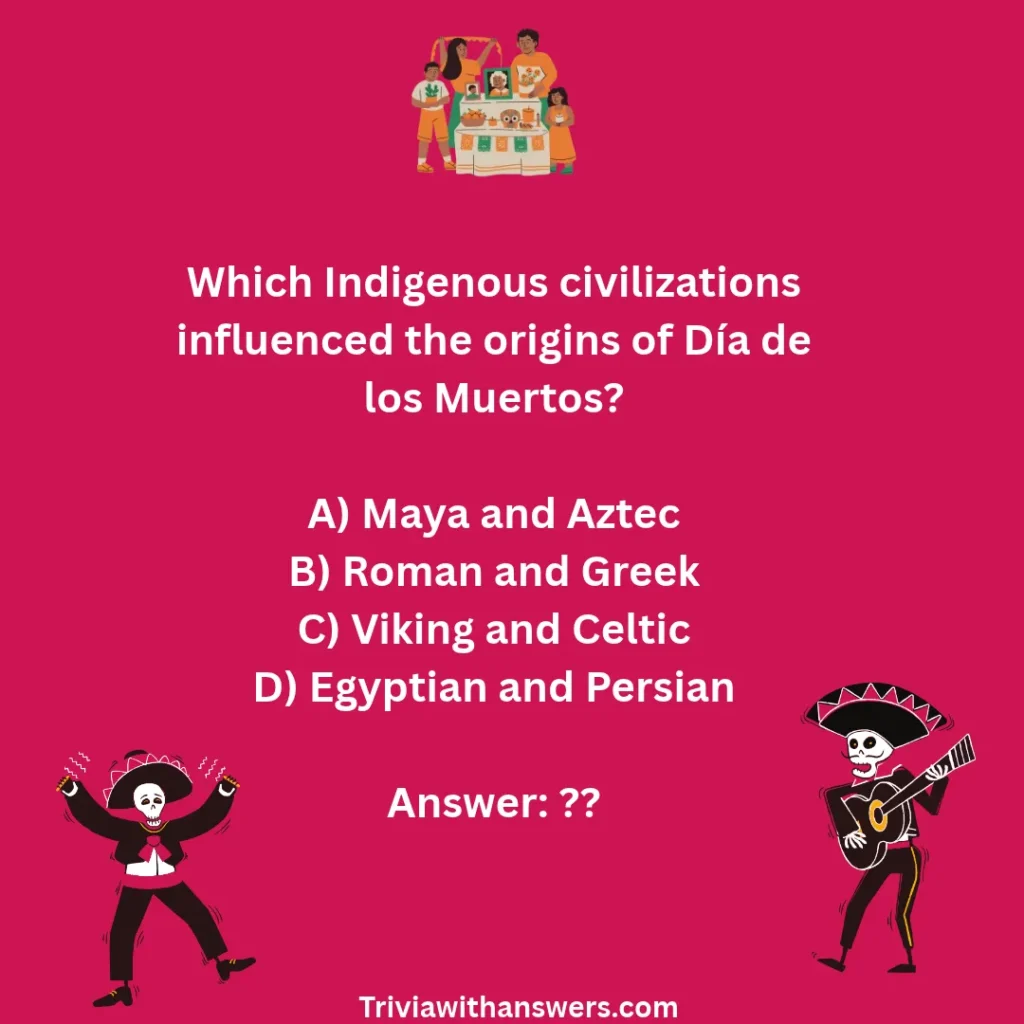
9. Question: Which Indigenous civilizations influenced the origins of Día de los Muertos?
A) Maya and Aztec
B) Roman and Greek
C) Viking and Celtic
D) Egyptian and Persian
Correct Answer: A) Maya and Aztec
Explanation: Indigenous traditions, including those of the Mexica (Aztec) and Maya peoples, contributed to the cultural roots of Day of the Dead. The modern celebration also reflects centuries of cultural blending.
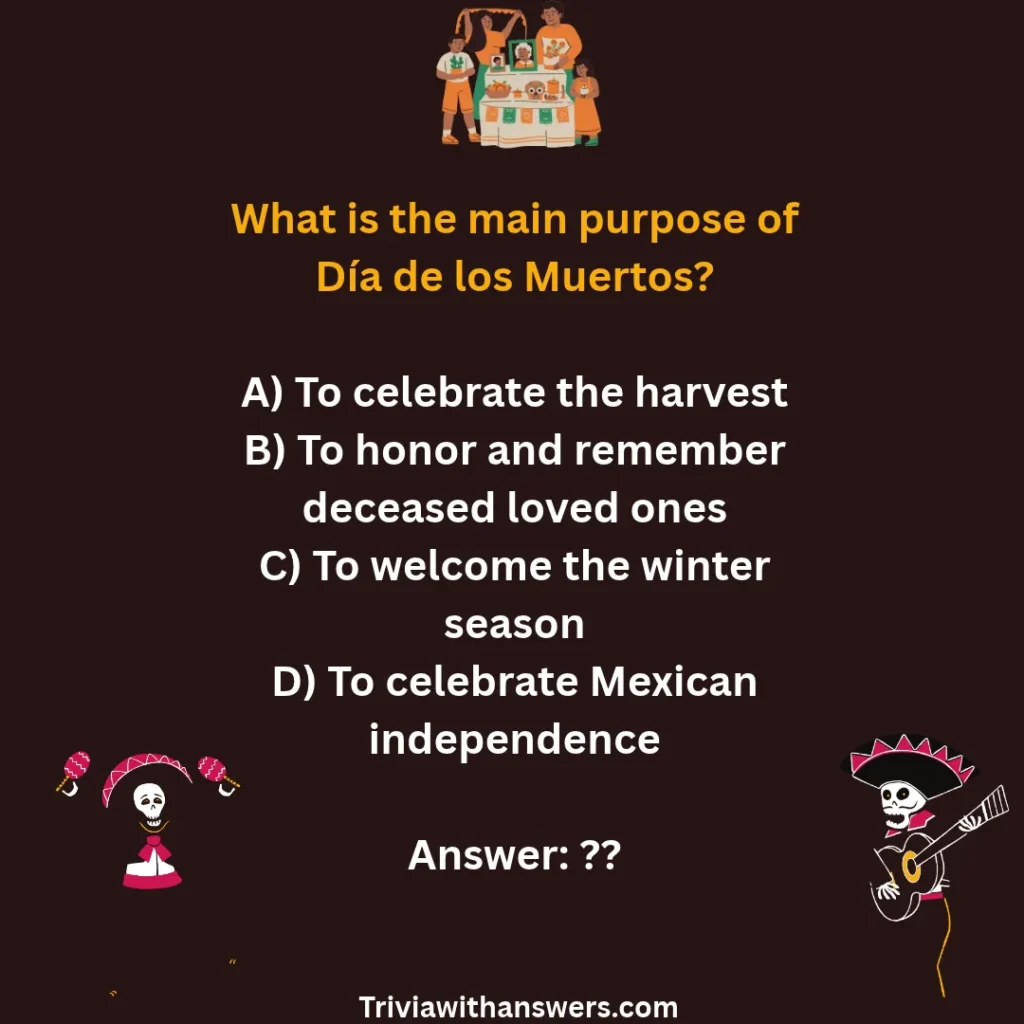
10. Question: What is the main purpose of Día de los Muertos?
A) To celebrate the beginning of winter
B) To honor and remember deceased loved ones
C) To celebrate Mexican independence
D) To welcome the harvest season
Correct Answer: B) To honor and remember deceased loved ones
Explanation: The celebration provides an opportunity for families to remember those who have passed away, share stories, and celebrate the lives they lived.
11. Question: What do candles on a Day of the Dead altar symbolize?
A) Wealth and prosperity
B) Guidance for returning spirits
C) The arrival of winter
D) Protection from rain
Correct Answer: B) Guidance for returning spirits
Explanation: Candles are believed to help guide the spirits of deceased loved ones back to their families during the celebration.
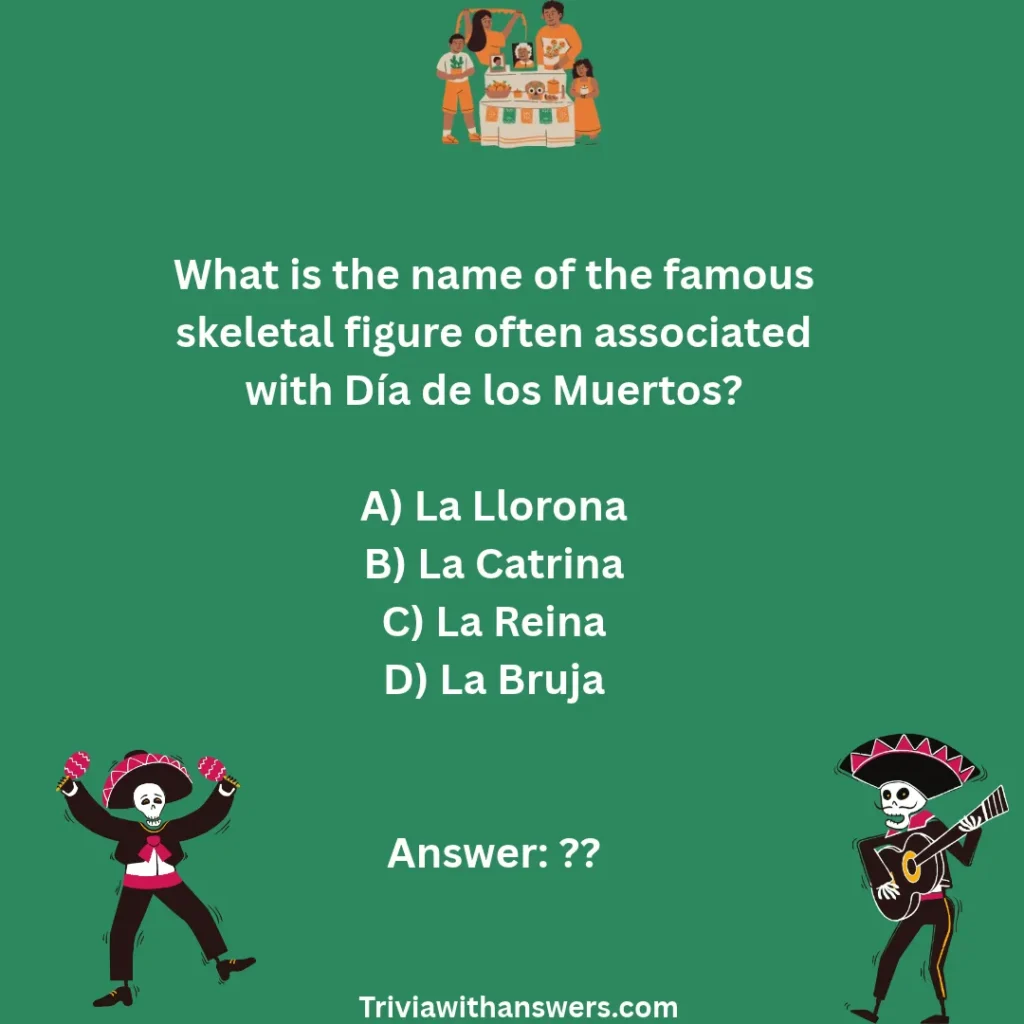
12. Question: What is the name of the famous skeletal figure often associated with Día de los Muertos?
A) La Llorona
B) La Catrina
C) La Reina
D) La Bruja
Correct Answer: B) La Catrina
Explanation: La Catrina is an elegant female skeleton often shown wearing a fancy hat and fashionable clothing. She became an iconic symbol of Day of the Dead.
13. Question: What do families often do at cemeteries during Día de los Muertos?
A) Hold sports competitions
B) Clean and decorate graves
C) Plant vegetable gardens
D) Build new houses
Correct Answer: B) Clean and decorate graves
Explanation: Families often visit cemeteries to clean and decorate the graves of loved ones with flowers, candles, photographs, and other meaningful decorations.
14. Question: What is papel picado?
A) A traditional Mexican soup
B) Colorful cut-paper decorations
C) A type of sugar skull
D) A traditional musical instrument
Correct Answer: B) Colorful cut-paper decorations
Explanation: Papel picado consists of delicate designs cut into colorful sheets of paper. These decorations are commonly hung above altars and throughout homes during the celebration.
15. Question: Which animal is sometimes associated with guiding souls in Mexican traditions?
A) Xoloitzcuintli
B) Eagle
C) Horse
D) Jaguar
Correct Answer: A) Xoloitzcuintli
Explanation: The Xoloitzcuintli, a hairless Mexican dog, has connections to ancient Indigenous beliefs. It was traditionally associated with guiding souls through the journey to the afterlife.
16. Question: What does the word “calavera” mean in English?
A) Flower
B) Candle
C) Skull
D) Bread
Correct Answer: C) Skull
Explanation: Calavera means skull in Spanish. Skulls are important symbols of Día de los Muertos and represent the connection between life, death, and remembrance.
17. Question: Which UNESCO designation recognizes Día de los Muertos as an important cultural tradition?
A) World Heritage Monument
B) Intangible Cultural Heritage of Humanity
C) International Holiday Festival
D) Global Religious Celebration
Correct Answer: B) Intangible Cultural Heritage of Humanity
Explanation: UNESCO recognized Mexico’s Indigenous festivity dedicated to the dead in 2008 on its Representative List of the Intangible Cultural Heritage of Humanity.
18. Question: What is commonly placed on an ofrenda to represent the four elements of nature?
A) Water, fire, earth, and air
B) Ice, snow, sunlight, and rain
C) Gold, silver, bronze, and copper
D) Wood, metal, plastic, and glass
Correct Answer: A) Water, fire, earth, and air
Explanation: Traditional ofrendas often include symbolic representations of the four elements. Water represents refreshment, candles represent fire, earth is represented by food or other natural materials, and papel picado represents air.
19. Question: Which Disney-Pixar animated movie features a family celebrating Día de los Muertos?
A) Toy Story
B) Finding Nemo
C) Coco
D) Inside Out
Correct Answer: C) Coco
Explanation: Coco is a popular animated movie released in 2017. It follows a young boy named Miguel as he explores his family’s history and the Land of the Dead during Día de los Muertos.
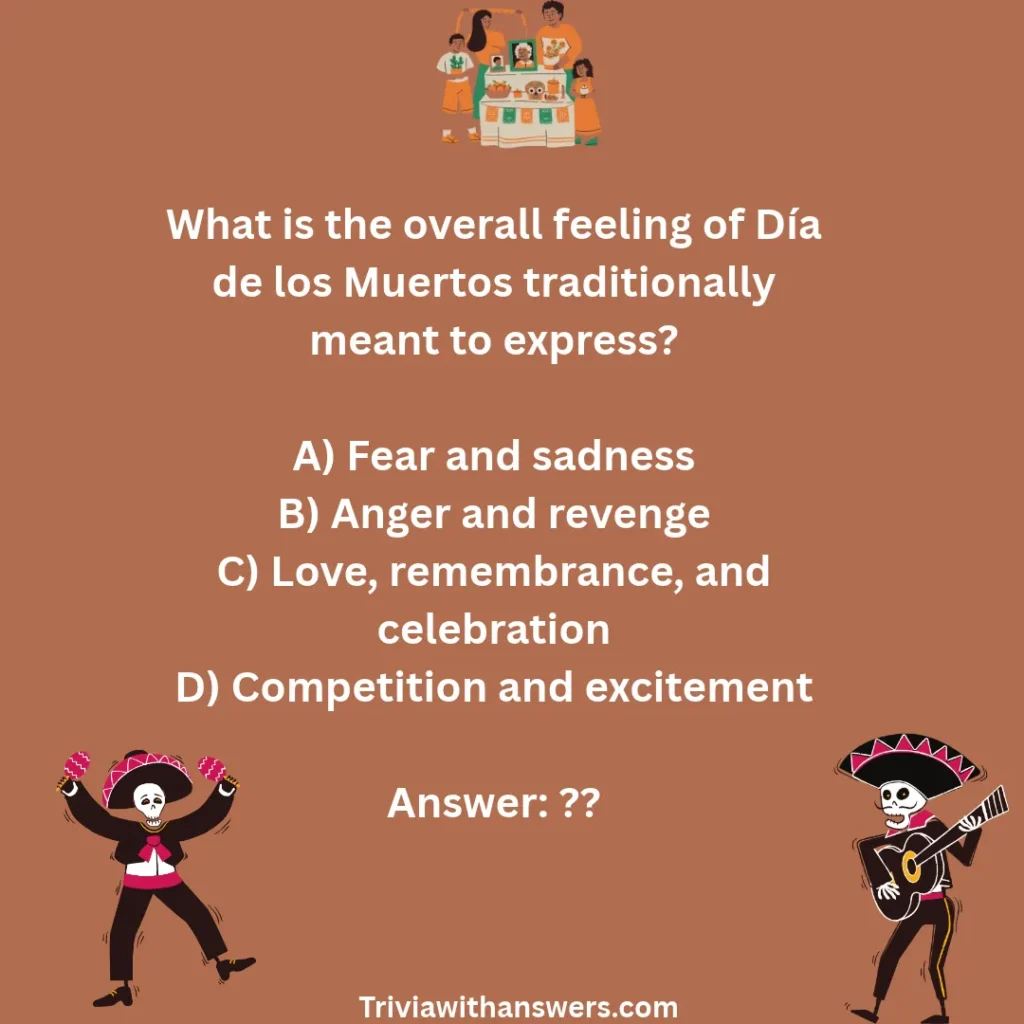
20. Question: What is the overall feeling of Día de los Muertos traditionally meant to express?
A) Fear and sadness
B) Anger and revenge
C) Love, remembrance, and celebration
D) Competition and excitement
Correct Answer: C) Love, remembrance, and celebration
Explanation: Día de los Muertos is not simply a day of mourning. It is a joyful celebration of family, memories, cultural traditions, and the continuing connection between the living and those who have passed away.
Recommended: 131+ Funny Day of the Dead Sayings For 2026
Easy Day of the Dead Trivia Questions and Answers
1. Question: Which country is most famously associated with Día de los Muertos?
Answer: Mexico.
2. Question: On which dates is Día de los Muertos celebrated?
Answer: November 1 and 2.
3. Question: What does “Día de los Muertos” mean in English?
Answer: Day of the Dead.
4. Question: Is Día de los Muertos the same as Halloween?
Answer: No. It’s a separate holiday that honors and remembers loved ones who have died, and it’s more celebratory than scary.
5. Question: Which movie from 2017 introduced Día de los Muertos to many families around the world?
Answer: Coco.
Symbols and Decorations
6. Question: What is the name of the altar families build to honor their loved ones?
Answer: An ofrenda.
7. Question: Which flower is most associated with Día de los Muertos?
Answer: The marigold, called cempasúchil in Mexico.
8. Question: What are the colorful paper banners with cut-out designs called?
Answer: Papel picado.
9. Question: What do candles on the altar symbolize?
Answer: They light the way and guide spirits back home.
10. Question: What is a “calavera”?
Answer: A skull.
11. Question: What are calaveras de azúcar?
Answer: Sugar skulls, which are decorated and often have a name written on the forehead.
12. Question: Who is La Catrina?
Answer: An elegant skeleton figure dressed in a fancy hat, and one of the best-known symbols of the holiday.
Food and Drink
13. Question: What sweet bread is traditionally eaten during Día de los Muertos?
Answer: Pan de muerto, or “bread of the dead.”
14. Question: What shapes often decorate the top of pan de muerto?
Answer: Bone shapes, often with a round piece in the middle.
15. Question: What warm drink is often served on Día de los Muertos?
Answer: Hot chocolate or atole.
16. Question: Why do families put a glass of water on the ofrenda?
Answer: To quench the thirst of spirits after their long journey.
17. Question: Why do families put a loved one’s favorite foods on the altar?
Answer: To welcome them back with the things they enjoyed in life.
Traditions and History
18. Question: What do many families do at cemeteries during the holiday?
Answer: Clean and decorate the graves, bring flowers and candles, and spend time remembering their loved ones.
19. Question: Which ancient people’s traditions about honoring the dead helped shape Día de los Muertos?
Answer: The Aztecs (Mexica) and other Indigenous peoples of Mexico.
20. Question: Which organization added Día de los Muertos to its list of Intangible Cultural Heritage of Humanity in 2008?
Answer: UNESCO.
Day of the Dead Trivia Questions and Answers for Adults
1. Question: What does “Día de los Muertos” mean in English?
Answer: Day of the Dead.
2. Question: On which dates is Día de los Muertos traditionally celebrated?
Answer: November 1 and 2.
3. Question: Which country is most closely associated with Día de los Muertos?
Answer: Mexico.
4. Question: What is the main purpose of Día de los Muertos?
Answer: To honor, remember, and celebrate deceased loved ones.
5. Question: What is an ofrenda?
Answer: An altar or offering created to welcome and honor deceased loved ones.
6. Question: Which flower is most associated with Día de los Muertos?
Answer: Marigolds, called cempasúchil in Spanish.
7. Question: Why are marigolds used during the celebration?
Answer: Their bright color and fragrance are believed to guide spirits to the ofrenda.
8. Question: What are decorated sugar skulls called in Spanish?
Answer: Calaveras.
9. Question: What sweet bread is traditionally associated with Día de los Muertos?
Answer: Pan de muerto.
10. Question: Which iconic elegant skeleton figure wears a fancy hat and dress?
Answer: La Calavera Catrina.
11. Question: Which Aztec goddess, known as the “Lady of the Dead,” is linked to the holiday’s ancient origins?
Answer: Mictecacihuatl.
12. Question: Which two Catholic holidays coincide with Día de los Muertos?
Answer: All Saints’ Day and All Souls’ Day.
13. Question: What does papel picado represent?
Answer: The movement and fragility of life; it also adds color and celebration to the ofrenda.
14. Question: What do families often place on an ofrenda besides photos and candles?
Answer: Food, water, salt, incense, flowers, and personal items belonging to loved ones.
15. Question: Where do many families in Mexico gather to honor loved ones during the holiday?
Answer: Cemeteries or gravesites.
16. Question: What is the purpose of salt on an ofrenda?
Answer: It is traditionally included as a purification element and to help preserve spirits during their journey.
17. Question: What animated Pixar film helped bring Día de los Muertos traditions to a global audience?
Answer: Coco.
18. Question: What is the Aztec underworld associated with the journey of souls?
Answer: Mictlán.
19. Question: Which international organization recognized Día de los Muertos as Intangible Cultural Heritage of Humanity?
Answer: UNESCO.
20. Question: Is Día de los Muertos the same as Halloween?
Answer: No. Although they occur near each other, Día de los Muertos is a distinct celebration focused on honoring and reconnecting with deceased loved ones rather than fear or horror.
Day of the Dead Trivia Questions and Answers Hard
1. Question: What is the Nahuatl name and approximate meaning of the marigold flower central to Día de los Muertos ofrendas?
Answer: Cempoalxóchitl (or cempasúchil), meaning “twenty flower” or “flower of twenty petals.”
2. Question: In Aztec belief, how many levels did a soul typically have to pass through to reach Mictlán, and roughly how long could the journey take?
Answer: Nine levels; the journey could take several years.
3. Question: Which Aztec goddess, known as the “Lady of the Dead” and ruler of Mictlán, is widely regarded as a major pre-Hispanic antecedent of modern Día de los Muertos imagery, including later associations with La Catrina?
Answer: Mictecacíhuatl (or Mictēcacihuātl).
4. Question: According to the Florentine Codex and related sources, what were the names of the two main pre-Hispanic Mexica festivals dedicated to the dead, one for children and one for adults?
Answer: Miccailhuitontli (or Miccaihuitontli – Feast of the Little Dead) and Hueymiccaihuitl (or Miccailhuitl – Feast of the Adult Dead).
5. Question: In which year did UNESCO inscribe Mexico’s “Indigenous festivity dedicated to the dead” on its Representative List of the Intangible Cultural Heritage of Humanity?
Answer: 2008 (it had been proclaimed a Masterpiece of the Oral and Intangible Heritage of Humanity in 2003).
6. Question: What was the original name José Guadalupe Posada gave to the satirical skeletal figure that later became known as La Catrina, and what social critique did it embody?
Answer: Calavera Garbancera (or La Calavera Garbancera). It mocked Mexicans, especially those of Indigenous background, who denied their roots and pretentiously adopted European/French fashions and manners.
7. Question: Which famous Mexican muralist featured Posada’s skeletal figure (and Posada himself) prominently in a 1947 mural, helping popularize the image as La Catrina?
Answer: Diego Rivera, in Sueño de una tarde dominical en la Alameda Central (“Dream of a Sunday Afternoon in the Alameda Central”).
8. Question: Traditional ofrendas often incorporate representations of the four classical elements. Which element is most commonly symbolized by papel picado?
Answer: Wind (or air).
9. Question: What European confectionery technique, introduced during the colonial period and related to sugar paste work, is the direct ancestor of modern Mexican sugar skulls (calaveras de azúcar or alfeñiques)?
Answer: Alfeñique (a molded sugar-paste tradition with roots in European, particularly Spanish and earlier Mediterranean/Arab, confectionery).
10. Question: What do the crossed bone-shaped pieces of dough on a traditional pan de muerto typically represent, and what does the circular shape of the loaf often symbolize?
Answer: Bones (and sometimes tears of sorrow); the circular shape represents the cycle of life and death.
11. Question: In some traditional ofrendas, why might seven levels or steps be used?
Answer: They can represent the seven steps a soul must take to reach the afterlife (or, in some interpretations, the seven deadly sins or stages of purification).
12. Question: What aromatic resin, used in pre-Hispanic ceremonies and still burned on many modern ofrendas, is believed to help attract or nourish the spirits?
Answer: Copal.
13. Question: What literary form, popular in the 19th and early 20th centuries, consists of short, humorous or satirical poems, often mock epitaphs, written for Día de los Muertos and published in newspapers?
Answer: Calaveras literarias (literary calaveras or skull poems).
14. Question: According to traditional belief in many communities, on which date do the spirits of deceased children (los angelitos or muertos chiquitos) return, and when do the adult spirits arrive?
Answer: Children on November 1 (All Saints’ Day / Día de los Inocentes or Día de los Angelitos); adults on November 2 (All Souls’ Day).
15. Question: In some regions of Mexico, celebrations and preparations for Día de los Muertos can begin as early as which date in late October?
Answer: October 28 (or around that date, depending on local custom).
16. Question: What Spanish colonial-era bread tradition is considered a key European influence on the development of pan de muerto?
Answer: Pan de ánimas (“bread of souls”) or related All Saints’ and All Souls’ breads from Spain and other Catholic European regions.
17. Question: Why is the strong scent of cempasúchil (marigolds) considered especially important on the ofrenda and paths leading to graves?
Answer: It is believed to help guide the returning souls home.
18. Question: What does the phrase “Todos somos calaveras” (often associated with Posada’s work) emphasize about the skeletal imagery?
Answer: That beneath social status, wealth, or appearance, everyone is equal in death (“we are all skeletons”).
19. Question: In Aztec cosmology, what was the name of the final resting place that most souls reached only after completing the difficult journey through the underworld levels?
Answer: Mictlán.
20. Question: Sugar skulls are often inscribed with a name on the forehead. For what two main purposes are these named skulls traditionally used?
Answer: As personalized offerings placed on the ofrenda for a specific deceased person, or as gifts given to the living (sometimes playfully “for” the recipient).
Day of the Dead Trivia Questions and Answers Multiple Choice
1. Question: What does “Día de los Muertos” mean in English?
A) Day of the Spirits
B) Day of the Dead
C) Festival of Flowers
D) Night of the Souls
Answer: B) Day of the Dead.
2. Question: On which dates is Día de los Muertos traditionally celebrated?
A) October 30 and 31
B) November 1 and 2
C) November 5 and 6
D) December 1 and 2
Answer: B) November 1 and 2.
3. Question: Which country is most closely associated with Día de los Muertos?
A) Spain
B) Brazil
C) Mexico
D) Argentina
Answer: C) Mexico.
4. Question: What is the main purpose of Día de los Muertos?
A) To celebrate the harvest
B) To honor and remember deceased loved ones
C) To welcome the winter season
D) To celebrate Mexican independence
Answer: B) To honor and remember deceased loved ones.
5. Question: What is an ofrenda?
A) A traditional Mexican dance
B) A decorated altar honoring deceased loved ones
C) A special Mexican costume
D) A traditional musical instrument
Answer: B) A decorated altar honoring deceased loved ones.
6. Question: Which flower is most associated with Día de los Muertos?
A) Rose
B) Tulip
C) Marigold
D) Daisy
Answer: C) Marigold.
7. Question: What is the Spanish name for the traditional marigold flower used during Día de los Muertos?
A) Flor de Luna
B) Cempasúchil
C) Rosa Blanca
D) Flor de Sol
Answer: B) Cempasúchil.
8. Question: What are decorated sugar skulls called in Spanish?
A) Pan de muerto
B) Calaveras
C) Papel picado
D) Ofrendas
Answer: B) Calaveras.
9. Question: What sweet bread is traditionally associated with Día de los Muertos?
A) Pan dulce
B) Conchas
C) Pan de muerto
D) Churros
Answer: C) Pan de muerto.
10. Question: Which iconic skeleton figure is famous for wearing an elegant hat and dress?
A) La Llorona
B) La Calavera Catrina
C) Mictecacíhuatl
D) La Reina
Answer: B) La Calavera Catrina.
11. Question: Which Aztec goddess is known as the Lady of the Dead?
A) Coatlicue
B) Chalchiuhtlicue
C) Mictecacíhuatl
D) Xochiquetzal
Answer: C) Mictecacíhuatl.
12. Question: Which two Catholic holidays coincide with Día de los Muertos?
A) Christmas and Easter
B) All Saints’ Day and All Souls’ Day
C) Good Friday and Palm Sunday
D) Epiphany and Pentecost
Answer: B) All Saints’ Day and All Souls’ Day.
13. Question: What are the colorful paper decorations with intricate cut-out designs called?
A) Calaveras
B) Papel picado
C) Ofrendas
D) Cempasúchil
Answer: B) Papel picado.
14. Question: Which of the following items is commonly placed on a traditional ofrenda?
A) Photographs
B) Favorite foods
C) Candles and flowers
D) All of the above
Answer: D) All of the above.
15. Question: Where do many Mexican families gather to honor deceased loved ones during Día de los Muertos?
A) Shopping malls
B) Cemeteries
C) Sports stadiums
D) Museums
Answer: B) Cemeteries.
16. Question: What is the traditional purpose of placing salt on an ofrenda?
A) To decorate the altar
B) To symbolize purification
C) To prepare traditional bread
D) To attract butterflies
Answer: B) To symbolize purification.
17. Question: Which animated Pixar movie helped introduce Día de los Muertos traditions to audiences worldwide?
A) Encanto
B) Toy Story
C) Coco
D) Soul
Answer: C) Coco.
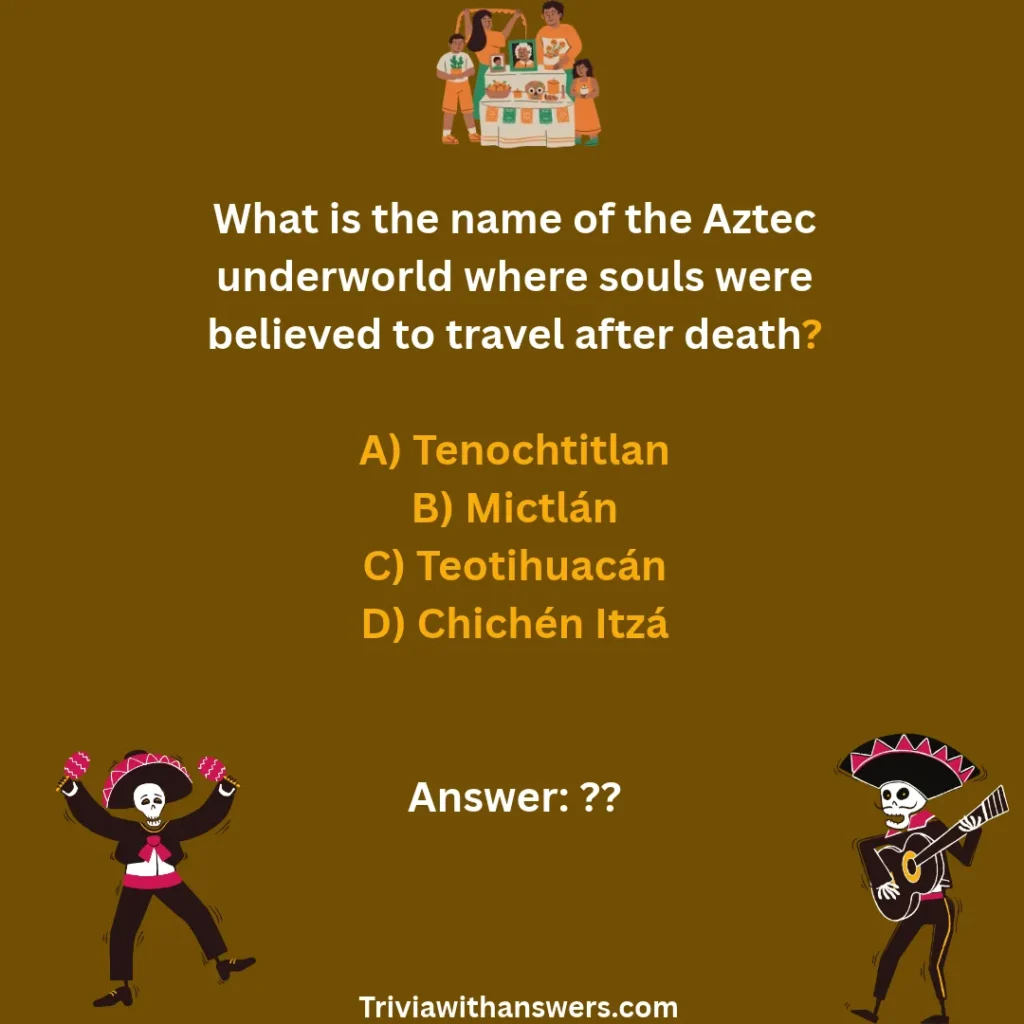
18. Question: What is the name of the Aztec underworld where souls were believed to travel after death?
A) Tenochtitlan
B) Mictlán
C) Teotihuacán
D) Chichén Itzá
Answer: B) Mictlán.
19. Question: Which international organization recognized Día de los Muertos as Intangible Cultural Heritage of Humanity in 2008?
A) UNICEF
B) UNESCO
C) WHO
D) United Nations Development Programme
Answer: B) UNESCO.
20. Question: Is Día de los Muertos the same as Halloween?
A) Yes, both are exactly the same celebration
B) Yes, both originated in Mexico
C) No, Día de los Muertos focuses on honoring and remembering deceased loved ones
D) No, Día de los Muertos is a Christmas celebration
Answer: C) No, Día de los Muertos focuses on honoring and remembering deceased loved ones.
Day of the Dead Trivia Questions and Answers Funny
1. Question: When is Day of the Dead?
Answer: Nov 1 & 2. Not Halloween’s after-party, it’s its own beautiful thing.
2. Question: What flower is basically the VIP of Día de los Muertos?
Answer: Marigold — cempasúchil. It’s like GPS for spirits. Follow the orange brick road!
3. Question: What’s on an ofrenda?
Answer: Photos, candles, favorite foods, drinks, and marigolds. Basically a love-filled snack table for your ancestors.
4. Question: Are sugar skulls — calaveras de azúcar — meant to be scary?
Answer: Nope! They’re sweet, colorful, and have names on them. The opposite of scary.
5. Question: Who is La Catrina?
Answer: The elegantly dressed skeleton lady. She’s the queen of the celebration and proves you can be dead and still be fabulous.
6. Question: Is Day of the Dead Mexican Halloween?
Answer: No! Halloween is spooky. Día de los Muertos is a celebration of life. One says BOO, the other says TE AMO.
7. Question: Why do people put bread — pan de muerto — on the altar?
Answer: It’s a sweet, round bread for the returning spirits. Yes, even ghosts need carbs.
8. Question: What do marigolds smell like to spirits?
Answer: Strong and bright — they follow the scent home. Like when you smell tacos and suddenly appear in the kitchen.
9. Question: Why are skeletons laughing and dancing?
Answer: Because death is part of life, not the end of the party. Even skeletons have jokes.
10. Question: What’s the main goal of Día de los Muertos?
Answer: To remember, honor, and celebrate loved ones who’ve passed — not to mourn them.
11. Question: Do people actually eat at the cemetery?
Answer: Yes! Families bring food, music, and stories and have a picnic with their ancestors. Best dinner guests ever.
12. Question: What’s written on a sugar skull?
Answer: A name — usually of the living OR the dead. It’s not morbid, it’s affectionate. Like a sweet edible name tag.
13. Question: How long has Day of the Dead been around?
Answer: Over 3,000 years, back to the Aztecs. Older than your abuela’s secret salsa recipe.
14. Question: Why are there 4 elements on an ofrenda?
Answer: Water, fire (candles), earth (food), and wind (papel picado). It’s full elemental magic.
15. Question: What’s papel picado?
Answer: Those colorful cut-paper banners. They’re so delicate the wind moves through them — that’s the spirits saying hi.
16. Question: Is face painting required?
Answer: Not required, but highly encouraged. Sugar skull makeup = honoring, not a Halloween costume.
17. Question: Can you put beer on an ofrenda?
Answer: Absolutely. If your uncle loved a cold beer, he gets a cold beer. The altar has his favorites.
18. Question: Why two days — Nov 1 and Nov 2?
Answer: Nov 1 is for angelitos — kids who passed. Nov 2 is for adults. Everyone gets their own welcome-home party.
19. Question: What does “Recuérdame” mean?
Answer: “Remember me.” The whole point. Coco wasn’t kidding.
20. Question: What happens if you forget to put someone on your ofrenda?
Answer: They still know you love them. But the marigolds might file a complaint for lack of decoration.
FAQS
What Are 5 Facts About Day of the Dead?
1. It is celebrated on November 1 and 2. Día de los Muertos is a Mexican tradition dedicated to remembering and honoring deceased loved ones.
2. Marigolds are an important symbol. Their bright orange color and strong scent are believed to help guide the spirits of loved ones back home.
3. Families create special altars called ofrendas. These altars often include photographs, candles, flowers, favorite foods, drinks, and personal belongings of the deceased.
4. Sugar skulls are colorful decorations and offerings. Known as calaveras de azúcar, they often feature bright icing designs and names of loved ones.
5. The celebration has ancient roots. Día de los Muertos combines Indigenous traditions, including those of ancient Mesoamerican cultures, with Catholic influences introduced during Spanish colonization.
What Are Some Questions I Can Ask About Day of the Dead?
Here are 10 interesting questions you can ask to learn more about Día de los Muertos:
- What is the meaning behind Día de los Muertos?
- Why is Day of the Dead celebrated on November 1 and 2?
- What is an ofrenda, and what items are placed on it?
- Why are marigold flowers important during the celebration?
- What do sugar skulls symbolize?
- What is the difference between Day of the Dead and Halloween?
- Why do families visit cemeteries during Día de los Muertos?
- What is pan de muerto, and why is it traditionally eaten?
- Who is La Catrina, and what does she represent?
- How do Mexican families celebrate and honor their deceased loved ones?
What Are 5 Symbols of Day of the Dead?
1. Marigolds (Cempasúchil): These bright orange flowers symbolize remembrance and are believed to guide the spirits of deceased loved ones back to their families.
2. Sugar Skulls (Calaveras): Colorful sugar skulls represent death as a natural part of life and are used to honor the departed.
3. Candles: Candles represent hope, remembrance, and light. They are often placed on ofrendas to help guide spirits home.
4. Papel Picado: These beautifully cut paper decorations represent wind and the connection between the living and the spiritual world.
5. Pan de Muerto: This traditional sweet bread symbolizes the cycle of life and death. Its bone-shaped decorations are associated with the deceased.
Is the Day of the Dead the same as Halloween?
No, the Day of the Dead and Halloween are different celebrations. Halloween focuses on spooky costumes, trick-or-treating, and frightening decorations, while the Day of the Dead celebrates family memories, honors deceased loved ones, and recognizes the connection between life and death.
What do sugar skulls represent during the Day of the Dead?
Sugar skulls, known as calaveras de azúcar, represent the remembrance of deceased loved ones. They are often decorated with colorful icing, patterns, and names to celebrate the lives of those being remembered.
Why is the Day of the Dead celebrated with music, food, and colorful decorations?
Music, traditional foods, and colorful decorations make the celebration joyful and meaningful. They help families remember their loved ones, share cultural traditions, and celebrate the lives and memories of those who have passed away.
Final Thoughts
The Day of the Dead is much more than a colorful celebration; it’s a meaningful tradition that brings families and communities together to remember, honor, and celebrate the lives of loved ones who have passed away.
We hope these Day of the Dead trivia questions and answers have helped you discover fascinating facts about its history, customs, symbols, and cultural significance while putting your knowledge to the test. Keep exploring, keep sharing, and most importantly, keep the spirit of remembrance alive!
1 thought on “157+ Fun Day of the Dead Trivia Questions and Answers (2026)”