

Challenge your brain with extremely difficult trivia questions designed to test your knowledge, sharpen your memory, and push your thinking skills to the limit.
From science and history to geography, literature, mathematics, and general knowledge, these challenging questions will put even the most knowledgeable trivia fans to the test.
Whether you enjoy solving tricky puzzles or competing with friends, get ready for a mind-bending experience full of surprising facts and unexpected answers.
If you think you know a little bit about everything, now is the perfect time to prove it! These hard trivia questions cover a wide range of topics, featuring obscure facts, confusing details, and questions that require more than just basic knowledge.
Take your time, think carefully, and see how many correct answers you can get without looking up the solutions.
Whether you’re preparing for a trivia night, hosting a quiz game, or simply looking for a fun mental challenge, these extremely difficult trivia questions offer an exciting way to test your limits.
Challenge your friends and family, compare your scores, and discover who has the strongest general knowledge. Are you ready to take on the challenge and prove yourself a true trivia expert?
Hard Extremely Difficult Trivia Questions
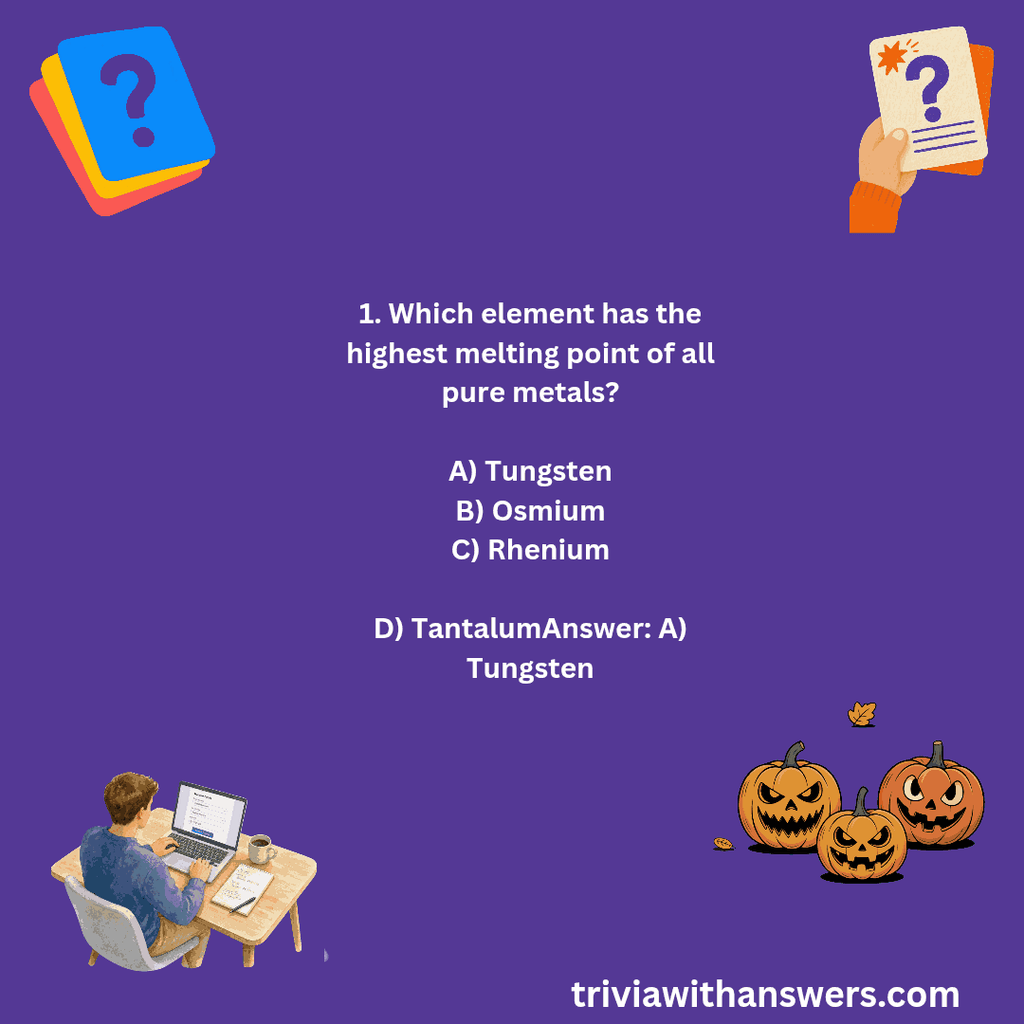
1. Which element has the highest melting point of all pure metals?
A) Tungsten
B) Osmium
C) Rhenium
D) Tantalum
Answer: A) Tungsten
2. What is the only number that is spelled with its letters in alphabetical order?
A) Forty
B) One
C) Eight
D) Thousand
Answer: A) Forty
3. Which planet has the shortest day in the Solar System?
A) Mars
B) Jupiter
C) Saturn
D) Neptune
Answer: B) Jupiter
4. What was the first country to grant women the right to vote nationwide?
A) Australia
B) Canada
C) New Zealand
D) Finland
Answer: C) New Zealand
5. Which chess piece can legally move first in a game besides a pawn?
A) Queen
B) Bishop
C) Rook
D) Knight
Answer: D) Knight
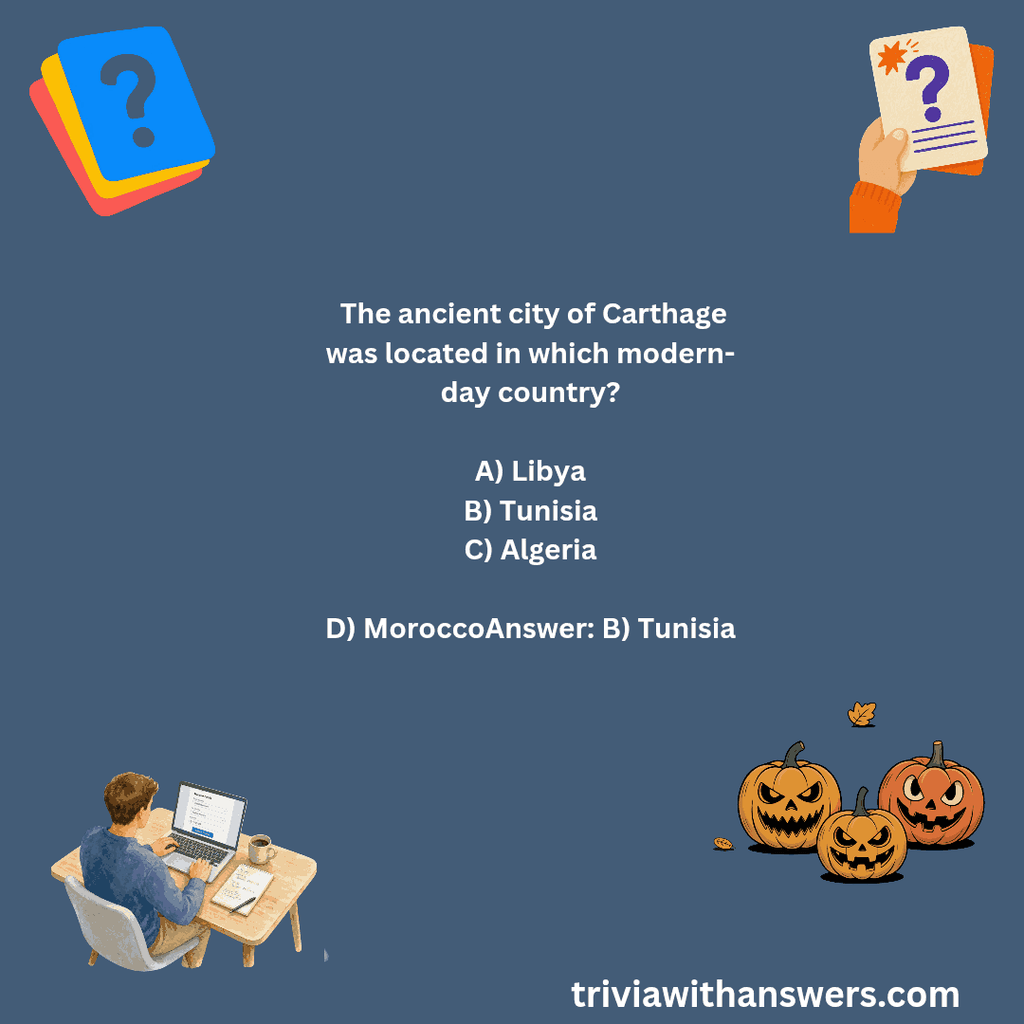
6. The ancient city of Carthage was located in which modern-day country?
A) Libya
B) Tunisia
C) Algeria
D) Morocco
Answer: B) Tunisia
7. What is the smallest bone in the human body?
A) Malleus
B) Incus
C) Stapes
D) Hyoid
Answer: C) Stapes
8. Which mathematician is credited with formulating the laws of planetary motion?
A) Galileo Galilei
B) Johannes Kepler
C) Tycho Brahe
D) René Descartes
Answer: B) Johannes Kepler
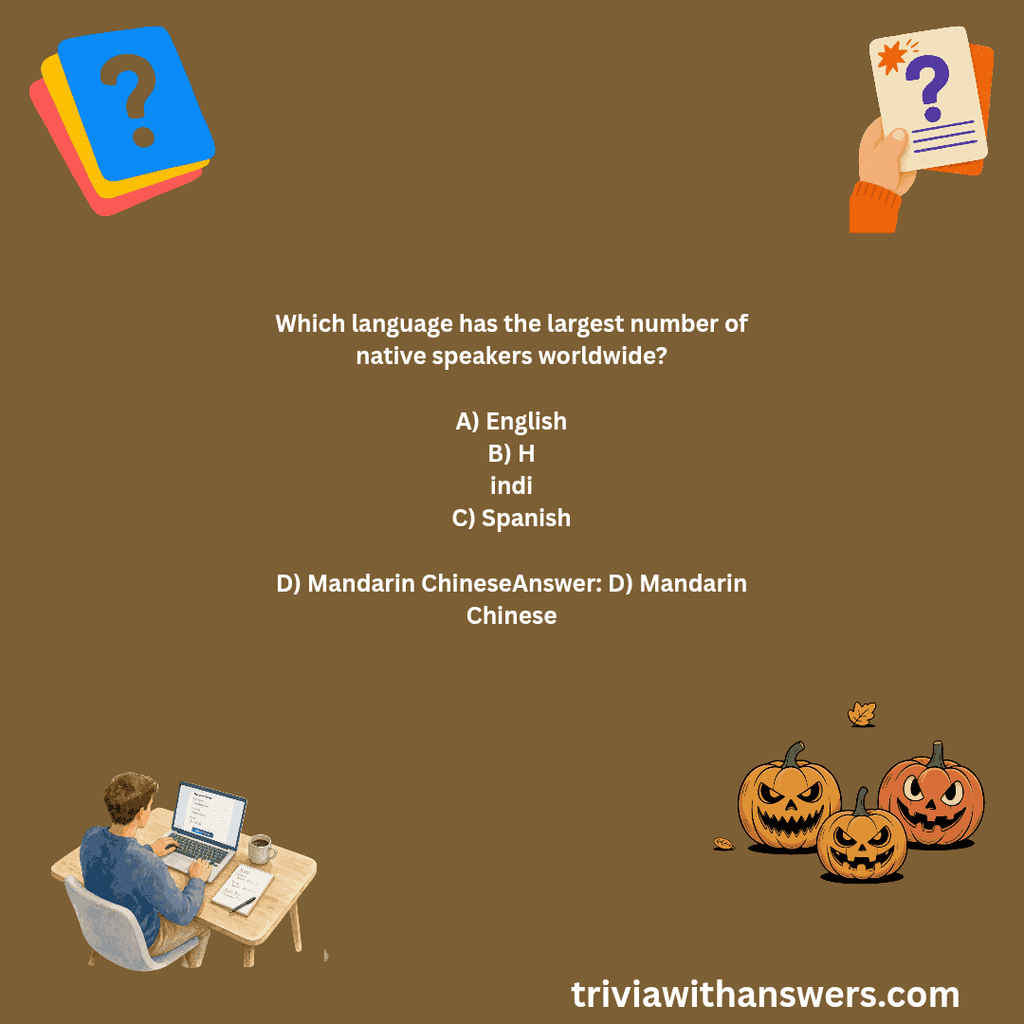
9. Which language has the largest number of native speakers worldwide?
A) English
B) Hindi
C) Spanish
D) Mandarin Chinese
Answer: D) Mandarin Chinese
10. What is the capital city of Mongolia?
A) Astana
B) Tashkent
C) Ulaanbaatar
D) Bishkek
Answer: C) Ulaanbaatar
11. Which ocean contains the Mariana Trench?
A) Atlantic Ocean
B) Indian Ocean
C) Pacific Ocean
D) Arctic Ocean
Answer: C) Pacific Ocean
12. Which physicist proposed the uncertainty principle?
A) Niels Bohr
B) Erwin Schrödinger
C) Werner Heisenberg
D) Max Planck
Answer: C) Werner Heisenberg
13. Which country has the world’s oldest continuously used national flag?
A) Denmark
B) Sweden
C) England
D) Portugal
Answer: A) Denmark
14. What is the rarest naturally occurring stable element on Earth?
A) Astatine
B) Francium
C) Iridium
D) Tellurium
Answer: C) Iridium
15. Which Shakespeare play contains the line, “The lady doth protest too much, methinks”?
A) Macbeth
B) Hamlet
C) Othello
D) King Lear
Answer: B) Hamlet
16. What is the name of the supercontinent that existed before Pangaea?
A) Gondwana
B) Rodinia
C) Laurasia
D) Baltica
Answer: B) Rodinia
17. Which country invented paper money?
A) India
B) Egypt
C) China
D) Greece
Answer: C) China
18. Which gas makes up the largest percentage of Earth’s atmosphere?
A) Oxygen
B) Argon
C) Carbon Dioxide
D) Nitrogen
Answer: D) Nitrogen
19. In computing, what does the acronym CAPTCHA stand for?
A) Computer Automated Password Test for Humans
B) Completely Automated Public Turing Test to Tell Computers and Humans Apart
C) Computer Access Protection Test for Human Authentication
D) Certified Automated Public Test for Human Access
Answer: B) Completely Automated Public Turing Test to Tell Computers and Humans Apart
20. Which country is home to the world’s highest uninterrupted waterfall, Angel Falls?
A) Peru
B) Brazil
C) Colombia
D) Venezuela
Answer: D) Venezuela
Extremely Difficult Trivia Questions For Friends
20 Extremely Difficult Trivia Questions
1. What is the only letter that does not appear in any U.S. state name?
A) Q
B) Z
C) X
D) J
Answer: A) Q
2. Which element has the highest melting point?
A) Tungsten
B) Carbon
C) Osmium
D) Platinum
Answer: B) Carbon — In its graphite form, carbon sublimes at about 3,642°C rather than melting at normal pressure.
3. Which country has the most time zones, including territories?
A) Russia
B) United States
C) France
D) United Kingdom
Answer: C) France — Counting overseas territories, France spans 12 time zones.
4. What was the first animal to orbit Earth?
A) Laika the dog
B) A fruit fly
C) A monkey
D) A mouse
Answer: B) A fruit fly — Fruit flies traveled aboard a U.S. V-2 rocket in 1947.
5. Which is the longest river entirely within one country?
A) Yangtze
B) Volga
C) Amazon
D) Nile
Answer: B) Volga — It flows entirely within Russia.
6. What is the rarest naturally occurring element on Earth?
A) Astatine
B) Francium
C) Promethium
D) Technetium
Answer: A) Astatine
7. Which planet has the shortest day in the Solar System?
A) Mercury
B) Jupiter
C) Mars
D) Venus
Answer: B) Jupiter — It completes one rotation in about 9.9 hours.
8. Which language has the largest alphabet?
A) Russian
B) Khmer
C) Arabic
D) Greek
Answer: B) Khmer — The Cambodian language has 74 letters.
9. What is the smallest country in the world by population?
A) Vatican City
B) Nauru
C) Tuvalu
D) Monaco
Answer: A) Vatican City
10. Which scientist developed the three laws of planetary motion?
A) Isaac Newton
B) Johannes Kepler
C) Galileo Galilei
D) Tycho Brahe
Answer: B) Johannes Kepler
11. What is the only continent without native ants?
A) Europe
B) Australia
C) Antarctica
D) South America
Answer: C) Antarctica
12. Which country was formerly known as Abyssinia?
A) Ethiopia
B) Eritrea
C) Sudan
D) Somalia
Answer: A) Ethiopia
13. Which is the only mammal capable of true flight?
A) Flying squirrel
B) Sugar glider
C) Bat
D) Colugo
Answer: C) Bat
14. What is the chemical symbol for tungsten?
A) Tg
B) W
C) Tu
D) Tn
Answer: B) W — From the German name Wolfram.
15. Which sea has no coastline?
A) Sargasso Sea
B) Red Sea
C) Black Sea
D) Dead Sea
Answer: A) Sargasso Sea
16. Which ancient wonder stood in Alexandria, Egypt?
A) Hanging Gardens
B) Lighthouse of Alexandria
C) Colossus of Rhodes
D) Temple of Artemis
Answer: B) Lighthouse of Alexandria
17. What is the hardest natural substance on Earth?
A) Quartz
B) Diamond
C) Corundum
D) Topaz
Answer: B) Diamond
18. Which planet rotates clockwise, unlike most planets?
A) Mars
B) Venus
C) Neptune
D) Saturn
Answer: B) Venus
19. Which is the largest internal organ in the human body?
A) Heart
B) Brain
C) Liver
D) Lungs
Answer: C) Liver
20. What is the national flower of Japan?
A) Lotus
B) Cherry blossom
C) Chrysanthemum
D) Camellia
Answer: C) Chrysanthemum — Although cherry blossoms are culturally iconic, the chrysanthemum is the imperial national flower.
Most Extremely Difficult Trivia Questions
1. Which Irish folk figure is considered a direct predecessor to the modern jack-o’-lantern legend?
A) The Dullahan
B) Stingy Jack
C) The Banshee
D) Far Darrig
Answer: B) Stingy Jack
2. In the original 1922 silent film Nosferatu, what is the name of the vampire count?
A) Count Orlok
B) Count Dracula
C) Count von Krolock
D) Count Alucard
Answer: A) Count Orlok
3. What was the original name of the holiday that later evolved into Halloween before it was Christianized?
A) Calan Gaeaf
B) Samhain
C) Nos Calan Gaeaf
D) Allantide
Answer: B) Samhain
4. In Mexican tradition, what is the name of the sweet bread specifically baked for Día de los Muertos?
A) Concha
B) Pan de Muerto
C) Rosca de Reyes
D) Tres Leches
Answer: B) Pan de Muerto
5. Which real historical figure inspired the character of Count Dracula more than Vlad the Impaler, according to some scholars?
A) Elizabeth Báthory
B) Gilles de Rais
C) Countess Erzsébet Báthory
D) John Polidori’s Lord Ruthven
Answer: A) Elizabeth Báthory
6. In the 1968 film Night of the Living Dead, what is the name of the first zombie that appears in the cemetery?
A) Johnny
B) The Cemetery Zombie (often called “Ghoul”)
C) Ben
D) Harry
Answer: B) The Cemetery Zombie (often called “Ghoul”)
7. What rare blood type is traditionally said to be preferred by vampires in certain folklore traditions?
A) AB negative
B) O negative
C) RH-null (“Golden Blood”)
D) Bombay blood type
Answer: C) RH-null (“Golden Blood”)
8. Which ancient Roman festival involving the dead was later absorbed into early Christian All Saints’ and All Souls’ traditions?
A) Parentalia
B) Lemuria
C) Feralia
D) Both A and C
Answer: D) Both A and C
9. In Japanese folklore, what is the name of the vengeful female spirit often associated with tragic death and long black hair?
A) Yuki-onna
B) Onryō
C) Kuchisake-onna
D) Rokurokubi
Answer: B) Onryō
10. What is the exact number of times the word “Halloween” is spoken in the original 1978 Halloween film?
A) 0
B) 1
C) 3
D) 5
Answer: A) 0
11. Which European country traditionally celebrated a form of Halloween called “Hop-tu-Naa” with turnip lanterns?
A) Ireland
B) Isle of Man
C) Scotland
D) Wales
Answer: B) Isle of Man
12. In the novel Dracula, what is the name of the ship that carries Count Dracula to England?
A) The Demeter
B) The Czarina Catherine
C) The Bessy
D) The Silver Star
Answer: A) The Demeter
13. What is the scientific name of the fungus that inspired some “zombie” folklore by controlling ant behavior?
A) Ophiocordyceps unilateralis
B) Cordyceps militaris
C) Beauveria bassiana
D) Entomophthora muscae
Answer: A) Ophiocordyceps unilateralis
14. Which 19th-century author wrote the short story “The Legend of Sleepy Hollow”?
A) Edgar Allan Poe
B) Washington Irving
C) Nathaniel Hawthorne
D) Mary Shelley
Answer: B) Washington Irving
15. In traditional Cornish folklore, what are the spirits of the dead called that were said to walk on Allhallowtide?
A) Piskies
B) Buccas
C) Ankow
D) Knockers
Answer: C) Ankow
16. What was the original material used for jack-o’-lanterns in Ireland before pumpkins became common?
A) Potatoes
B) Turnips
C) Beets
D) Both B and C
Answer: D) Both B and C
17. In the 1982 film The Thing, what is the name of the Norwegian dog that first brings the creature to the American camp?
A) Jed
B) The Norwegian dog (unnamed in dialogue)
C) Shadow
D) Max
Answer: B) The Norwegian dog (unnamed in dialogue)
18. Which real psychiatric condition was historically linked to beliefs about lycanthropy (werewolf transformation)?
A) Clinical lycanthropy
B) Capgras syndrome
C) Cotard’s delusion
D) Fregoli syndrome
Answer: A) Clinical lycanthropy
19. What is the name of the ancient Egyptian god of mummification and the dead who is often associated with Halloween-adjacent imagery?
A) Anubis
B) Osiris
C) Thoth
D) Set
Answer: A) Anubis
20. In Scottish folklore, what is the name of the shape-shifting water spirit that can appear as a horse and drag people to their deaths?
A) Kelpie
B) Each-uisge
C) Both A and B
D) Selkie
Answer: C) Both A and B
Very Extremely Difficult Trivia Questions
1. Which chemical element has the highest melting point of all elements?
A) Osmium B) Tungsten C) Rhenium D) Tantalum
Answer: B) Tungsten
2. What is the only sea in the world without any land boundaries?
A) Arabian Sea B) Coral Sea C) Sargasso Sea D) Philippine Sea
Answer: C) Sargasso Sea
3. Which mathematician proved the incompleteness theorems in 1931?
A) David Hilbert B) Kurt Gödel C) Bertrand Russell D) Alan Turing
Answer: B) Kurt Gödel
4. What is the name of the deepest known point in Earth’s oceans?
A) Tonga Deep B) Java Trench C) Challenger Deep D) Milwaukee Deep
Answer: C) Challenger Deep
5. Which ancient civilization developed the earliest known writing system, cuneiform?
A) Ancient Egyptians B) Sumerians C) Phoenicians D) Minoans
Answer: B) Sumerians
6. Which planet has the shortest day in the Solar System?
A) Mercury B) Jupiter C) Saturn D) Neptune
Answer: B) Jupiter
7. What is the SI unit of catalytic activity?
A) Katal B) Becquerel C) Siemens D) Weber
Answer: A) Katal
8. Who wrote the philosophical work Being and Time?
A) Jean-Paul Sartre B) Friedrich Nietzsche C) Martin Heidegger D) Immanuel Kant
Answer: C) Martin Heidegger
9. Which treaty ended the Thirty Years’ War in 1648?
A) Treaty of Utrecht B) Peace of Westphalia C) Treaty of Versailles D) Treaty of Tordesillas
Answer: B) Peace of Westphalia
10. Which moon in the Solar System has a dense atmosphere primarily composed of nitrogen?
A) Europa B) Titan C) Ganymede D) Triton
Answer: B) Titan
11. What is the smallest bone in the human body?
A) Malleus B) Incus C) Stapes D) Hyoid
Answer: C) Stapes
12. Which country was formerly known as Abyssinia?
A) Eritrea B) Ethiopia C) Sudan D) Somalia
Answer: B) Ethiopia
13. What is the mathematical constant approximately equal to 2.71828?
A) Pi B) Phi C) Euler’s number D) Apéry’s constant
Answer: C) Euler’s number
14. Which scientist formulated the uncertainty principle in quantum mechanics?
A) Niels Bohr B) Werner Heisenberg C) Max Planck D) Erwin Schrödinger
Answer: B) Werner Heisenberg
15. Which African empire was ruled by Mansa Musa in the 14th century?
A) Songhai Empire B) Ghana Empire C) Mali Empire D) Aksumite Empire
Answer: C) Mali Empire
16. What is the term for animals that are most active at dawn and dusk?
A) Nocturnal B) Diurnal C) Crepuscular D) Cathemeral
Answer: C) Crepuscular
17. Which language is the oldest among the following with a substantial continuous literary tradition?
A) Sanskrit B) Tamil C) Latin D) Classical Greek
Answer: B) Tamil
18. What is the name of the boundary surrounding a black hole beyond which nothing can escape?
A) Accretion disk B) Photon sphere C) Event horizon D) Singularity
Answer: C) Event horizon
19. Who was the first woman to win a Nobel Prize?
A) Dorothy Hodgkin B) Marie Curie C) Rosalind Franklin D) Lise Meitner
Answer: B) Marie Curie
20. Which theorem states that no consistent formal system capable of expressing basic arithmetic can prove all truths expressible within that system?
A) Fermat’s Last Theorem B) Gödel’s First Incompleteness Theorem C) Noether’s Theorem D) Bayes’ Theorem
Answer: B) Gödel’s First Incompleteness Theorem
Short Extremely Difficult Trivia Questions
1. Which country was the first to give women the right to vote in national elections, in 1893?
A) Australia
B) New Zealand
C) Finland
D) Norway
Answer: B) New Zealand
2. What is the only letter that does not appear in the name of any U.S. state?
A) Q
B) X
C) Z
D) J
Answer: A) Q
3. Which element has the highest melting point of all metals?
A) Osmium
B) Tungsten
C) Rhenium
D) Tantalum
Answer: B) Tungsten
4. In which year was the Treaty of Westphalia signed, ending the Thirty Years’ War?
A) 1618
B) 1648
C) 1678
D) 1701
Answer: B) 1648
5. What is the smallest bone in the human body?
A) Stapes
B) Malleus
C) Incus
D) Hyoid
Answer: A) Stapes
6. Which planet has the shortest day in our solar system?
A) Mercury
B) Mars
C) Jupiter
D) Venus
Answer: C) Jupiter
7. Who composed the opera The Ring of the Nibelung?
A) Giuseppe Verdi
B) Richard Wagner
C) Wolfgang Amadeus Mozart
D) Ludwig van Beethoven
Answer: B) Richard Wagner
8. What is the deepest point in the world’s oceans?
A) Puerto Rico Trench
B) Java Trench
C) Mariana Trench
D) Tonga Trench
Answer: C) Mariana Trench
9. Which language has the most native speakers worldwide?
A) English
B) Spanish
C) Hindi
D) Mandarin Chinese
Answer: D) Mandarin Chinese
10. In Greek mythology, who was the Titan condemned to hold up the sky for eternity?
A) Prometheus
B) Atlas
C) Cronus
D) Hyperion
Answer: B) Atlas
11. What is the only mammal capable of true sustained flight?
A) Flying squirrel
B) Colugo
C) Bat
D) Sugar glider
Answer: C) Bat
12. Which country has the most time zones?
A) Russia
B) United States
C) China
D) France
Answer: D) France (12 time zones, counting overseas territories)
13. What is the hardest naturally occurring substance on Earth?
A) Quartz
B) Corundum
C) Diamond
D) Topaz
Answer: C) Diamond
14. Who was the first person to win two Nobel Prizes in different sciences?
A) Albert Einstein
B) Marie Curie
C) Linus Pauling
D) John Bardeen
Answer: B) Marie Curie (Physics 1903, Chemistry 1911)
15. Which river is the longest in the world?
A) Amazon
B) Nile
C) Yangtze
D) Mississippi
Answer: B) Nile (traditionally; some measurements place the Amazon close or longer)
16. What is the rarest naturally occurring element on Earth?
A) Francium
B) Astatine
C) Promethium
D) Plutonium
Answer: B) Astatine
17. In which year did the Berlin Wall fall?
A) 1987
B) 1989
C) 1991
D) 1993
Answer: B) 1989
18. Which philosopher wrote Critique of Pure Reason?
A) Friedrich Nietzsche
B) Immanuel Kant
C) Georg Wilhelm Friedrich Hegel
D) Arthur Schopenhauer
Answer: B) Immanuel Kant
19. What is the largest internal organ in the human body?
A) Heart
B) Lungs
C) Liver
D) Kidneys
Answer: C) Liver
20. Which ancient wonder was located in Alexandria, Egypt?
A) Hanging Gardens
B) Colossus of Rhodes
C) Lighthouse of Alexandria
D) Statue of Zeus
Answer: C) Lighthouse of Alexandria
Best Extremely Difficult Trivia Questions
1. Which vegetable is commonly carved into a Halloween lantern?
A) Cucumber
B) Pumpkin
C) Potato
D) Onion
Answer: B) Pumpkin
2. What is the name for a carved Halloween pumpkin with a face?
A) Jack-o’-lantern
B) Moon basket
C) Spooky squash
D) Witch light
Answer: A) Jack-o’-lantern
3. What do children traditionally say when asking for Halloween treats?
A) Happy holidays
B) Trick or treat
C) Please and thank you
D) Boo to you
Answer: B) Trick or treat
4. Which color is commonly associated with Halloween?
A) Orange
B) Pink
C) Turquoise
D) Gold
Answer: A) Orange
5. Which creature is said to transform during a full moon?
A) Vampire
B) Werewolf
C) Mummy
D) Goblin
Answer: B) Werewolf
6. What do witches traditionally ride in Halloween stories?
A) A broomstick
B) A bicycle
C) A wagon
D) A boat
Answer: A) A broomstick
7. Which animal is often associated with witches and Halloween?
A) Black cat
B) Goldfish
C) Parrot
D) Rabbit
Answer: A) Black cat
8. What do people often wear on Halloween?
A) Uniforms
B) Costumes
C) Pajamas
D) Raincoats
Answer: B) Costumes
9. Which spooky creature is often wrapped in bandages?
A) Mummy
B) Werewolf
C) Vampire
D) Goblin
Answer: A) Mummy
10. Which of these is a popular Halloween decoration?
A) A snowman
B) A jack-o’-lantern
C) A beach ball
D) A birthday cake
Answer: B) A jack-o’-lantern
11. What do bats use to find their way in the dark?
A) Echolocation
B) A compass
C) Moonlight only
D) Their sense of smell only
Answer: A) Echolocation
12. Which spooky character is often said to drink blood?
A) Vampire
B) Fairy
C) Mermaid
D) Elf
Answer: A) Vampire
13. What is a group of witches often called in stories?
A) A pack
B) A coven
C) A flock
D) A crew
Answer: B) A coven
14. Which sweet treat is shaped like a small piece of corn?
A) Candy corn
B) Jelly beans
C) Chocolate coins
D) Gumdrops
Answer: A) Candy corn
15. Which place is often featured in spooky stories?
A) Haunted house
B) Shopping mall
C) Swimming pool
D) Playground
Answer: A) Haunted house
16. What is the traditional name for the night before Halloween?
A) Christmas Eve
B) All Hallows’ Eve
C) New Year’s Eve
D) Midsummer Night
Answer: B) All Hallows’ Eve
17. Which object is often used to make a spooky sound in a haunted house?
A) Creaky door
B) Tea kettle
C) Alarm clock
D) Doorbell
Answer: A) Creaky door
18. What do people often place inside a carved pumpkin to make it glow?
A) A candle or light
B) A flower
C) A bell
D) A mirror
Answer: A) A candle or light
19. Which of these is a common Halloween symbol?
A) Spiderweb
B) Seashell
C) Snowflake
D) Sunflower
Answer: A) Spiderweb
20. Which phrase best describes Halloween?
A) A spring planting festival
B) A spooky holiday with costumes and treats
C) A winter sports celebration
D) A summer beach party
Answer: B) A spooky holiday with costumes and treats
Tips for Answering Extremely Difficult Trivia Questions
Extremely difficult trivia questions can challenge even people with excellent general knowledge. Use these tips to improve your performance, think strategically, and make the most of every quiz.
1. Read every question carefully: Pay attention to specific words, dates, names, and details. A small word such as not, first, or largest can completely change the correct answer.
2. Use the process of elimination: If a question has multiple-choice answers, eliminate the options you know are incorrect. Narrowing down the choices can improve your chances of selecting the right answer.
3. Think across different subjects: Difficult trivia often covers science, history, geography, literature, art, mathematics, sports, and pop culture. Build your knowledge across a wide range of topics rather than focusing on just one subject.
4. Avoid rushing your answers: Take a moment to recall relevant facts and consider the question’s context. Careful thinking can help you avoid mistakes caused by rushing.
5. Trust your knowledge, but verify facts: Your memory may occasionally mix up dates, names, or statistics. When practicing, check the correct answers using reliable sources and learn why they are correct.
6. Learn from incorrect answers: Don’t simply move on after getting a question wrong. Review the explanation, understand the correct answer, and remember the key fact for future quizzes.
7. Practice regularly: Try a few difficult trivia questions every day. Consistent practice helps strengthen recall, expose knowledge gaps, and make unfamiliar topics easier to understand.
8. Pay attention to commonly confused facts: Many challenging questions involve similar historical events, scientific terms, geographical locations, or famous people. Learning the differences between these facts can give you an advantage.
9. Use clues in the question: Sometimes, the wording provides hints about the subject or the type of answer required. Look for contextual clues before making your final choice.
10. Stay calm when a question seems impossible: You won’t know every answer, and that’s part of the challenge. Make your best educated guess when necessary and use the experience as a learning opportunity.
11. Challenge friends and family: Group trivia games let you compare knowledge, discuss possible answers, and learn from other people’s strengths. They also make difficult quizzes more engaging.
12. Keep track of your progress: Record your scores and note the subjects where you struggle most. Focus your practice on those areas to gradually improve your performance.
Frequently Asked Questions (FAQs)
1. What are extremely difficult trivia questions?
Extremely difficult trivia questions are challenging questions designed to test advanced general knowledge, memory, reasoning, and familiarity with less commonly known facts. They may cover subjects such as history, science, geography, literature, mathematics, and world culture.
2. What topics are included in hard trivia questions?
Hard trivia questions can cover a broad range of subjects, including:
- World history and ancient civilizations
- Science, biology, chemistry, and physics
- Geography, countries, capitals, and landmarks
- Literature, famous authors, and classic books
- Mathematics and logical reasoning
- Art, music, and entertainment
- Sports, records, and famous athletes
- Inventions, discoveries, and technology
- Politics, world events, and cultural traditions
3. Who should try extremely difficult trivia questions?
Anyone who enjoys learning, solving challenging questions, or testing their general knowledge can try them. They are particularly enjoyable for trivia enthusiasts, students, quiz competitors, teachers, and people who like intellectual challenges.
4. How can I improve my trivia knowledge?
Read books, explore educational websites, follow reliable news sources, watch educational documentaries, and practice quizzes regularly. Reviewing incorrect answers and studying unfamiliar subjects can help you build a stronger foundation of knowledge.
5. Are extremely difficult trivia questions suitable for quiz nights?
Yes! They can make quiz nights more competitive and exciting, especially for participants who already know the basics. For a balanced game, combine difficult questions with a few moderate ones so everyone has an opportunity to participate.
6. How many questions should a difficult trivia quiz include?
It depends on your audience and the time available. A short quiz might contain 10–15 questions, while a longer trivia challenge could include 25–50 or more. For a group competition, divide the questions into rounds based on different subjects.
7. Should I include answers with difficult trivia questions?
Yes. Including an answer key makes it easier to check scores and learn from mistakes. Brief explanations are even more useful because they help participants understand the facts behind each correct answer.
8. Are difficult trivia questions the same as IQ test questions?
No. Trivia questions primarily test factual knowledge and recall, while IQ tests are designed to assess certain cognitive abilities, such as pattern recognition and reasoning. Some trivia questions require logical thinking, but trivia scores do not measure intelligence comprehensively.
9. Can I use hard trivia questions for educational purposes?
Absolutely! Teachers, parents, and students can use trivia questions to reinforce learning, review important facts, encourage curiosity, and make lessons more interactive. Choose questions that match the participants’ age and knowledge level.
10. What is the best way to answer a question when I don’t know the answer?
First, identify any clues in the wording and eliminate answers that seem incorrect. Then use your existing knowledge to make an educated guess. If guessing is not necessary, take the opportunity to research the question and learn something new.
11. How can I make a trivia competition more challenging?
Include questions about lesser-known facts, introduce time limits, mix several subject areas, and award bonus points for particularly difficult questions. You can also use tie-breaker questions to determine the winner when participants have equal scores.
12. Can I play difficult trivia games alone?
Yes! Playing alone is an excellent way to test your knowledge and identify areas for improvement. Try answering all the questions before checking the answer key, then review any mistakes to make the experience more educational.
13. Why are some trivia questions so difficult?
Some questions focus on obscure facts, specialized subjects, precise dates, or details that people rarely encounter in everyday life. Others require connecting information from different fields or carefully interpreting the wording.
14. How do I know whether a trivia answer is correct?
Check trustworthy sources, such as reputable reference books, educational institutions, scientific organizations, and official historical or statistical records. For questions involving changing records or current information, verify that the source is up to date.
15. Do difficult trivia questions help improve memory?
Trivia practice encourages you to retrieve stored information and revisit facts you may have forgotten. Reviewing answers and practicing consistently can support learning and recall, although trivia alone does not guarantee improvements in every aspect of memory.
16. What should I do after completing a difficult trivia quiz?
Check your score, review the questions you missed, and explore the topics you found most challenging. You can then try another quiz, focus on a weaker subject, or challenge friends to see how your knowledge compares.
Final Tip
The key to mastering extremely difficult trivia questions is to stay curious, practice consistently, and treat every mistake as a chance to learn. Whether you’re preparing for a quiz competition or simply enjoying a mental challenge, keep exploring new subjects and testing your knowledge. You might be surprised by how much you can learn along the way!
Final Thoughts
Extremely difficult trivia questions are a great way to challenge your knowledge, improve your critical thinking, and discover fascinating facts about the world. From science and history to geography, literature, and general knowledge, these questions push you beyond the basics and encourage you to think more carefully.
Keep track of your score, review the answers you missed, and explore unfamiliar topics to strengthen your knowledge over time. Are you ready to prove your trivia skills? Take on these extremely difficult trivia questions, challenge yourself to beat your best score, and see how much you really know.
You May Also Like:
156+ Fun Random Trivia Questions and Answers
176+ Fun True or False Trivia Questions With Answers
134+ Fun Icebreaker Trivia Questions and Answers