

Halloween is an exciting time to bring learning and laughter into the classroom. From mysterious pumpkins and spooky costumes to fascinating traditions and classic monsters, Halloween offers plenty of opportunities for students to explore history, culture, literature, and fun facts.
Whether you are a teacher planning a classroom Halloween party, a parent organizing a learning activity, or a student looking for a fun challenge, this collection of Halloween trivia questions for the classroom with answers offers something for everyone.
The questions range from easy Halloween facts to challenging historical questions, making them suitable for different ages and learning levels.
Every question includes four answer choices, the correct answer, and a brief explanation to help students understand the topic.
Get your students ready to test their knowledge, learn surprising facts, and enjoy a memorable Halloween classroom experience!
Halloween Trivia for Classroom with Answers UK
Halloween is celebrated in the United Kingdom with costumes, pumpkins, parties, and trick-or-treating. However, the holiday also connects to older traditions, British folklore, and seasonal customs. These multiple-choice questions introduce students to Halloween in the UK while encouraging them to learn about history and culture.
1. On which date is Halloween celebrated in the UK?
A. October 1
B. October 31
C. November 5
D. December 24
Correct Answer: B. October 31
Explanation: Halloween takes place on October 31 every year, the evening before All Saints’ Day.
2. Which vegetable was traditionally carved into lanterns in parts of Ireland and Britain before pumpkins became popular?
A. Cabbage
B. Turnip
C. Potato
D. Cucumber
Correct Answer: B. Turnip
Explanation: Turnips and other root vegetables were carved into lanterns in some traditional Halloween customs.
3. What is the evening before All Saints’ Day commonly called?
A. Christmas Eve
B. Bonfire Night
C. All Hallows’ Eve
D. New Year’s Eve
Correct Answer: C. All Hallows’ Eve
Explanation: Halloween developed from the name All Hallows’ Eve, referring to the evening before All Saints’ Day.
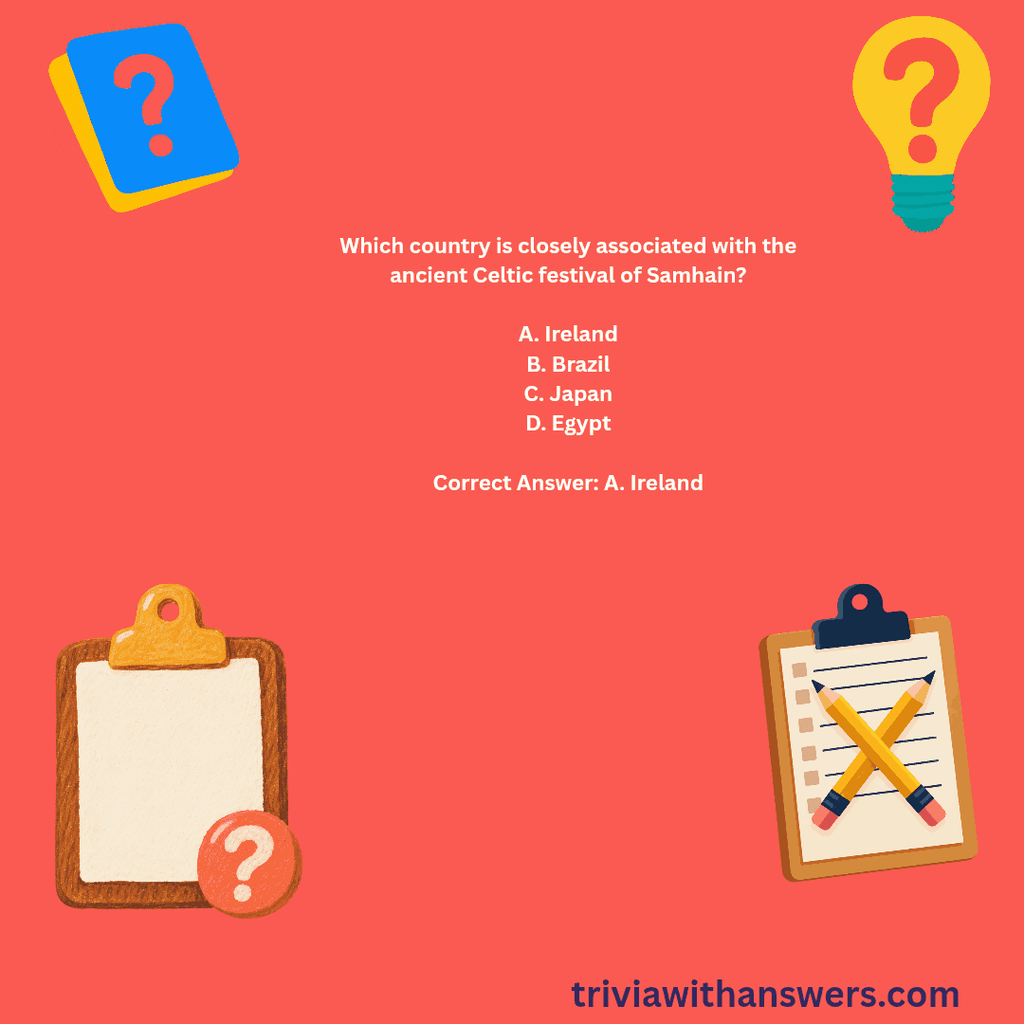
4. Which country is closely associated with the ancient Celtic festival of Samhain?A. Ireland
B. Brazil
C. Japan
D. EgyptCorrect Answer: A. Ireland
Explanation: Samhain was an important seasonal festival among Celtic communities, particularly associated with Ireland and other Celtic regions.
5. Which activity is especially associated with Halloween in modern Britain?
A. Decorating Christmas trees
B. Trick-or-treating
C. Lighting birthday candles
D. Exchanging Easter eggs
Correct Answer: B. Trick-or-treating
Explanation: Children often dress up and visit participating homes to ask for sweets and other treats.
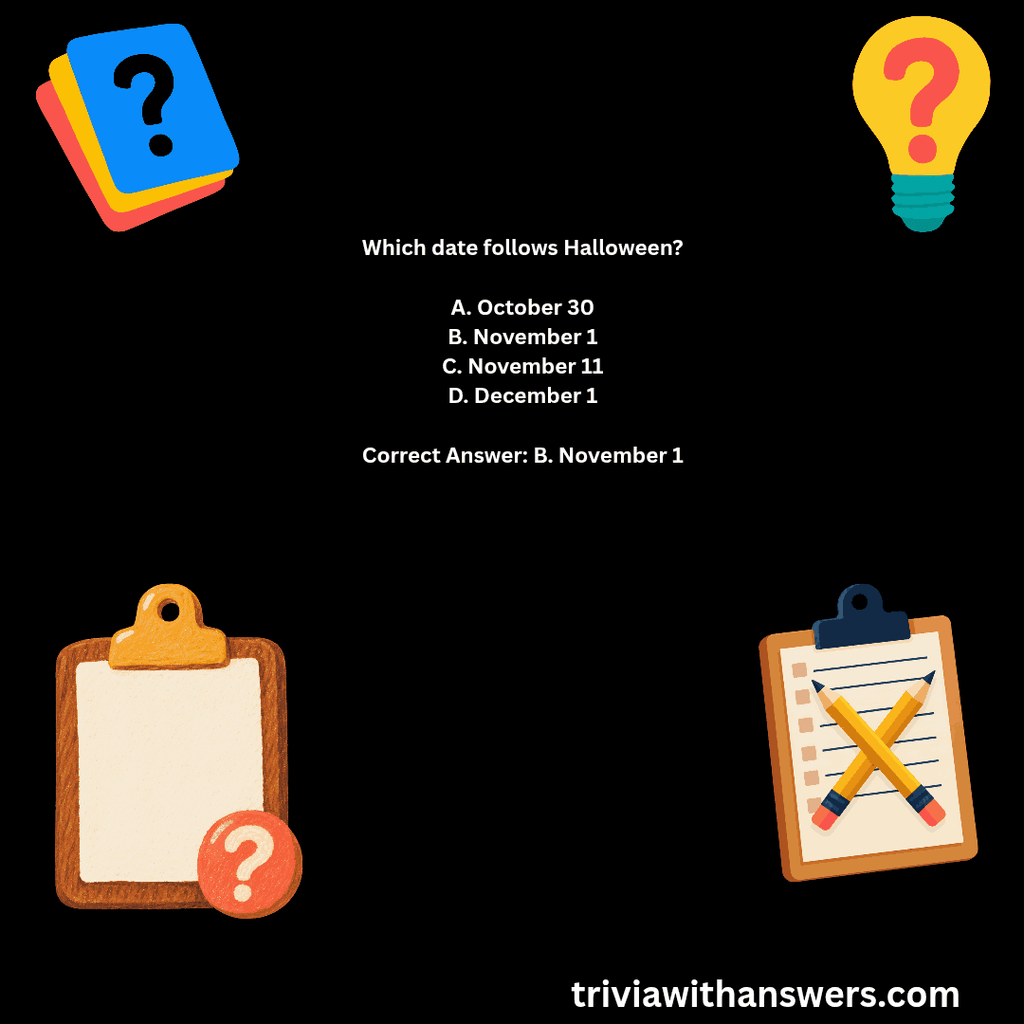
6. Which date follows Halloween?
A. October 30
B. November 1
C. November 11
D. December 1
Correct Answer: B. November 1
Explanation: November 1 is All Saints’ Day, a Christian observance that follows Halloween.
7. What do people traditionally place inside a carved pumpkin to make it glow?
A. A small light or candle
B. A flower
C. A bell
D. A mirror
Correct Answer: A. A small light or candle
Explanation: A light inside a carved pumpkin creates the familiar glowing jack-o’-lantern effect. Battery-operated lights are a safer classroom choice.
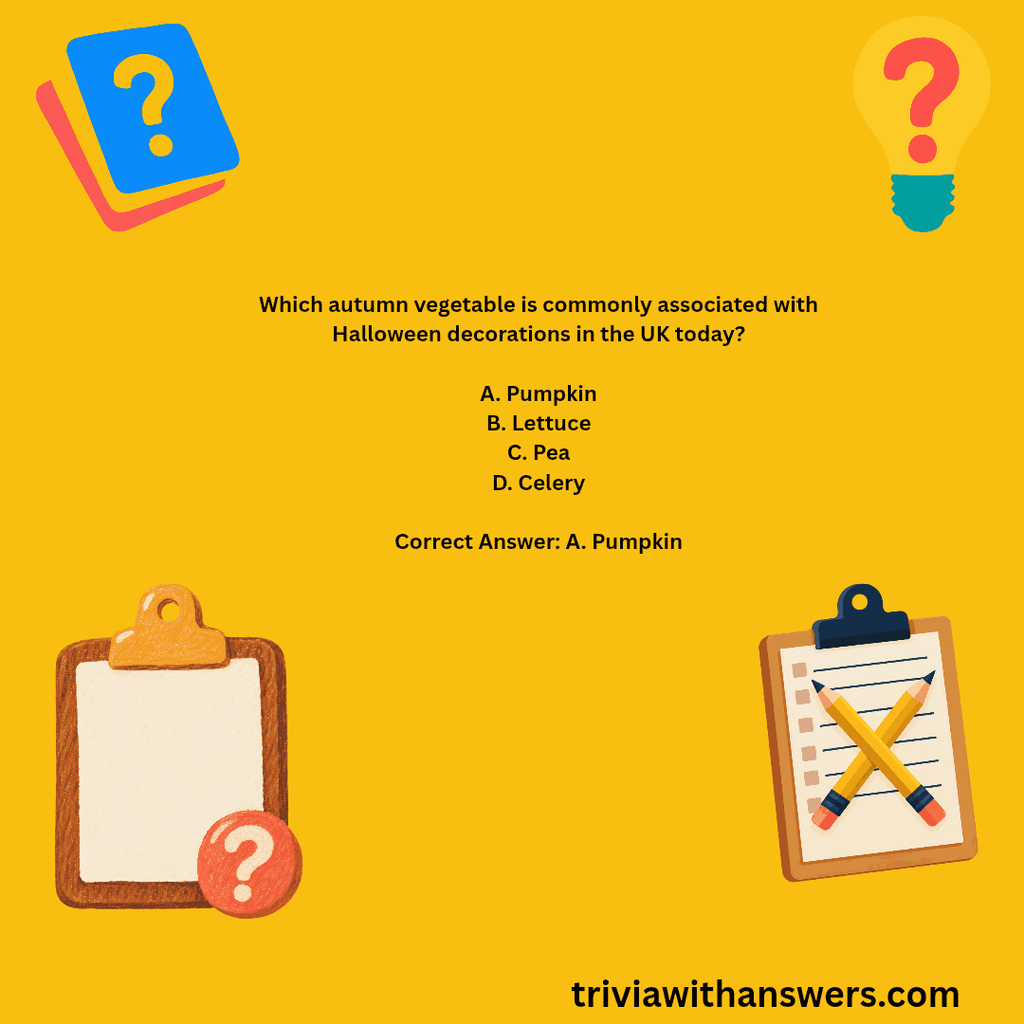
8. Which autumn vegetable is commonly associated with Halloween decorations in the UK today?
A. Pumpkin
B. Lettuce
C. Pea
D. Celery
Correct Answer: A. Pumpkin
Explanation: Pumpkins have become a popular symbol of Halloween, appearing in decorations, crafts, and seasonal displays.
9. What does the word “Samhain” refer to?
A. An ancient seasonal festival
B. A type of candy
C. A famous castle
D. A Halloween costume
Correct Answer: A. An ancient seasonal festival
Explanation: Samhain marked a seasonal transition in the Celtic calendar and influenced some later Halloween customs.
10. Which British celebration takes place on November 5?
A. May Day
B. Bonfire Night
C. Halloween
D. Boxing Day
Correct Answer: B. Bonfire Night
Explanation: Bonfire Night, also called Guy Fawkes Night, is marked by bonfires and fireworks in many parts of the UK.
11. What is a jack-o’-lantern?
A. A decorated lantern, traditionally made from a carved pumpkin
B. A type of school uniform
C. A winter hat
D. A musical instrument
Correct Answer: A. A decorated lantern, traditionally made from a carved pumpkin
Explanation: Jack-o’-lanterns are popular Halloween decorations featuring carved faces or creative designs.
12. Which creatures are commonly linked to traditional Halloween imagery?
A. Ghosts and witches
B. Dolphins and penguins
C. Kangaroos and koalas
D. Parrots and peacocks
Correct Answer: A. Ghosts and witches
Explanation: Ghosts and witches appear in folklore, stories, decorations, and many Halloween costumes.
13. Which season includes Halloween in the UK?
A. Spring
B. Summer
C. Autumn
D. Winter
Correct Answer: C. Autumn
Explanation: Halloween occurs during autumn in the Northern Hemisphere, when the weather often becomes cooler and the leaves change color.
14. What do children commonly say when visiting houses for Halloween treats?
A. Happy birthday
B. Trick or treat
C. Good morning
D. Congratulations
Correct Answer: B. Trick or treat
Explanation: “Trick or treat” is the familiar phrase used by children collecting sweets during Halloween.
15. Which item is most suitable for a safe classroom jack-o’-lantern activity?
A. A battery-powered tea light
B. An unattended open flame
C. A lit firework
D. A burning match
Correct Answer: A. A battery-powered tea light
Explanation: Battery-powered lights provide a glowing effect without the fire risk of an open flame.
Recommended: 174+ Halloween Icebreaker Quiz Questions for Work
Easy Halloween Trivia for Classroom with Answers
These easy Halloween trivia questions are perfect for younger students, beginners, and classroom warm-up activities.
They focus on familiar Halloween symbols, characters, colors, and traditions. Teachers can read the questions aloud or print them as a simple worksheet.
16. Which color is most commonly associated with Halloween pumpkins?
A. Orange
B. Blue
C. Pink
D. Silver
Correct Answer: A. Orange
Explanation: Orange is the natural color of many pumpkins and has become one of Halloween’s most recognizable colors.
17. Which character is famous for flying on a broomstick in Halloween stories?
A. Pirate
B. Witch
C. Astronaut
D. Chef
Correct Answer: B. Witch
Explanation: Witches are frequently portrayed flying on broomsticks in fairy tales and Halloween illustrations.
18. Which animal is often associated with vampires in Halloween decorations?
A. Bat
B. Cow
C. Rabbit
D. Sheep
Correct Answer: A. Bat
Explanation: Bats are nocturnal animals, making them a popular symbol in spooky Halloween scenes.
19. What do children commonly collect while trick-or-treating?
A. Homework
B. Candy
C. Schoolbooks
D. Leaves
Correct Answer: B. Candy
Explanation: Sweets and other small treats are traditionally handed out to trick-or-treaters.
20. Which Halloween character is usually wrapped in strips of cloth?
A. Mummy
B. Mermaid
C. Clown
D. Knight
Correct Answer: A. Mummy
Explanation: Mummies are commonly depicted as ancient figures wrapped in bandages.
21. Which object is often carved into a scary face for Halloween?
A. Pumpkin
B. Watermelon
C. Coconut
D. Pineapple
Correct Answer: A. Pumpkin
Explanation: Carved pumpkins are called jack-o’-lanterns and are popular Halloween decorations.
22. Which creature is traditionally said to howl at the moon?
A. Werewolf
B. Goldfish
C. Turtle
D. Parrot
Correct Answer: A. Werewolf
Explanation: Werewolves are mythical creatures that transform into wolf-like beings in legends and popular stories.
23. What do many people wear to celebrate Halloween?
A. Costumes
B. Graduation gowns only
C. Bathrobes only
D. Sports uniforms only
Correct Answer: A. Costumes
Explanation: Dressing up as spooky characters, superheroes, animals, or other imaginative figures is a popular Halloween tradition.
24. Which of these is commonly used as a Halloween decoration?
A. Spiderweb
B. Beach umbrella
C. Picnic basket
D. Snow shovel
Correct Answer: A. Spiderweb
Explanation: Artificial spiderwebs create a haunted-house atmosphere at Halloween parties and events.
25. Which word best describes a friendly Halloween ghost?
A. Spooky
B. Invisible homework
C. Delicious sandwich
D. Noisy bicycle
Correct Answer: A. Spooky
Explanation: Ghosts are commonly described as spooky characters in Halloween stories, although they can also be funny and friendly.
26. Which treat is often associated with Halloween in the United States?
A. Candy corn
B. Sushi
C. Pickled olives
D. Plain rice
Correct Answer: A. Candy corn
Explanation: Candy corn is a small, sweet confection that has become closely associated with American Halloween celebrations.
27. What is the traditional color of many skeleton decorations?
A. White
B. Bright green only
C. Orange only
D. Purple only
Correct Answer: A. White
Explanation: Skeleton decorations are often white to resemble bones, although Halloween decorations can come in many colors.
28. What is a haunted house designed to do?
A. Create a spooky experience
B. Teach swimming
C. Grow vegetables
D. Sell schoolbooks
Correct Answer: A. Create a spooky experience
Explanation: Haunted houses use decorations, sound effects, lighting, and sometimes actors to create a frightening or playful experience.
29. Which item would a vampire traditionally have in a Halloween costume?
A. Fangs
B. Flippers
C. A snorkel
D. A football helmet
Correct Answer: A. Fangs
Explanation: Pointed teeth are a familiar feature of fictional vampires.
30. What is the best description of a Halloween costume?
A. Clothing worn to dress up as a character
B. A type of school desk
C. A cooking recipe
D. A weather report
Correct Answer: A. Clothing worn to dress up as a character
Explanation: Costumes allow people to portray fictional characters, animals, historical figures, and imaginative creations.
31. Which creature is often shown with eight legs in Halloween pictures?
A. Spider
B. Bat
C. Ghost
D. Vampire
Correct Answer: A. Spider
Explanation: Spiders have eight legs and are commonly featured in Halloween decorations.
32. What is a popular Halloween activity involving apples?
A. Apple bobbing
B. Apple painting with house paint
C. Apple juggling with knives
D. Apple freezing contests only
Correct Answer: A. Apple bobbing
Explanation: In the traditional game of apple bobbing, participants try to catch floating apples using their mouths. Classroom versions should use appropriate hygiene and supervision.
33. Which shape is often used for a classic jack-o’-lantern face?
A. A smiling or frightening face
B. A road map
C. A calendar
D. A musical note
Correct Answer: A. A smiling or frightening face
Explanation: Pumpkins are carved with facial expressions ranging from friendly smiles to spooky grins.
34. Which of these is a common Halloween sound effect?
A. A ghostly howl
B. A printer warming up
C. A phone charging
D. A pencil sharpening
Correct Answer: A. A ghostly howl
Explanation: Howls, creaking doors, and eerie laughter are frequently used in Halloween decorations and haunted attractions.
35. What is the main purpose of a Halloween trivia game?
A. To test knowledge while having fun
B. To replace every school lesson
C. To make students afraid of learning
D. To stop students asking questions
Correct Answer: A. To test knowledge while having fun
Explanation: Trivia games combine learning, friendly competition, and seasonal entertainment.
Recommended: 157+ Scary Halloween Pumpkin Carving Ideas
Halloween History Trivia Questions for Classroom
Halloween has a fascinating history that connects ancient seasonal festivals, Christian observances, folk traditions, and modern celebrations. These questions help students understand how the holiday developed over time and why its customs vary between countries.
36. Which ancient Celtic festival is commonly connected with the origins of Halloween?
A. Samhain
B. Saturnalia
C. Holi
D. Hanami
Correct Answer: A. Samhain
Explanation: Samhain marked the transition into the darker part of the year in the Celtic seasonal calendar and is commonly discussed in histories of Halloween.
37. What does the name Halloween derive from?
A. All Hallows’ Eve
B. Harvest Moon Day
C. Winter Morning
D. Pumpkin Sunday
Correct Answer: A. All Hallows’ Eve
Explanation: Halloween is a shortened form of All Hallows’ Eve, the evening before All Saints’ Day.
38. Which Christian observance occurs on November 1?
A. All Saints’ Day
B. Good Friday
C. Palm Sunday
D. Epiphany Eve
Correct Answer: A. All Saints’ Day
Explanation: All Saints’ Day honors saints and is observed on November 1 in many Christian traditions.
39. Which country is particularly associated with the development of the modern American Halloween celebration through immigration and cultural exchange?
A. Ireland
B. Thailand
C. Peru
D. Mongolia
Correct Answer: A. Ireland
Explanation: Irish immigrants brought Halloween customs to North America, where traditions developed and changed over time.
40. Before pumpkins became widely used in American Halloween traditions, what were sometimes carved into lanterns in Ireland and Britain?
A. Turnips
B. Bananas
C. Peaches
D. Grapes
Correct Answer: A. Turnips
Explanation: In some older traditions, people carved turnips or similar root vegetables to create lanterns.
41. Which event helped Halloween become a large community celebration in the United States during the twentieth century?
A. The spread of neighborhood parties and trick-or-treating
B. The invention of the telephone alone
C. The introduction of school uniforms
D. The first Olympic Games
Correct Answer: A. The spread of neighborhood parties and trick-or-treating
Explanation: Community events, costumes, and organized trick-or-treating helped shape the modern holiday.
42. What was one purpose of some older seasonal customs associated with Halloween?
A. Marking the transition between seasons
B. Celebrating the start of summer vacation
C. Welcoming the first day of spring
D. Beginning the school year
Correct Answer: A. Marking the transition between seasons
Explanation: Samhain was associated with the end of the harvest season and the beginning of winter in the Celtic calendar.
43. Which statement about Halloween history is most accurate?
A. It developed from several traditions over time
B. It was invented entirely by one modern candy company
C. It has always been celebrated in exactly the same way
D. It began as a twentieth-century school subject
Correct Answer: A. It developed from several traditions over time
Explanation: Halloween reflects a mixture of religious observances, regional folklore, immigration, commercial influences, and modern entertainment.
44. Which holiday is celebrated on October 31?
A. Halloween
B. Thanksgiving in the United States
C. New Year’s Day
D. Valentine’s Day
Correct Answer: A. Halloween
Explanation: Halloween is observed on October 31 every year.
45. Which of these is an example of a traditional Halloween activity?
A. Wearing costumes
B. Decorating a Christmas tree
C. Hunting for Easter eggs
D. Lighting a birthday cake
Correct Answer: A. Wearing costumes
Explanation: Costumes are one of the most recognizable features of Halloween in many countries.
46. What is folklore?
A. Traditional stories, customs, and beliefs passed between people
B. A type of laboratory equipment
C. A mathematical formula
D. A modern computer program
Correct Answer: A. Traditional stories, customs, and beliefs passed between people
Explanation: Folklore includes legends, ghost stories, seasonal customs, and traditional explanations of mysterious events.
47. Which topic would best fit a classroom lesson about Halloween history?
A. How Halloween customs changed across generations
B. How to repair a bicycle chain
C. How to calculate a building’s height only
D. How to grow tropical coral
Correct Answer: A. How Halloween customs changed across generations
Explanation: Comparing past and present traditions helps students understand cultural change.
48. Why did pumpkins become popular Halloween lanterns in North America?
A. Pumpkins were widely available and practical for carving
B. Pumpkins were invented specifically for Halloween
C. Pumpkins naturally produce electric light
D. Pumpkins were originally made from paper
Correct Answer: A. Pumpkins were widely available and practical for carving
Explanation: Pumpkins were abundant in North America and generally larger and easier to carve than many traditional root vegetables.
49. Which statement best describes the modern Halloween celebration?
A. It includes a variety of cultural, family, and community activities
B. Everyone celebrates it in exactly the same way
C. It is only a holiday for professional actors
D. It is celebrated only inside schools
Correct Answer: A. It includes a variety of cultural, family, and community activities
Explanation: Modern Halloween may include costumes, parties, trick-or-treating, crafts, festivals, and other local activities.
50. Why is it useful to study the history of Halloween in school?
A. It helps students explore traditions and cultural change
B. It teaches that every country has identical customs
C. It removes the need to study history
D. It proves every ghost story is true
Correct Answer: A. It helps students explore traditions and cultural change
Explanation: Seasonal celebrations provide examples of how beliefs and customs develop and spread.
Recommended: 137+ Funny Horror Movie Jokes
Halloween Trivia for Elementary Students
These questions are designed for elementary classrooms where students benefit from short questions, familiar examples, and clear explanations. Teachers can use them for small-group challenges, reading comprehension, or a Halloween quiz competition.
51. Which fruit is commonly used in the traditional game of apple bobbing?
A. Apple
B. Mango
C. Lemon
D. Pineapple
Correct Answer: A. Apple
Explanation: Apples float in water, which makes them suitable for this traditional Halloween game.
52. Which of these creatures is a mammal that can fly?
A. Bat
B. Spider
C. Butterfly
D. Dragonfly
Correct Answer: A. Bat
Explanation: Bats are mammals and the only mammals capable of sustained powered flight.
53. Which animal is often associated with witches in fairy tales?
A. Black cat
B. Goldfish
C. Dolphin
D. Camel
Correct Answer: A. Black cat
Explanation: Black cats have appeared in European folklore and Halloween imagery, although they are ordinary domestic animals and not unlucky.
54. Which sense do you use to hear a spooky sound?
A. Hearing
B. Taste
C. Smell
D. Touch
Correct Answer: A. Hearing
Explanation: Hearing allows us to detect sounds such as howling wind, creaking doors, and Halloween music.
55. What should students do before eating Halloween treats distributed at school?
A. Follow school safety rules and check with a trusted adult
B. Eat everything without checking
C. Share food without considering allergies
D. Hide all ingredient labels
Correct Answer: A. Follow school safety rules and check with a trusted adult
Explanation: Checking treats and considering food allergies helps make classroom celebrations safer.
56. Which material is commonly used to make a simple ghost craft?
A. White paper or fabric
B. Wet cement
C. Broken glass
D. Sharp metal scraps
Correct Answer: A. White paper or fabric
Explanation: White paper, tissue, and fabric are useful materials for making simple ghost decorations.
57. Which object is useful for safely carrying Halloween treats?
A. A treat bag
B. An open glass container
C. A sharp-edged metal tray
D. A lit candle holder
Correct Answer: A. A treat bag
Explanation: A sturdy treat bag is convenient for collecting candy and other small items.
58. Which shape is commonly associated with a spiderweb?
A. A web with connected lines
B. A perfect solid cube
C. A single straight line
D. A flat circle with no markings
Correct Answer: A. A web with connected lines
Explanation: Spiderwebs often contain radial lines and connecting strands that create a recognizable web pattern.
59. Which of these is a good Halloween classroom activity?
A. A themed trivia competition
B. Running through dark hallways
C. Throwing sharp objects
D. Playing with open flames
Correct Answer: A. A themed trivia competition
Explanation: A trivia competition encourages participation and learning while keeping the activity organized.
60. What can students learn from Halloween costume design?
A. Creativity and problem-solving
B. How to ignore every instruction
C. How to damage classroom furniture
D. How to avoid working together
Correct Answer: A. Creativity and problem-solving
Explanation: Designing a costume can involve planning, selecting materials, and finding creative solutions.
61. Which object is commonly used to decorate a haunted-house display?
A. Artificial cobwebs
B. A classroom timetable only
C. A garden hose only
D. A cooking spoon only
Correct Answer: A. Artificial cobwebs
Explanation: Artificial cobwebs are inexpensive decorations that create a spooky atmosphere.
62. Which of these is a mythical creature?
A. Werewolf
B. House sparrow
C. Domestic rabbit
D. Honeybee
Correct Answer: A. Werewolf
Explanation: Werewolves are legendary beings that appear in stories and popular culture.
63. What does the word “costume” mean?
A. Special clothing used to represent a character or theme
B. A type of classroom test
C. A weather forecast
D. A musical note
Correct Answer: A. Special clothing used to represent a character or theme
Explanation: Costumes are worn for celebrations, performances, festivals, and imaginative play.
64. Which activity helps students practice teamwork during Halloween trivia?
A. Working together in quiz teams
B. Refusing to listen to teammates
C. Keeping every question secret from the team
D. Preventing classmates from participating
Correct Answer: A. Working together in quiz teams
Explanation: Team quizzes encourage discussion, cooperation, and shared problem-solving.
65. Which item should be avoided when making a Halloween craft with young children?
A. Sharp tools without proper adult supervision
B. Colored paper
C. Washable markers
D. Glue sticks suitable for children
Correct Answer: A. Sharp tools without proper adult supervision
Explanation: Age-appropriate materials and adult supervision help reduce the risk of injuries during craft activities.
Recommended: 123+ Halloween Knock Knock Jokes
Halloween Trivia for Middle School Students
Middle school students may enjoy questions that require a little more reasoning and general knowledge. This section explores folklore, animals, science, literature, and Halloween traditions while maintaining a fun multiple-choice format.
66. Why are bats frequently associated with Halloween?
A. They are nocturnal animals often seen in spooky stories
B. They are the only animals that live underground
C. They can change into ghosts
D. They naturally glow orange
Correct Answer: A. They are nocturnal animals often seen in spooky stories
Explanation: Many bat species are active at night, which contributes to their association with nighttime imagery.
67. Which scientific field studies spiders?
A. Arachnology
B. Astronomy
C. Botany
D. Geology
Correct Answer: A. Arachnology
Explanation: Arachnology is the study of arachnids, including spiders, scorpions, and related animals.
68. What is the name of the process by which a pumpkin plant produces seeds inside its fruit?
A. Plant reproduction
B. Metal casting
C. Evaporation only
D. Rock formation
Correct Answer: A. Plant reproduction
Explanation: Pumpkin plants reproduce through flowers, pollination, and the development of fruits containing seeds.
69. Which term describes an animal that is most active at night?
A. Nocturnal
B. Aquatic
C. Domestic
D. Herbaceous
Correct Answer: A. Nocturnal
Explanation: Nocturnal animals, such as many bats, are primarily active during nighttime hours.
70. Which part of a pumpkin is commonly removed when carving a jack-o’-lantern?
A. Seeds and stringy pulp
B. The entire root system
C. Its leaves from the vine
D. Its flowers before growth
Correct Answer: A. Seeds and stringy pulp
Explanation: Carvers typically remove the seeds and pulp to create space for the design and light source.
71. Which word means a traditional story that may explain a belief or cultural practice?
A. Legend
B. Calculator
C. Thermometer
D. Blueprint
Correct Answer: A. Legend
Explanation: Legends are traditional narratives that may feature historical figures, extraordinary events, or supernatural elements.
72. Which of these animals is not an insect?
A. Spider
B. Ant
C. Beetle
D. Moth
Correct Answer: A. Spider
Explanation: Spiders are arachnids with eight legs, while insects typically have six legs.
73. Which scientific explanation best describes why a carved pumpkin eventually decays?
A. Microorganisms and natural processes break down its tissues
B. The pumpkin turns into stone
C. It absorbs moonlight and disappears
D. Its seeds become metal
Correct Answer: A. Microorganisms and natural processes break down its tissues
Explanation: Fungi, bacteria, moisture, and other natural processes contribute to the decomposition of plant material.
74. Which of these is an example of a fictional supernatural character?
A. Vampire
B. Botanist
C. Pilot
D. Architect
Correct Answer: A. Vampire
Explanation: Vampires are legendary figures commonly portrayed in folklore, literature, and films.
75. What is the purpose of a metaphor in a Halloween story?
A. To describe one thing in terms of another
B. To list only mathematical answers
C. To remove all descriptive language
D. To provide a weather measurement
Correct Answer: A. To describe one thing in terms of another
Explanation: Metaphors create vivid descriptions, such as comparing a dark forest to a sea of shadows.
76. Which word best describes a setting filled with mystery and fear?
A. Eerie
B. Ordinary
C. Sunny
D. Routine
Correct Answer: A. Eerie
Explanation: “Eerie” describes something strange, unsettling, or mysteriously frightening.
77. Which of these is a renewable natural material used in some Halloween crafts?
A. Fallen leaves
B. Plastic from a new bottle only
C. Concrete dust
D. Steel wire only
Correct Answer: A. Fallen leaves
Explanation: Fallen leaves can be collected responsibly and used for seasonal decorations or art projects.
78. Why should Halloween decorations not block classroom exits?
A. Clear exits are important for emergency evacuation
B. Decorations must cover every doorway
C. Students should never leave the room
D. Exits are only for decoration
Correct Answer: A. Clear exits are important for emergency evacuation
Explanation: Keeping doors, hallways, and emergency routes clear is an important classroom safety practice.
79. Which type of story often includes haunted houses and supernatural events?
A. Gothic fiction
B. A shopping receipt
C. A road manual
D. A basic timetable
Correct Answer: A. Gothic fiction
Explanation: Gothic fiction often features dark settings, mystery, suspense, and supernatural or frightening elements.
80. Which skill can students develop by explaining their trivia answers?
A. Reasoning and communication
B. Avoiding evidence
C. Ignoring instructions
D. Memorizing without understanding anything
Correct Answer: A. Reasoning and communication
Explanation: Explaining an answer encourages students to connect facts, organize thoughts, and communicate clearly.
Recommended: 154+ Fun Halloween Candy Quiz Questions and Answers
Halloween Trivia for High School Students
These questions are suitable for older students who enjoy a deeper challenge. They cover cultural history, literary traditions, language, biology, and critical thinking.
Teachers can use them for advanced teams, bonus rounds, or end-of-class competitions.
81. Which literary author wrote the short story “The Legend of Sleepy Hollow”?
A. Washington Irving
B. Charles Dickens
C. Mark Twain
D. Jane Austen
Correct Answer: A. Washington Irving
Explanation: Washington Irving wrote the famous tale featuring the mysterious Headless Horseman.
82. Which author wrote the novel Frankenstein?
A. Mary Shelley
B. Emily Brontë
C. Virginia Woolf
D. Louisa May Alcott
Correct Answer: A. Mary Shelley
Explanation: Mary Shelley published Frankenstein; or, The Modern Prometheus in 1818. The novel explores scientific ambition, responsibility, and isolation.
83. Which literary genre is especially associated with suspense, dread, and supernatural threats?
A. Horror
B. Travel writing
C. Instruction manuals
D. Gardening guides
Correct Answer: A. Horror
Explanation: Horror is designed to create fear, suspense, unease, or shock in an audience.
84. What does the term “supernatural” generally describe?
A. Events or beings beyond ordinary natural explanation
B. Ordinary arithmetic
C. A common school timetable
D. A basic cooking technique
Correct Answer: A. Events or beings beyond ordinary natural explanation
Explanation: Supernatural stories may include ghosts, magical powers, spirits, and unexplained phenomena.
85. Which of these is a real biological process rather than a supernatural event?
A. Decomposition
B. A ghost passing through a wall
C. A vampire living forever
D. A werewolf transforming by magic
Correct Answer: A. Decomposition
Explanation: Decomposition is the natural breakdown of organic material by microorganisms and other processes.
86. What is the main purpose of suspense in a horror story?
A. To create anticipation and uncertainty
B. To reveal every event immediately
C. To remove all conflict
D. To replace the characters with equations
Correct Answer: A. To create anticipation and uncertainty
Explanation: Suspense encourages readers to wonder what will happen next and whether characters are in danger.
87. Which statement about folklore is correct?
A. It can change as stories are passed between generations
B. It never changes across time
C. It consists only of scientific experiments
D. It contains no cultural information
Correct Answer: A. It can change as stories are passed between generations
Explanation: Folklore changes as communities adapt stories and customs to new circumstances.
88. Which of these is a common feature of Gothic literature?
A. Dark settings and mysterious events
B. Instructions for operating a printer
C. Lists of grocery prices only
D. Mathematical tables without characters
Correct Answer: A. Dark settings and mysterious events
Explanation: Gothic literature often uses gloomy locations, secrets, suspense, and intense emotions.
89. What is a common theme in stories about Frankenstein’s creature?
A. Responsibility for scientific creations
B. The importance of learning to surf
C. The history of train tickets
D. The design of school lockers
Correct Answer: A. Responsibility for scientific creations
Explanation: Mary Shelley’s novel raises questions about ambition, ethics, rejection, and the consequences of creation.
90. Which term describes a word or phrase that imitates a sound?
A. Onomatopoeia
B. Metaphor
C. Hyperbole
D. Alliteration
Correct Answer: A. Onomatopoeia
Explanation: Words such as “creak,” “buzz,” and “bang” imitate sounds and can make Halloween stories more vivid.
91. What is alliteration?
A. Repetition of similar initial consonant sounds
B. A comparison using “like” or “as”
C. A story with no characters
D. A method of measuring temperature
Correct Answer: A. Repetition of similar initial consonant sounds
Explanation: Phrases such as “spooky spiders spin” use alliteration to create rhythm and emphasis.
92. Which author created the fictional detective Sherlock Holmes?
A. Arthur Conan Doyle
B. H. G. Wells
C. Lewis Carroll
D. J. R. R. Tolkien
Correct Answer: A. Arthur Conan Doyle
Explanation: Although Sherlock Holmes is not a Halloween character, mysteries involving the detective can make a useful comparison with suspenseful storytelling.
93. What is an unreliable narrator?
A. A storyteller whose account may not be fully trustworthy
B. A narrator who always tells the truth
C. A character who never speaks
D. A reader who skips the ending
Correct Answer: A. A storyteller whose account may not be fully trustworthy
Explanation: Unreliable narrators can create uncertainty and suspense, techniques often used in mystery and horror fiction.
94. Which statement best describes critical thinking during a trivia quiz?
A. Evaluating information before choosing an answer
B. Selecting every answer randomly
C. Ignoring the question
D. Copying a teammate without discussion
Correct Answer: A. Evaluating information before choosing an answer
Explanation: Critical thinking involves examining evidence, comparing options, and making reasoned decisions.
95. Why can studying horror stories be useful in a literature class?
A. It helps students analyze mood, imagery, symbolism, and suspense
B. It eliminates the need to read
C. It proves supernatural events are real
D. It prevents discussion of writing techniques
Correct Answer: A. It helps students analyze mood, imagery, symbolism, and suspense
Explanation: Horror stories offer opportunities to examine literary devices and the ways authors influence readers’ emotions.
Halloween Movie and Character Trivia for Classroom
Movies, television shows, and animated stories have introduced generations of audiences to memorable Halloween characters. These multiple-choice questions focus on recognizable fictional characters and family-friendly screen entertainment.
96. Which character is the main monster in the classic film Frankenstein?
A. Frankenstein’s creature
B. Peter Pan
C. Robin Hood
D. Pinocchio
Correct Answer: A. Frankenstein’s creature
Explanation: The creature created by Victor Frankenstein is commonly called Frankenstein’s monster in popular culture.
97. Which film features a character named Jack Skellington?
A. The Nightmare Before Christmas
B. Finding Nemo
C. Toy Story
D. The Lion King
Correct Answer: A. The Nightmare Before Christmas
Explanation: Jack Skellington is the Pumpkin King of Halloween Town in the stop-motion fantasy film.
98. Which fictional character is a famous vampire from literature and film?
A. Dracula
B. Sherlock Holmes
C. Peter Rabbit
D. Winnie-the-Pooh
Correct Answer: A. Dracula
Explanation: Dracula is the central vampire character in Bram Stoker’s 1897 novel of the same name.
99. Which animated family is known for its spooky and unusual lifestyle?
A. The Addams Family
B. The Peanuts gang
C. The Jetsons
D. The Flintstones
Correct Answer: A. The Addams Family
Explanation: The Addams Family is a fictional family known for its dark humor and macabre interests.
100. Which character is famous for a headless appearance in an American legend?
A. The Headless Horseman
B. Peter Pan
C. The Mad Hatter
D. Captain Hook
Correct Answer: A. The Headless Horseman
Explanation: The Headless Horseman appears in Washington Irving’s story “The Legend of Sleepy Hollow.”
101. Which character is associated with the Harry Potter series and is a ghost at Hogwarts?
A. Nearly Headless Nick
B. Hagrid’s dragon
C. Hedwig
D. Dobby’s sock
Correct Answer: A. Nearly Headless Nick
Explanation: Nearly Headless Nick is the nickname of Sir Nicholas de Mimsy-Porpington, a ghost in the Harry Potter stories.
102. Which fictional character is a wooden puppet who wants to become a real boy?
A. Pinocchio
B. Dracula
C. Shrek
D. Tarzan
Correct Answer: A. Pinocchio
Explanation: Pinocchio is a well-known fictional puppet whose story has been adapted into many films and performances.
103. Which character is commonly depicted as a friendly ghost in children’s entertainment?
A. Casper
B. Darth Vader
C. Captain Ahab
D. King Kong
Correct Answer: A. Casper
Explanation: Casper is a friendly ghost character known from cartoons, comics, and films.
104. Which animated film features a family of monsters who run a hotel?
A. Hotel Transylvania
B. Cars
C. Ratatouille
D. Up
Correct Answer: A. Hotel Transylvania
Explanation: The animated comedy follows Dracula and a hotel designed for monsters and supernatural guests.
105. Which character is known for wearing a striped shirt and a red-and-white striped hat in a popular children’s book?
A. The Cat in the Hat
B. The Little Mermaid
C. The BFG
D. Paddington Bear
Correct Answer: A. The Cat in the Hat
Explanation: The Cat in the Hat is a well-known character created by Dr. Seuss, although he is not specifically a Halloween character.
106. Which movie series features a young wizard attending Hogwarts School of Witchcraft and Wizardry?
A. Harry Potter
B. Star Wars
C. Jurassic Park
D. The Hunger Games
Correct Answer: A. Harry Potter
Explanation: The Harry Potter series features magic, spells, magical creatures, and a school for young witches and wizards.
107. Which character is associated with a magical lamp in a famous folk tale?
A. Aladdin
B. Dracula
C. The Headless Horseman
D. Frankenstein’s creature
Correct Answer: A. Aladdin
Explanation: Aladdin’s story features a magical lamp and a genie, elements often associated with fantasy storytelling.
108. Which movie is about a family of superheroes with extraordinary powers?
A. The Incredibles
B. Coco
C. Bambi
D. The Jungle Book
Correct Answer: A. The Incredibles
Explanation: The animated film follows a family with superpowers. Students may enjoy comparing superhero costumes with Halloween dress-up traditions.
109. Which fictional character is a famous detective who lives at 221B Baker Street?
A. Sherlock Holmes
B. Dracula
C. Jack Skellington
D. Casper
Correct Answer: A. Sherlock Holmes
Explanation: Sherlock Holmes is the detective created by Arthur Conan Doyle, and his London address is a well-known part of the stories.
110. Which film is especially known for its magical chocolate factory?
A. Charlie and the Chocolate Factory
B. The Wizard of Oz
C. Frozen
D. Finding Dory
Correct Answer: A. Charlie and the Chocolate Factory
Explanation: The story features Willy Wonka’s extraordinary chocolate factory and imaginative sweets, making it a fun connection to Halloween candy trivia.
Halloween Science and Nature Trivia
Halloween offers an excellent opportunity to connect seasonal fun with real science. Students can learn about nocturnal animals, pumpkins, spiders, sound, and the natural processes that make autumn interesting.
111. How many legs does a typical spider have?
A. Six
B. Eight
C. Ten
D. Twelve
Correct Answer: B. Eight
Explanation: Spiders are arachnids and have eight legs, unlike insects, which generally have six.
112. What type of animal is a bat?
A. Mammal
B. Reptile
C. Amphibian
D. Fish
Correct Answer: A. Mammal
Explanation: Bats have fur, give birth to live young, and feed their young with milk.
113. Which part of a pumpkin contains many of its seeds?
A. The inside of the fruit
B. The outer stem only
C. The leaves
D. The roots
Correct Answer: A. The inside of the fruit
Explanation: Pumpkin seeds develop inside the fruit after successful pollination and fertilization.
114. What is pollination?
A. The transfer of pollen between flower parts
B. The breakdown of rocks
C. The freezing of water
D. The movement of clouds
Correct Answer: A. The transfer of pollen between flower parts
Explanation: Pollination is an important stage in plant reproduction and helps many plants produce seeds and fruit.
115. Why do some leaves change color in autumn?
A. Changes in pigments become visible as chlorophyll breaks down
B. Every leaf is painted by insects
C. Leaves absorb artificial Halloween lights
D. All leaves turn black overnight
Correct Answer: A. Changes in pigments become visible as chlorophyll breaks down
Explanation: As days become shorter and temperatures change, chlorophyll breaks down, allowing yellow and orange pigments to become more visible.
116. Which of these animals is commonly active at night?
A. Many species of bats
B. Every butterfly
C. All domestic chickens
D. Every garden snail only during daylight
Correct Answer: A. Many species of bats
Explanation: Many bats are nocturnal and search for food after sunset, although activity patterns vary by species.
117. What causes the sound of thunder?
A. Rapid heating and expansion of air caused by lightning
B. A giant opening a door
C. The moon hitting the clouds
D. Leaves turning orange
Correct Answer: A. Rapid heating and expansion of air caused by lightning
Explanation: Lightning heats the surrounding air rapidly, causing expansion that produces thunder.
118. Which process describes liquid water changing into water vapor?
A. Evaporation
B. Condensation
C. Freezing
D. Melting
Correct Answer: A. Evaporation
Explanation: Evaporation occurs when liquid water changes into a gas, often because of heat.
119. Which natural process turns fallen leaves into simpler materials?
A. Decomposition
B. Photosynthesis alone
C. Pollination
D. Magnetism
Correct Answer: A. Decomposition
Explanation: Decomposers such as fungi and bacteria break down fallen leaves and return nutrients to the soil.
120. Which statement about black cats is scientifically correct?
A. They are ordinary domestic cats with dark-colored fur
B. They can predict every future event
C. They can become invisible at midnight
D. They have supernatural powers
Correct Answer: A. They are ordinary domestic cats with dark-colored fur
Explanation: The association between black cats and bad luck comes from folklore, not scientific evidence.
121. Which sense helps bats detect echoes in a process called echolocation?
A. Hearing
B. Taste
C. Smell alone
D. Touch alone
Correct Answer: A. Hearing
Explanation: Many bats emit sounds and use returning echoes to help locate objects and prey.
122. What is the main function of seeds in plants?
A. To develop into new plants under suitable conditions
B. To produce artificial light
C. To turn soil into metal
D. To make clouds disappear
Correct Answer: A. To develop into new plants under suitable conditions
Explanation: Seeds contain an embryo and stored resources that support the beginning of a new plant’s life.
123. Which type of material is a pumpkin?
A. Plant material
B. Metal
C. Glass
D. Ceramic
Correct Answer: A. Plant material
Explanation: Pumpkins are fruits produced by flowering plants and belong to the squash family.
124. Why should students avoid touching unfamiliar spiders during Halloween activities?
A. Some species may bite, and identification can be difficult
B. Every spider is poisonous
C. Spiders can turn into ghosts
D. All spiders are made of plastic
Correct Answer: A. Some species may bite, and identification can be difficult
Explanation: Most spiders are not dangerous to humans, but students should observe wildlife carefully and avoid handling unknown species.
125. Which tool is most useful for observing small details of an insect or spider?
A. Magnifying glass
B. Frying pan
C. Paint roller
D. Garden shovel
Correct Answer: A. Magnifying glass
Explanation: A magnifying glass enlarges nearby objects, making it easier to observe small features.
Halloween Vocabulary Trivia for Classroom
Vocabulary trivia helps students develop language skills while exploring seasonal words. These questions are useful for spelling lessons, reading activities, vocabulary worksheets, and classroom word games.
126. What does the word “haunted” usually mean in a Halloween story?
A. Believed to be visited by ghosts or spirits
B. Recently painted
C. Filled with fresh fruit
D. Covered in snow
Correct Answer: A. Believed to be visited by ghosts or spirits
Explanation: Haunted places are often portrayed as locations where supernatural events occur.
127. What does “eerie” mean?
A. Strange and unsettling
B. Bright and ordinary
C. Delicious and sweet
D. Extremely tidy
Correct Answer: A. Strange and unsettling
Explanation: “Eerie” describes something that creates a feeling of mystery or unease.
128. Which word is a synonym for “frightened”?
A. Scared
B. Excited
C. Relaxed
D. Curious
Correct Answer: A. Scared
Explanation: “Scared” and “frightened” both describe feeling fear.
129. Which word is closest in meaning to “enormous”?
A. Huge
B. Tiny
C. Narrow
D. Brief
Correct Answer: A. Huge
Explanation: “Enormous” means extremely large, making it useful for describing a giant monster in a story.
130. What is a “cauldron”?
A. A large pot used in traditional depictions of witches
B. A type of flying bird
C. A small musical instrument
D. A winter coat
Correct Answer: A. A large pot used in traditional depictions of witches
Explanation: Witches are often illustrated stirring bubbling potions in cauldrons.
131. Which word describes something that cannot easily be seen?
A. Invisible
B. Colorful
C. Noisy
D. Heavy
Correct Answer: A. Invisible
Explanation: Invisible objects cannot be seen with ordinary vision, a common idea in ghost stories.
132. What is a “legend”?
A. A traditional story passed down through generations
B. A school timetable
C. A scientific measuring tool
D. A type of vegetable
Correct Answer: A. A traditional story passed down through generations
Explanation: Legends often feature extraordinary characters, historical settings, or mysterious events.
133. Which word describes a person who tells a story?
A. Narrator
B. Carpenter
C. Pilot
D. Gardener
Correct Answer: A. Narrator
Explanation: A narrator communicates the events of a story to the reader or audience.
134. What does “mysterious” mean?
A. Difficult to explain or understand
B. Completely ordinary and obvious
C. Easy to measure
D. Brightly colored
Correct Answer: A. Difficult to explain or understand
Explanation: A mysterious event leaves questions unanswered or creates curiosity.
135. Which word is an antonym of “brave”?
A. Fearful
B. Courageous
C. Bold
D. Daring
Correct Answer: A. Fearful
Explanation: “Fearful” contrasts with “brave,” which describes someone who faces danger or difficulty with courage.
Halloween Riddles and Bonus Trivia for Students
This bonus round combines general Halloween knowledge with riddles and simple reasoning questions. It works well as a final classroom challenge after students have completed the main multiple-choice quiz.
136. Which Halloween character has no physical body in many traditional stories?
A. Ghost
B. Pumpkin
C. Scarecrow
D. Pirate
Correct Answer: A. Ghost
Explanation: Ghosts are usually depicted as spirits rather than living physical beings.
137. What becomes smaller as it is used to light a room and eventually burns away?
A. Candle
B. Pumpkin
C. Spiderweb
D. Costume
Correct Answer: A. Candle
Explanation: A burning candle gradually consumes its wax and wick. In classrooms, battery-powered candles are a safer alternative.
138. Which item can be both a Halloween decoration and a source of seeds for gardening?
A. Pumpkin
B. Plastic mask
C. Paper hat
D. Glass bottle
Correct Answer: A. Pumpkin
Explanation: Pumpkins are fruits containing seeds that can be saved and planted under suitable conditions.
139. Which Halloween character is traditionally associated with a broomstick?
A. Witch
B. Mermaid
C. Astronaut
D. Lifeguard
Correct Answer: A. Witch
Explanation: Broomsticks are a familiar part of witch imagery in folklore and popular culture.
140. Which word completes the common Halloween expression “trick or ___”?
A. Treat
B. Train
C. Tree
D. Treasure
Correct Answer: A. Treat
Explanation: “Trick or treat” is the familiar phrase associated with collecting Halloween sweets.
141. What is a group of people wearing costumes and walking together on a route called?
A. Parade
B. Laboratory
C. Library
D. Greenhouse
Correct Answer: A. Parade
Explanation: Halloween parades allow participants to display costumes and celebrate together.
142. Which item would be most helpful for identifying the correct answer in a classroom trivia contest?
A. Reliable information
B. A random guess every time
C. An unrelated picture
D. An empty notebook
Correct Answer: A. Reliable information
Explanation: Accurate information and careful reasoning help students answer trivia questions correctly.
143. Which Halloween decoration is often shaped like a human skeleton?
A. A plastic or paper bone figure
B. A flowerpot
C. A basketball
D. A pencil case
Correct Answer: A. A plastic or paper bone figure
Explanation: Skeleton decorations are common Halloween symbols and can be used in age-appropriate science activities about the human body.
144. Which activity is best for students who prefer drawing to speaking during a Halloween quiz?
A. Drawing a picture that represents a quiz answer
B. Shouting over every classmate
C. Refusing to participate
D. Removing all classroom materials
Correct Answer: A. Drawing a picture that represents a quiz answer
Explanation: Drawing provides another way for students to demonstrate understanding and participate creatively.
145. What should a student do if two multiple-choice answers seem correct?
A. Read the question carefully and compare the choices
B. Stop reading the question
C. Choose the longest option automatically
D. Ignore the instructions
Correct Answer: A. Read the question carefully and compare the choices
Explanation: Looking closely at the wording and eliminating incorrect options can help students make a more informed decision.
146. Which of these is a good way to celebrate Halloween while respecting different cultural preferences?
A. Offer optional, inclusive activities
B. Require every student to wear a costume
C. Make fun of students who do not participate
D. Assume everyone celebrates Halloween
Correct Answer: A. Offer optional, inclusive activities
Explanation: Inclusive classroom planning respects different beliefs, comfort levels, and family traditions.
147. What is the best reason to explain answers after a trivia question?
A. Students can understand why the answer is correct
B. The quiz should become longer without purpose
C. Students should avoid learning facts
D. The correct answer should remain a secret forever
Correct Answer: A. Students can understand why the answer is correct
Explanation: Brief explanations turn a quiz into a learning activity rather than simply a competition.
148. Which object is commonly used to represent a haunted castle in a classroom drawing?
A. Towers and dark windows
B. A sunny beach umbrella
C. A grocery receipt
D. A school lunch tray
Correct Answer: A. Towers and dark windows
Explanation: Towers, shadows, and unusual windows are common visual features in spooky castle illustrations.
149. Which activity can turn a Halloween quiz into a cooperative game?
A. Letting teams discuss answers before responding
B. Preventing teammates from speaking
C. Hiding all questions from students
D. Removing all opportunities to collaborate
Correct Answer: A. Letting teams discuss answers before responding
Explanation: Team discussions encourage cooperation, listening, and the exchange of ideas.
150. What is the main lesson students can learn from a Halloween trivia activity?
A. Learning can be informative and enjoyable
B. Every question must be frightening
C. Only the fastest student can learn
D. Mistakes should never be discussed
Correct Answer: A. Learning can be informative and enjoyable
Explanation: Well-designed trivia helps students practice recalling information, reasoning, teamwork, and respectful competition.
Advanced Halloween Trivia Challenge for Classroom
Use this final section for students who want a harder challenge. The questions explore cultural comparisons, literature, scientific reasoning, and the meaning of Halloween traditions.
151. Which statement best describes the relationship between Samhain and modern Halloween?
A. Samhain is one of the historical traditions commonly associated with Halloween’s development
B. Samhain is a modern brand of candy
C. Samhain is another name for Christmas Day
D. Samhain was invented as a school examination
Correct Answer: A. Samhain is one of the historical traditions commonly associated with Halloween’s development
Explanation: Samhain is an important part of Halloween’s historical background, although modern Halloween also reflects other religious, regional, and cultural influences.
152. Which of these is an example of cultural diffusion?
A. A tradition spreading between communities
B. A pumpkin changing color as it ripens
C. Water freezing in a cold room
D. A book being placed on a shelf
Correct Answer: A. A tradition spreading between communities
Explanation: Cultural diffusion occurs when ideas, customs, foods, or practices spread from one community to another.
153. Which detail most effectively creates an eerie atmosphere in a story?
A. A deserted hallway with flickering lights and unexplained sounds
B. A bright classroom at lunchtime
C. A clear shopping list
D. A sunny garden picnic
Correct Answer: A. A deserted hallway with flickering lights and unexplained sounds
Explanation: Uncertainty, unusual sounds, and unsettling settings help build suspense in horror writing.
154. What is the main difference between a myth and a scientific explanation?
A. Scientific explanations rely on evidence and testing
B. Myths are always written in textbooks
C. Scientific explanations never change
D. Myths always contain laboratory measurements
Correct Answer: A. Scientific explanations rely on evidence and testing
Explanation: Scientific explanations are evaluated using evidence, observation, and testing, while myths are traditional narratives that may explain cultural beliefs or natural events.
155. Which of these is a responsible way to research a historical Halloween custom?
A. Compare information from credible historical sources
B. Believe every social media rumor
C. Copy an unsourced claim without checking
D. Assume every tradition began in the same year
Correct Answer: A. Compare information from credible historical sources
Explanation: Comparing trustworthy sources helps students distinguish historical evidence from exaggeration and popular myths.
156. Why might Halloween customs differ between countries?
A. Communities have different histories, beliefs, and local traditions
B. Every country follows identical customs
C. Customs cannot change over time
D. Weather controls every cultural tradition
Correct Answer: A. Communities have different histories, beliefs, and local traditions
Explanation: Local history, religion, migration, and popular culture all influence how celebrations develop.
157. Which statement about Halloween and All Saints’ Day is correct?
A. Halloween occurs on the evening before All Saints’ Day
B. Halloween always falls on November 1
C. All Saints’ Day occurs in February
D. The two names refer to Christmas Eve
Correct Answer: A. Halloween occurs on the evening before All Saints’ Day
Explanation: Halloween is observed on October 31, while All Saints’ Day is observed on November 1 in many Christian traditions.
158. Which classroom approach best supports students with different learning needs during trivia?
A. Offer clear instructions and several ways to participate
B. Give every student the same time limit regardless of need
C. Refuse to repeat questions
D. Penalize students for asking for clarification
Correct Answer: A. Offer clear instructions and several ways to participate
Explanation: Accessible instructions, flexible participation, and appropriate support help more students engage successfully.
159. Which feature makes a multiple-choice question fair and effective?
A. One clearly correct answer supported by accurate information
B. Four confusing answers that mean the same thing
C. No correct answer
D. An unclear question with missing details
Correct Answer: A. One clearly correct answer supported by accurate information
Explanation: Clear wording and defensible answer choices make quizzes more useful and reduce confusion.
160. Which statement about fictional monsters is most accurate?
A. Their appearance and abilities vary across stories and cultures
B. Every monster has the same appearance
C. All monster stories describe real animals
D. Monsters exist only in science textbooks
Correct Answer: A. Their appearance and abilities vary across stories and cultures
Explanation: Monsters reflect the imagination of writers and the cultural traditions that influence their stories.
161. Which literary technique uses sensory details to help readers imagine a scene?
A. Imagery
B. Division
C. Estimation
D. Classification only
Correct Answer: A. Imagery
Explanation: Imagery appeals to senses such as sight, hearing, smell, taste, and touch, helping readers picture a scene.
162. Why might a writer describe a Halloween night as “a blanket of darkness”?
A. To create a metaphorical image
B. To provide a scientific weather measurement
C. To explain a math equation
D. To describe a recipe
Correct Answer: A. To create a metaphorical image
Explanation: The phrase compares darkness to a blanket, creating a vivid description without meaning that a literal blanket covers the night.
163. Which activity best combines Halloween trivia with scientific observation?
A. Observing pumpkin seeds and recording their characteristics
B. Guessing facts without looking at evidence
C. Lighting fireworks in the classroom
D. Mixing unknown chemicals for fun
Correct Answer: A. Observing pumpkin seeds and recording their characteristics
Explanation: Students can examine seed size, shape, and texture while practicing observation and recording skills.
164. Which is the strongest reason to include explanations with classroom quiz answers?
A. They reinforce learning and correct misunderstandings
B. They prevent students from asking questions
C. They make every question impossible
D. They eliminate the need for accurate answers
Correct Answer: A. They reinforce learning and correct misunderstandings
Explanation: Explanations help students understand the reasoning behind an answer and remember the information more effectively.
165. What is the best way to end a classroom Halloween trivia competition?
A. Celebrate participation, review interesting facts, and recognize teamwork
B. Announce that only one student learned anything
C. Ignore the questions after the final round
D. Make fun of students who answered incorrectly
Correct Answer: A. Celebrate participation, review interesting facts, and recognize teamwork
Explanation: A positive ending reinforces learning, encourages confidence, and keeps the activity enjoyable for everyone.
How to Use Halloween Trivia in the Classroom
Halloween trivia can be adapted to different subjects, ages, and classroom schedules. With a little planning, teachers can turn these questions into a fun activity that encourages participation while supporting learning objectives.
1. Organize Students Into Teams
Divide the class into small groups and assign each team a Halloween-themed name, such as Pumpkin Power, Friendly Ghosts, or Clever Bats. Read each question aloud and give teams time to discuss their choices.
Award one point for each correct answer. For harder questions, you can add a bonus point when a team explains its reasoning accurately.
2. Create a Printable Halloween Quiz
Copy selected questions into a worksheet with space for students to mark A, B, C, or D. You can prepare separate versions for younger and older students, depending on their reading levels and classroom objectives.
Keep the answer key separate if you want students to complete the quiz independently.
3. Add a Science Connection
Use questions about bats, spiders, pumpkins, and autumn leaves to introduce real science topics. Students can observe plant seeds, examine leaf colors, compare animal characteristics, or discuss how decomposition works.
This approach helps students connect a seasonal celebration with scientific observation and evidence-based reasoning.
4. Connect Trivia With Literature
Use questions about Frankenstein, “The Legend of Sleepy Hollow,” and Gothic fiction to explore storytelling techniques. Ask students to identify suspense, imagery, setting, and characterization.
Students can then write their own short spooky stories using age-appropriate themes and vocabulary.
5. Try a Quick-Fire Round
For a short classroom warm-up, choose five to ten questions and set a brief time limit. Students can answer independently on paper or use classroom response cards.
Allow enough time for students who need questions repeated or additional reading support.
6. Include a Bonus Question
End the game with one challenging question. Students can earn a bonus point for a correct answer and an additional point for explaining the answer clearly.
A bonus round creates excitement while rewarding understanding rather than speed alone.
7. Keep the Celebration Inclusive
Not every student celebrates Halloween, and some may prefer not to wear costumes or participate in spooky activities. Offer alternatives such as autumn nature trivia, pumpkin science, storytelling, or general seasonal puzzles.
Use classroom rules that respect different preferences and make participation comfortable for everyone.
Tips for Creating a Successful Halloween Trivia Game
A successful classroom quiz should be fun, fair, and educational. The following suggestions can help teachers organize an activity that students remember for the right reasons.
- Choose suitable questions: Match the difficulty to the students’ ages, reading abilities, and background knowledge.
- Use clear answer choices: Make sure each question has one defensible correct answer and three plausible but incorrect alternatives.
- Explain the answers: Brief explanations help students learn new facts instead of simply memorizing letters.
- Encourage teamwork: Let students discuss difficult questions and explain how they reached their conclusions.
- Mix easy and challenging rounds: Begin with familiar topics before moving to history, literature, and science.
- Provide different ways to participate: Allow students to answer orally, write responses, or use cards.
- Keep safety in mind: Use battery-powered lights, age-appropriate craft materials, and clear classroom pathways.
- Celebrate effort: Recognize thoughtful answers, cooperation, curiosity, and improvement, not just the highest score.
Frequently Asked Questions About Halloween Trivia for Classroom
1. What is Halloween classroom trivia?
Halloween classroom trivia is a quiz activity featuring questions about Halloween traditions, history, characters, science, literature, and seasonal customs. Students choose answers and learn interesting facts along the way.
2. How many questions should a classroom Halloween quiz include?
A short activity may include 10 to 20 questions, while a full classroom competition can include 30 to 50 or more. Teachers can select from this collection of 165 questions to suit their available time.
3. Are these Halloween trivia questions multiple choice?
Yes. Every question in this collection includes four options labeled A, B, C, and D, followed by the correct answer and an explanation.
4. Can elementary students play Halloween trivia?
Yes. Elementary students can begin with easy questions about pumpkins, costumes, candy, ghosts, and familiar Halloween symbols. Teachers should choose questions that match their students’ reading levels.
5. Are these questions suitable for middle school and high school?
Yes. The collection includes sections on science, vocabulary, literature, cultural history, and critical thinking, making it adaptable for older students.
6. How can teachers make Halloween trivia competitive?
Divide students into teams, award points for correct answers, and include bonus questions. Keep the rules clear and encourage respectful teamwork throughout the game.
7. Can Halloween trivia be used as a printable worksheet?
Yes. Teachers can copy selected questions into a document, provide space for students to mark their answers, and place the answer key on a separate page.
8. What subjects can Halloween trivia support?
Halloween trivia can support reading, writing, science, history, vocabulary, cultural studies, and critical thinking. The teacher can select questions that match the learning goals of the lesson.
9. How can I make Halloween trivia inclusive?
Offer optional participation, avoid requiring costumes, and provide non-spooky alternatives such as autumn science, seasonal vocabulary, or general knowledge questions.
10. Should students receive explanations after each answer?
Explanations are highly recommended because they help students understand the correct answer, address misconceptions, and remember new information.
11. Can these questions be used for a Halloween party?
Yes. They are suitable for classroom parties, school events, family gatherings, youth groups, and other Halloween-themed activities.
12. What is the best way to score a Halloween trivia game?
Award one point for each correct answer and consider bonus points for explaining challenging questions. You can also recognize teamwork, creativity, and improvement to encourage broader participation.
13. Can teachers adapt the questions for different learning levels?
Yes. Choose simpler questions for beginners and more advanced questions for students who are ready for deeper historical, literary, or scientific content.
14. How long does a classroom Halloween trivia game take?
A short quiz may take 10 to 15 minutes, while a longer team competition with explanations and bonus rounds may take 30 to 45 minutes.
15. Why is Halloween trivia useful for students?
Halloween trivia encourages recall, reasoning, vocabulary development, teamwork, and curiosity. It makes seasonal learning more interactive while giving students opportunities to discuss interesting facts.
Final Thoughts
Halloween trivia is an easy and enjoyable way to bring seasonal excitement into the classroom while supporting meaningful learning. This collection of Halloween trivia questions with multiple-choice answers includes easy questions, UK Halloween traditions, historical facts, science topics, vocabulary challenges, literature, and advanced bonus rounds.
Teachers can use these questions for printable worksheets, classroom competitions, morning activities, Halloween parties, and subject-based lessons. With the right mix of spooky fun and educational discovery, your Halloween trivia session can become one of the most memorable classroom activities of the season!
1 thought on “165+ Fun Halloween Trivia Questions and answers for Classroom”