

Thanksgiving is more than just a holiday filled with delicious food, family gatherings, and gratitude. It’s also packed with fascinating history, surprising traditions, and interesting stories that many people don’t know!
In this collection of Thanksgiving Fun Facts, you’ll discover amazing facts about the first Thanksgiving, turkey traditions, pumpkin pie, the Macy’s Thanksgiving Day Parade, and how people celebrate this special holiday.
Whether you’re looking for fun Thanksgiving facts for kids, interesting information to share with family and friends, or surprising holiday trivia to test your knowledge, there’s something here for everyone.
Get ready to explore the history, customs, and little-known details that make Thanksgiving such a memorable celebration
Top 10 Most Surprising Thanksgiving Facts
Short on time? These are the ten facts that get the biggest reaction at the table.
- The first Thanksgiving lasted three days, and the Wampanoag guests outnumbered the colonists almost two to one.
- Deer, not turkey, is the only meat named in the firsthand account of the 1621 feast.
- Thomas Jefferson refused to declare a Thanksgiving at all.
- The woman who campaigned for 17 years to make Thanksgiving national also wrote ‘Mary Had a Little Lamb’.
- In 1939 and 1940, Americans celebrated Thanksgiving on two different Thursdays.
- Only male turkeys gobble, and wild turkeys can fly at up to about 55 mph.
- Green bean casserole was invented in a soup company’s test kitchen in 1955.
- The first Macy’s parade in 1924 had live bears, elephants and camels from the zoo.
- ‘Jingle Bells’ may have been written for Thanksgiving, not Christmas.
- Turkey doesn’t make you sleepy. It has about as much tryptophan as chicken.
Fun Facts About the First Thanksgiving
The 1621 harvest celebration at Plymouth has been retold so many times that the myths often crowd out the facts. Here’s what historians actually know about it.
- The first Thanksgiving lasted three days. Edward Winslow described about three days of feasting and ‘recreations’, which probably included games, races and showing off muskets.
- The Wampanoag outnumbered the colonists almost two to one. About 90 Wampanoag men arrived with their leader Massasoit. Only around 50 English colonists had survived the first year.
- The Pilgrims wouldn’t have called it Thanksgiving. To them, a ‘day of thanksgiving’ was a solemn day of prayer and often fasting. The 1621 meal was a harvest celebration, not a religious holiday.
- Only two firsthand descriptions of the feast survive. Edward Winslow’s letter and William Bradford’s history are all we have. Together they mention fowl, deer and corn, but no full menu.
- Deer was the star of the meal. Winslow wrote that the Wampanoag went out and killed five deer, which they presented to the colony’s leaders.
- The ‘fowl’ may have been ducks and geese rather than turkey. Bradford sent men out ‘fowling’, and he wrote that wild turkeys were around that autumn. But no surviving account says turkey was served at the feast.
- There was no pumpkin pie. The colonists had no ovens for baking and very little butter, sugar or wheat flour, so pie crust wasn’t possible.
- Seafood was probably on the table. Eels, mussels, clams and lobster were plentiful around Plymouth, and historians think some of them were eaten during the celebration.
- Nobody used forks. Forks didn’t become common in England until later in the 1600s. People at the feast ate with spoons, knives and their fingers.
- Squanto spoke English because he had been kidnapped. Tisquantum was taken by an English captain in 1614 and sold in Spain. He made his way to England and returned home in 1619, only to find his village gone.
- The Mayflower was aiming for the Hudson River, not Massachusetts. The Pilgrims had permission to settle near the Hudson River in northern Virginia, as the area was called then. Rough seas and shoals pushed them back to Cape Cod.
- About half of the Mayflower’s passengers died in the first winter. Disease, cold and poor food killed about 50 of the 102 passengers before spring 1621.
- The Mayflower had worked as a cargo ship in the wine trade. Before 1620, the ship carried goods such as wine between England and France. It wasn’t built for passengers.
- Plymouth was built on the site of an empty Native village. The Patuxet village there had been wiped out by an epidemic between about 1616 and 1619, a few years before the Pilgrims arrived.
- The Wampanoag have lived in the region for more than 12,000 years. Their history in what is now Massachusetts and Rhode Island goes back thousands of years before the Mayflower arrived.
Want to test what you know about Plymouth? Try our Thanksgiving Day trivia questions and answers.
How Thanksgiving Became a National Holiday
It took more than 240 years, one very determined magazine editor and a calendar argument with the president to turn a harvest feast into the fourth Thursday of November.
Here are the key dates at a glance:
| Year | What happened |
|---|---|
| 1621 | Harvest feast at Plymouth Colony |
| 1789 | George Washington declares the first national day of thanksgiving |
| 1863 | Abraham Lincoln makes Thanksgiving a national holiday |
| 1870 | Thanksgiving becomes a federal holiday for workers in Washington, D.C. |
| 1939 | FDR moves Thanksgiving a week earlier (‘Franksgiving’) |
| 1941 | Congress fixes the date as the fourth Thursday of November |
| 1989 | The White House turkey pardon becomes an official yearly ceremony |
- George Washington declared the first national day of thanksgiving. At the request of Congress, Washington set aside Thursday, November 26, 1789, as a day of public thanksgiving.
- Thomas Jefferson refused to declare a Thanksgiving. Jefferson believed that a presidential call to prayer mixed church and state, so he didn’t issue any Thanksgiving proclamations.
- For decades, each state picked its own Thanksgiving date. Before 1863, governors chose their own dates, so Thanksgiving could fall on different days in neighboring states, and some states didn’t celebrate at all.
- A magazine editor campaigned for 17 years to make it national. Sarah Josepha Hale, editor of Godey’s Lady’s Book, wrote editorials and letters to several presidents asking for a single national holiday.
- The same woman wrote ‘Mary Had a Little Lamb’. Sarah Josepha Hale published the poem in 1830, long before her Thanksgiving campaign succeeded.
- Lincoln made Thanksgiving national during the Civil War. His 1863 proclamation set the last Thursday of November as a national day of thanksgiving. Secretary of State William Seward wrote the text.
- In 1939, the country celebrated Thanksgiving on two different days. FDR moved the holiday a week earlier to give stores more shopping days before Christmas. Many states refused, and a few celebrated both Thursdays.
- Critics called FDR’s version ‘Franksgiving’. The change was unpopular with people who saw it as putting business ahead of tradition, and it was a running joke for two years.
- Congress settled the date in 1941. A new law made Thanksgiving the fourth Thursday of November, starting in 1942. It hasn’t moved since.
- Thanksgiving can fall as early as November 22 and as late as November 28. Because it’s always the fourth Thursday, the date moves around within that seven-day range.
- Thanksgiving has been a federal holiday since 1870. Congress first made it a holiday for federal workers in Washington, D.C., in 1870, along with New Year’s Day, Independence Day and Christmas.
- The White House turkey pardon only became official in 1989. Earlier presidents sometimes let a turkey go, but George H.W. Bush was the first to call it a pardon and make it a yearly ceremony.
Fun Facts About Turkeys
The turkey is the best-known symbol of Thanksgiving, and it’s a much more interesting bird than its reputation suggests.
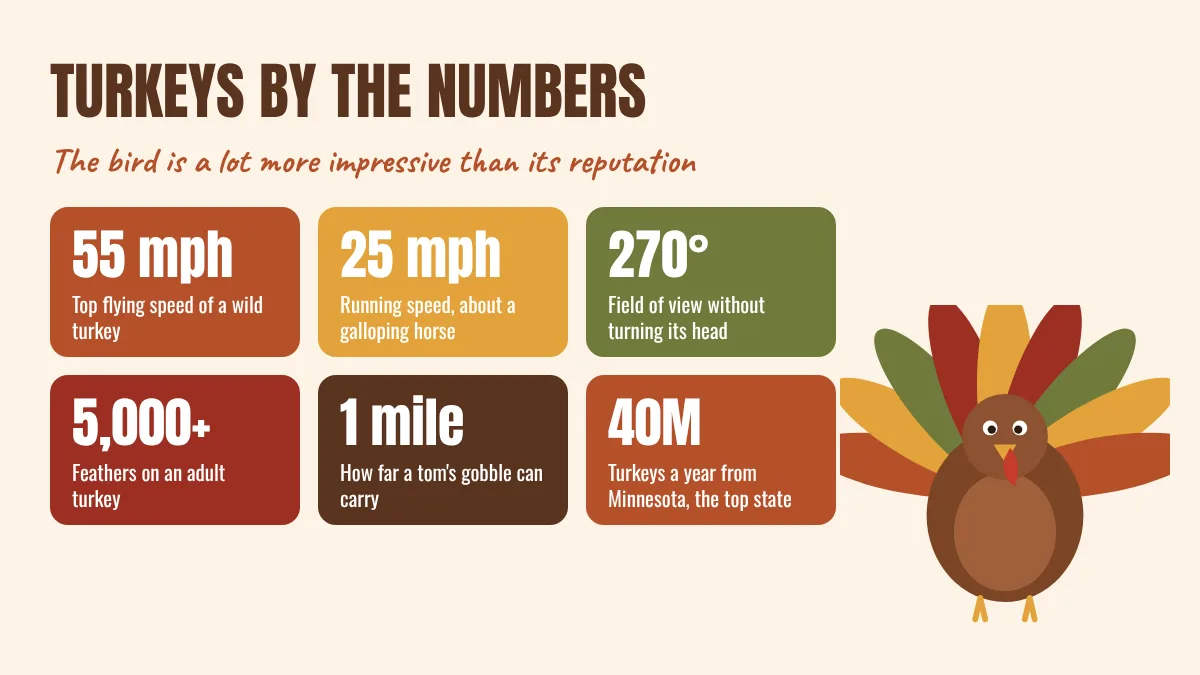
- Only male turkeys gobble. Toms gobble to attract hens and warn off rivals. Hens communicate with clucks, purrs and yelps.
- Wild turkeys can fly at up to about 55 mph. They fly in short, powerful bursts and roost in trees at night to stay safe from predators.
- Wild turkeys can run at about 25 mph. That’s about as fast as a racehorse at a steady gallop, and much faster than most people can sprint.
- Turkeys see in color and have a very wide field of view. Their eyes are on the sides of their heads, so they can see about 270 degrees around them without turning their heads.
- A turkey’s head can change color. A tom’s bare head can turn red, white or blue depending on his mood, and it gets brighter when he’s excited or showing off.
- The flap of skin over a turkey’s beak is called a snood. A long, red snood shows a male is healthy, and hens seem to prefer males with longer ones.
- Farm turkeys can’t fly. Most supermarket turkeys are Broad Breasted Whites, which have been bred to be so heavy that they can’t fly or even mate naturally.
- Minnesota raises more turkeys than any other state. Minnesota usually raises around 40 million turkeys a year, followed by North Carolina and Arkansas.
- Wild turkeys nearly disappeared. By the early 1900s, hunting and habitat loss had left only about 30,000 wild turkeys in the US. Conservation efforts brought them back to millions.
- Benjamin Franklin admired turkeys. In a 1784 letter to his daughter, he called the turkey ‘a much more respectable bird’ than the bald eagle. He never actually proposed it as the national bird.
- Male turkeys grow a ‘beard’. The beard is a tuft of hair-like feathers on the chest. It keeps growing throughout the bird’s life, and a few hens grow one too.
- A baby turkey is called a poult. Poults can walk and feed themselves within a day of hatching.
- Turkey eggs are bigger than chicken eggs, but we rarely eat them. Turkeys lay far fewer eggs than chickens and take longer to mature, so their eggs would be much more expensive to sell.
- The bird is named after the country by mistake. Europeans confused the American bird with guinea fowl that came through Turkish (Ottoman) traders, and the name ‘turkey’ stuck.
- Pardoned White House turkeys have stayed in a luxury hotel. In recent years, the birds have spent the night before the ceremony at a hotel near the White House before retiring to a farm or university.
For more about the bird, play our turkey trivia questions and answers or the lighter fun turkey trivia quiz.
Thanksgiving Food Fun Facts
Most of the classic Thanksgiving foods are much newer than the holiday. Several were invented in company test kitchens in the 20th century.
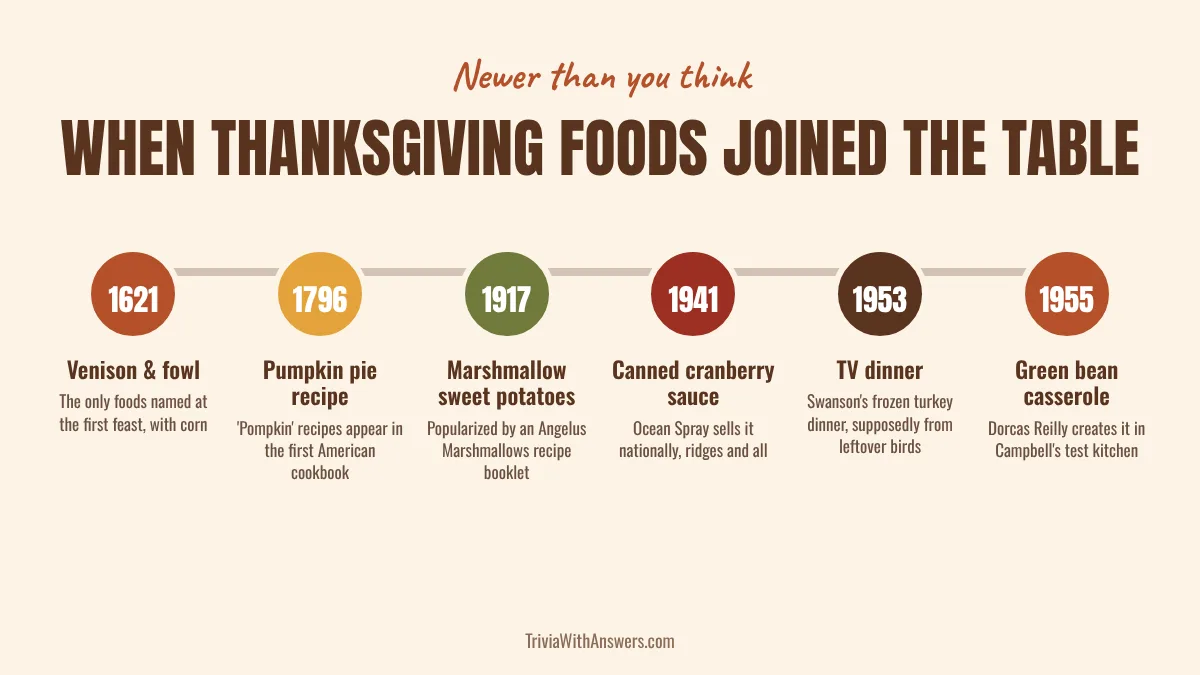
- Green bean casserole was invented in 1955. Dorcas Reilly created it in Campbell’s test kitchen to sell more cream of mushroom soup. It’s now a holiday staple across the US.
- Canned cranberry sauce arrived in 1941. Ocean Spray sold the first canned jellied cranberry sauce nationally, and it’s still a favorite at many tables.
- The ridges on canned cranberry sauce come from the can. The jelly sets in the can, so when it slides out it keeps the shape of the ridges. Many families slice it along the lines.
- Ripe cranberries bounce. Air pockets inside firm, fresh berries make them bounce. Growers once sorted cranberries by bouncing them over small wooden barriers.
- Cranberries float. The same air pockets let them float. Growers flood the bogs and knock the berries loose, then gather them from the surface of the water.
- Wisconsin grows more cranberries than any other state. Wisconsin produces more than half of the US crop, even though most people associate cranberries with Massachusetts.
- Most canned pumpkin comes from Illinois. Illinois grows more pumpkins than any other state, and many of them are a variety grown specially for canning.
- Pumpkin pie recipes appear in the first American cookbook. ‘American Cookery’ by Amelia Simmons, published in 1796, includes recipes for ‘pompkin’ pudding baked in a pastry crust.
- Stuffing and dressing are basically the same dish. ‘Stuffing’ is usually cooked inside the bird. ‘Dressing’ is baked in a pan and is the more common name in the South.
- Most ‘yams’ in US stores are actually sweet potatoes. True yams are starchy tubers from Africa and Asia. Orange sweet potatoes were labeled ‘yams’ to set them apart from paler sweet potato varieties.
- Marshmallows on sweet potatoes started as an advertising idea. A 1917 recipe booklet from Angelus Marshmallows helped make the topping popular in American kitchens.
- The TV dinner was supposedly born from leftover turkey. The story goes that in 1953 Swanson ended up with about 260 tons of extra Thanksgiving turkey and turned it into frozen dinners.
- Turkey doesn’t actually make you sleepy. Turkey has about the same amount of tryptophan as chicken or beef. A big meal and lots of carbohydrates are more likely to make you drowsy.
- The Butterball Turkey Talk-Line answers more than 100,000 questions a season. The hotline started in 1981 and now takes calls, texts and messages from nervous cooks every November and December.
- A turducken is three birds in one. It’s a deboned chicken inside a deboned duck inside a deboned turkey. It became famous in the 1980s and 1990s.
- The wishbone tradition is thousands of years old. The Etruscans in ancient Italy are believed to have used bird bones for luck, and the Romans spread the habit of breaking them.
- A full Thanksgiving dinner can easily top 3,000 calories. Turkey, stuffing, potatoes, gravy, rolls, pie and drinks add up quickly, which is why so many people want a nap afterwards.
- Mashed potatoes weren’t at the first Thanksgiving. Potatoes hadn’t become common in New England by 1621, so there were no mashed potatoes at the feast.
- Classic pecan pie became popular thanks to corn syrup. Karo corn syrup popularized the modern pecan pie recipe in the 1930s, though pecan pies existed earlier.
- A French wine is released just before Thanksgiving. Beaujolais Nouveau comes out on the third Thursday of November, so it’s often served with turkey a week later.
- Native peoples used cranberries for food, medicine and dye. Cranberries were mixed into pemmican, used to treat wounds and used to dye fabric red long before the colonists arrived.
- Old cookbooks called stuffing ‘forcemeat’. The word ‘stuffing’ only became common in the 1500s, and some Victorians preferred ‘dressing’ because they thought ‘stuffing’ sounded vulgar.
Still hungry? Our pie trivia and fall food trivia questions have plenty more.
Macy’s Thanksgiving Day Parade Fun Facts
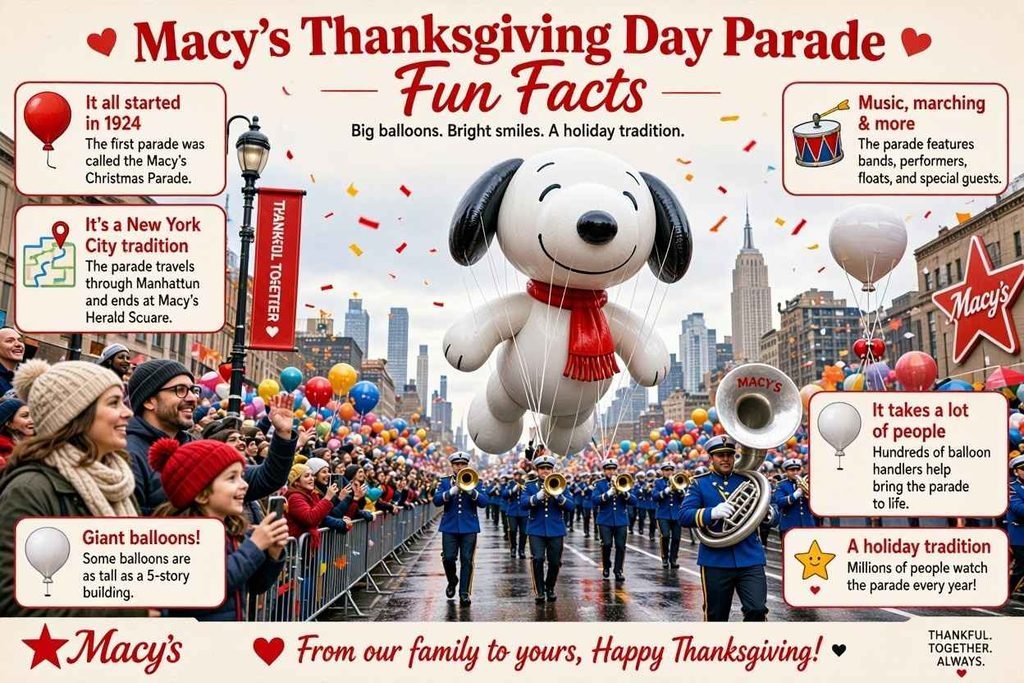
The parade started as a store promotion and became a national tradition that millions of people watch every year.
- The first parade in 1924 was called the Macy’s Christmas Parade. It was meant to start the holiday shopping season and ended with Santa arriving at the Herald Square store.
- The early parades had live zoo animals. Bears, elephants, camels and monkeys from the Central Park Zoo marched in the 1924 parade.
- Felix the Cat was the first character balloon. Felix flew in 1927, starting the giant-balloon tradition that replaced the animals.
- Balloons were once released into the sky at the end of the parade. From 1928, balloons were let go after the parade, and people who found them could return them to Macy’s for a reward.
- The parade stopped during World War II. It was cancelled from 1942 to 1944, and Macy’s donated its rubber balloons to the war effort.
- Snoopy has appeared more times than any other character. He first flew in 1968 and has appeared in several outfits, including as the Flying Ace and an astronaut.
- The balloons are inflated the night before. Crowds gather on the streets near the American Museum of Natural History on Wednesday night to watch the balloons being inflated.
- Some balloons need about 90 handlers. Teams of volunteers hold the ropes, and they have to train for the job before the parade.
- Santa Claus always comes last. Santa’s float closes the parade and officially marks the start of the Christmas season in New York.
- ‘Miracle on 34th Street’ opens at the parade. The 1947 film used real footage of the 1946 parade, and the story starts with Kris Kringle replacing a drunk Santa.
- The parade route is about 2.5 miles long. It runs from the Upper West Side down to Macy’s flagship store at Herald Square.
- Millions watch the parade in person, and tens of millions more on TV. About 3.5 million people line the streets of New York, making it one of the most-watched parades in the world.
Thanksgiving Football Fun Facts
For many families, football is as much a part of Thanksgiving as turkey.
- Football was played on Thanksgiving before the NFL existed. College teams have played on Thanksgiving since 1876, when Yale and Princeton met in the new intercollegiate championship.
- The first NFL Thanksgiving games were played in 1920. Several games were played on Thanksgiving Day in the league’s very first season.
- The Detroit Lions have hosted a Thanksgiving game since 1934. Owner George A. Richards started the tradition to attract fans, and the game was broadcast on radio across the country.
- The Dallas Cowboys have hosted since 1966. Dallas has hosted nearly every year since then. The only exceptions were 1975 and 1977.
- A third, night-time Thanksgiving game was added in 2006. It started on NFL Network and later moved to NBC, so there are now three games every Thanksgiving Day.
- John Madden handed out turkey legs to standout players. Madden’s ‘Turkey Leg Award’ started in 1989, and players sometimes ate them on camera after the game.
- A 1993 Thanksgiving blunder became famous. In a snowy game, Cowboys defender Leon Lett touched a blocked field goal he should have left alone, and Miami kicked the winning field goal.
- A disputed coin toss on Thanksgiving changed the NFL rules. In 1998, Jerome Bettis and the referee disagreed about whether he called ‘heads’ or ‘tails’. The NFL changed its coin toss rules after that game.
- The NFL played its first Black Friday game in 2023. The Dolphins played the Jets on the day after Thanksgiving, and the game was streamed on Amazon Prime Video.
- A ‘turkey’ in bowling is three strikes in a row. One story is that in the 1800s, bowling alleys gave real turkeys as prizes for three strikes in a row around the holidays.
Football fans can keep going with our Thanksgiving football trivia questions.
Weird and Surprising Thanksgiving Facts
Thanksgiving has a few strange traditions and unexpected connections that make great dinner table conversation.
- ‘Jingle Bells’ may have been written for Thanksgiving. Some historians believe James Lord Pierpont wrote ‘One Horse Open Sleigh’ for a Thanksgiving program in the 1850s, though this is still debated. Either way, the song never mentions Christmas.
- The night before Thanksgiving is one of the busiest bar nights of the year. People home for the holiday meet up with old friends, so it’s sometimes called ‘Blackout Wednesday’ or ‘Drinksgiving’.
- ‘Black Friday’ started as a complaint from police. Philadelphia police officers in the 1950s and 1960s used it to describe the traffic jams and crowds of shoppers after Thanksgiving.
- Cyber Monday was named in 2005. The National Retail Federation’s online division noticed that online sales jumped on the Monday after Thanksgiving, when people were back at their work computers.
- Giving Tuesday began in 2012. It was created by New York’s 92nd Street Y and the United Nations Foundation as a day of giving after the shopping days.
- An 18-minute song is a Thanksgiving radio tradition. Many stations play Arlo Guthrie’s ‘Alice’s Restaurant Massacree’, which is based on a real Thanksgiving dinner and an arrest for littering.
- America’s oldest running road race is a Turkey Trot. The Buffalo Turkey Trot in New York started in 1896 and is still held every Thanksgiving morning.
- A dog show airs right after the parade. The National Dog Show has followed the Macy’s parade on NBC every Thanksgiving since 2002.
- Charlie Brown served jelly beans for Thanksgiving dinner. In ‘A Charlie Brown Thanksgiving’ (1973), Peppermint Patty and the others get toast, pretzel sticks, popcorn and jelly beans.
- A TV station once dropped live turkeys from a helicopter. It happened in a famous 1978 episode of ‘WKRP in Cincinnati’, which ends with the line ‘As God is my witness, I thought turkeys could fly’.
- There are towns named Turkey in Texas and North Carolina. There’s also a Cranberry Township in Pennsylvania, so the holiday menu is on the map too.
- The day after Thanksgiving is the busiest day of the year for plumbers. Plumbing companies call it ‘Brown Friday’ because of all the grease, potato peelings and extra guests that clog drains.
- Thanksgiving weekend is one of the busiest travel periods of the year in the US. Tens of millions of people travel by car or plane, and the Sunday after Thanksgiving is often one of the busiest days for flying.
- Many states give workers the day after Thanksgiving off too. A number of states treat the Friday after Thanksgiving as a holiday for state employees, which gives them a four-day weekend.
- Children used to dress up and ask for treats on Thanksgiving. In the late 1800s and early 1900s, children in New York dressed as ‘ragamuffins’ and went door to door asking for pennies or treats.
Thanksgiving Myths Busted
Some of the best-known Thanksgiving ‘facts’ turn out to be wrong. Here are the myths most often repeated at the dinner table.
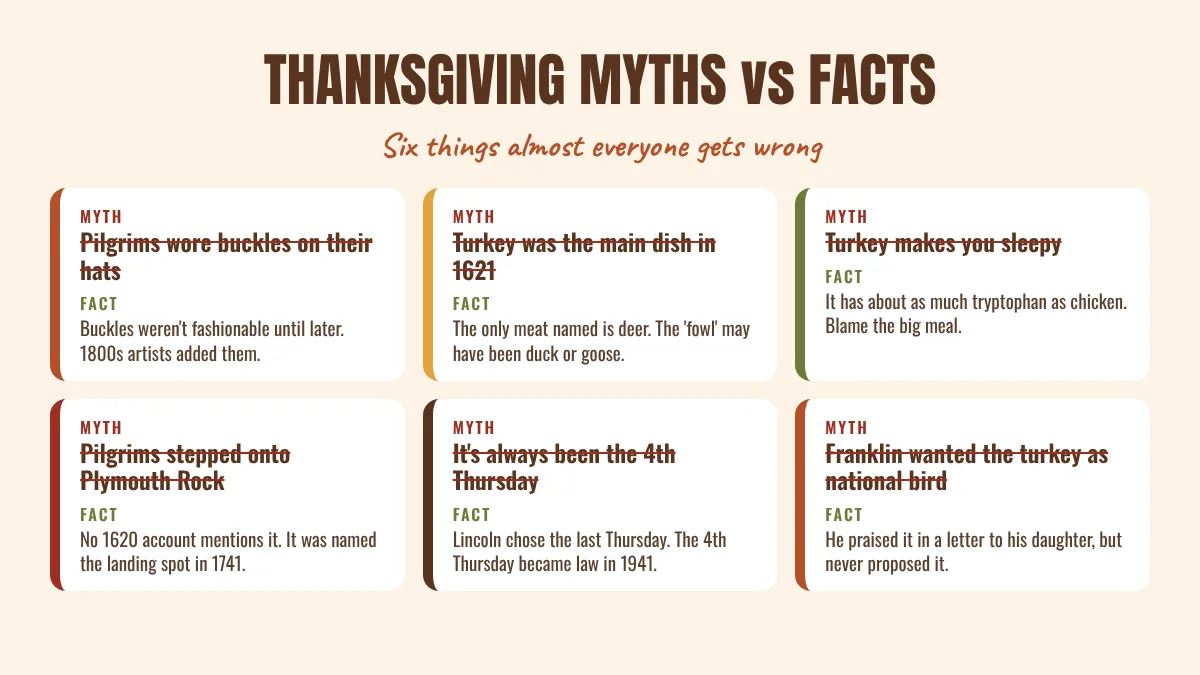
- Myth: The Pilgrims wore buckles on their hats. Buckles weren’t fashionable until later in the 1600s. Artists in the 1800s added them to paintings, and the image stuck.
- Myth: The Pilgrims only wore black. Black was expensive and saved for special occasions. In daily life, they wore browns, greens, reds and other colors.
- Myth: Turkey was definitely the main dish in 1621. The only meat the accounts mention by name is deer. ‘Fowl’ was served, but it could have been ducks or geese.
- Myth: Plymouth was the first Thanksgiving in America. Spanish settlers and the Timucua shared a meal of thanksgiving at St. Augustine, Florida, in 1565, and Virginia’s Berkeley Hundred held a day of thanksgiving in 1619.
- Myth: The Plymouth settlers called themselves Pilgrims. Bradford used the word once in his writings. The name became popular in the late 1700s.
- Myth: The Pilgrims stepped onto Plymouth Rock. No account from 1620 mentions the rock. It was first identified as the landing spot in 1741, more than 120 years later.
- Myth: Thanksgiving has always been the fourth Thursday. Lincoln chose the last Thursday of November, FDR moved it in 1939, and the fourth Thursday only became law in 1941.
- Myth: The turkey pardon goes back to Lincoln. There’s a story that Lincoln’s son Tad saved a turkey, but the official pardon ceremony only began in 1989.
- Myth: Benjamin Franklin wanted the turkey as the national bird. He only praised the turkey in a private letter. He never formally proposed it.
- Myth: Tryptophan in turkey makes you sleepy. Turkey doesn’t have more tryptophan than other common meats. The size of the meal is what makes you sleepy.
Thanksgiving Around the World
Many other countries and cultures also hold festivals to give thanks for the harvest.
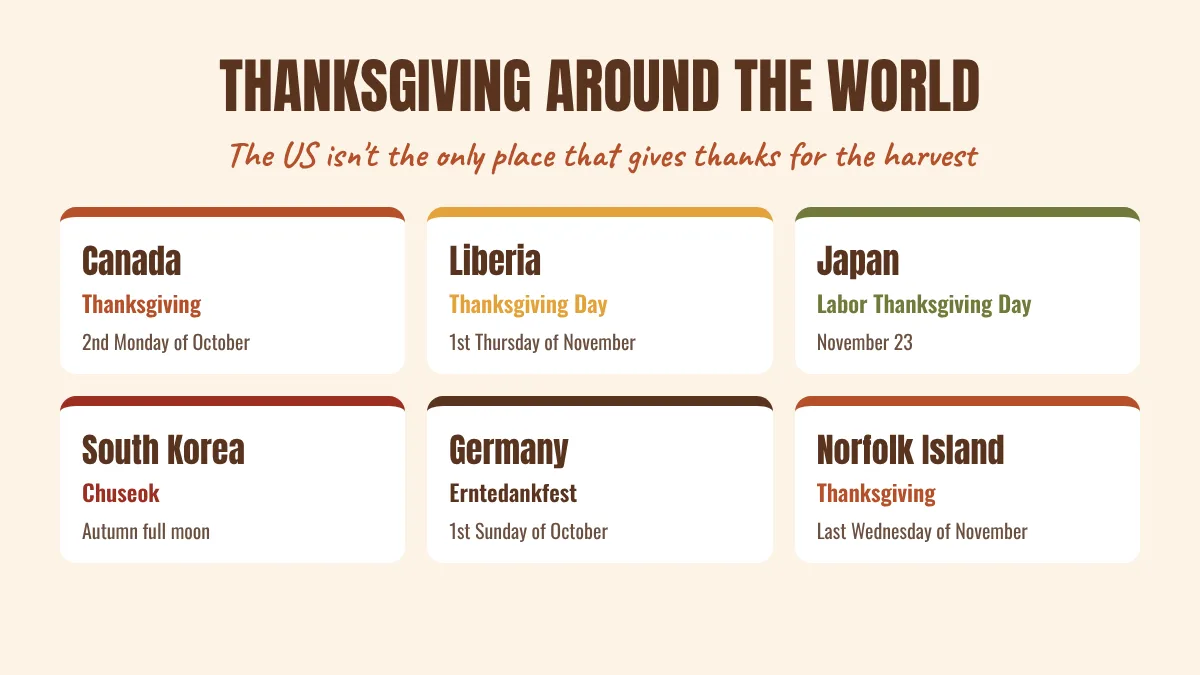
- Canada celebrates Thanksgiving in October. Canadian Thanksgiving falls on the second Monday of October, partly because the harvest ends earlier in the north.
- Liberia celebrates Thanksgiving on the first Thursday of November. The custom came with formerly enslaved Americans who settled in Liberia in the 1800s.
- Japan has a Labor Thanksgiving Day. Every November 23, Japan celebrates Kinrō Kansha no Hi, which honors work and comes from an ancient rice harvest festival.
- South Korea’s big harvest festival is Chuseok. During Chuseok, families visit their hometowns, honor their ancestors and eat rice cakes called songpyeon.
- Germany gives thanks with Erntedankfest. Churches are decorated with fruit, vegetables and grain, usually on the first Sunday of October.
- Norfolk Island in the Pacific celebrates an American-style Thanksgiving. American whalers brought the custom in the 1800s, and islanders still celebrate on the last Wednesday of November.
- Grenada celebrates Thanksgiving on October 25. The holiday marks the anniversary of the 1983 US-led military intervention on the island.
- China’s Mid-Autumn Festival is a harvest celebration. Families share mooncakes under the full moon, and the round shape stands for being together as a family.
- Sukkot is a Jewish harvest festival. For a week, families eat meals in a temporary outdoor hut called a sukkah, remembering the shelters the Israelites used in the desert.
- The UK celebrates Harvest Festival. Churches and schools collect food, often for local charities, around the time of the Harvest Moon in September or October.
Learn more in our Thanksgiving traditions around the world trivia and fall harvest trivia.
Thanksgiving Fun Facts for Kids
These easy facts are good for classrooms, kids’ tables and anyone who’s new to the holiday.
- Wild turkeys sleep in trees. They fly up to high branches at dusk to stay safe from foxes and other predators.
- An adult turkey has about 5,000 to 6,000 feathers. Some of those feathers are on its beautiful fan-shaped tail.
- A tom’s gobble can be heard up to a mile away. Toms gobble loudest in spring to let hens know where they are.
- Turkeys have ears, even though you can’t see them. Small openings just behind their eyes let them hear very well.
- A group of turkeys is called a rafter. You can also call it a flock or a gang.
- Pumpkins are a fruit. Botanists class pumpkins as fruit because they grow from a flower and have seeds inside.
- Cranberries are one of only a few fruits that are native to North America. Blueberries and Concord grapes are two others.
- Squanto showed the colonists how to plant corn with fish. Burying a small fish in each mound helped feed the soil and grow a better crop.
- One of the biggest pumpkin pies ever made weighed over 3,600 pounds. It was baked in Ohio in 2010 and measured 20 feet across.
- Kids once dressed up on Thanksgiving, a bit like Halloween. Over 100 years ago, children in New York wore costumes and went door to door asking for treats.
Thanksgiving Fun Facts Quiz (10 Questions)
Did any of it stick? Try these multiple-choice questions on your family or friends. The answers and explanations are under each question.
1. How long did the 1621 harvest celebration at Plymouth last?
- A) One afternoon
- B) One day
- C) About three days
- D) A full week
Answer: C) About three days. Edward Winslow described about three days of feasting and recreation.
2. Which meat is named in the firsthand account of the 1621 feast?
- A) Turkey
- B) Deer
- C) Ham
- D) Lamb
Answer: B) Deer. Winslow wrote that the Wampanoag killed five deer and brought them to the feast.
3. Which president refused to issue Thanksgiving proclamations?
- A) George Washington
- B) John Adams
- C) Thomas Jefferson
- D) Abraham Lincoln
Answer: C) Thomas Jefferson. Jefferson thought a presidential call to prayer mixed church and state.
4. Who campaigned for 17 years to make Thanksgiving a national holiday?
- A) Martha Washington
- B) Sarah Josepha Hale
- C) Harriet Beecher Stowe
- D) Louisa May Alcott
Answer: B) Sarah Josepha Hale. Sarah Josepha Hale, editor of Godey’s Lady’s Book, wrote to five presidents before Lincoln agreed in 1863.
5. What nickname did critics give FDR’s earlier Thanksgiving in 1939?
- A) Franksgiving
- B) Roosevelt Day
- C) Early Bird Thursday
- D) New Deal Day
Answer: A) Franksgiving. Moving the date to help retailers was unpopular, and ‘Franksgiving’ stuck.
6. Which turkeys gobble?
- A) Only males
- B) Only females
- C) Both
- D) Only chicks
Answer: A) Only males. Toms gobble. Hens cluck, purr and yelp.
7. In what year was green bean casserole invented?
- A) 1925
- B) 1941
- C) 1955
- D) 1972
Answer: C) 1955. Dorcas Reilly created it at Campbell’s in 1955.
8. Which character was the first balloon in the Macy’s parade?
- A) Mickey Mouse
- B) Snoopy
- C) Felix the Cat
- D) Popeye
Answer: C) Felix the Cat. Felix the Cat flew in 1927. Snoopy holds the record for most appearances.
9. Which NFL team has hosted a Thanksgiving game since 1934?
- A) Dallas Cowboys
- B) Detroit Lions
- C) Chicago Bears
- D) Green Bay Packers
Answer: B) Detroit Lions. Detroit has hosted every year since 1934, except during World War II.
10. When does Canada celebrate Thanksgiving?
- A) First Monday of September
- B) Second Monday of October
- C) Fourth Thursday of November
- D) December 1
Answer: B) Second Monday of October. The earlier date fits Canada’s shorter growing season.
Want a full game? Our 175+ Thanksgiving Day trivia questions and November trivia questions have plenty more.
Thanksgiving Discussion Questions for Families
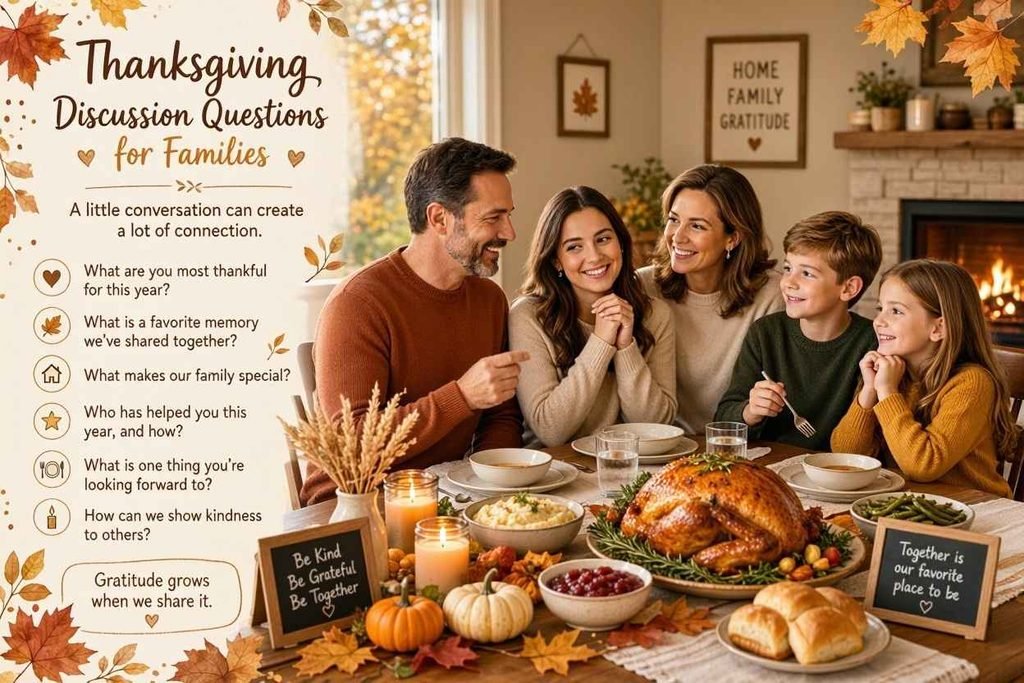
Fun facts are a good way to get everyone talking. Read one of the facts above, then ask one of these questions:
- Which fact surprised you most, and why?
- If you could go back to 1621 for the three-day feast, what would you most want to see?
- Which Thanksgiving food would you take off the table, and which would you add?
- Should Thanksgiving have stayed on the last Thursday of November, or is the fourth Thursday better?
- What’s one family tradition you’d want to keep for the next 50 years?
- The Wampanoag have lived in New England for more than 12,000 years. What would you like to learn about their history?
- If you could start a new Thanksgiving tradition this year, what would it be?
Using These Facts in the Classroom
Teachers can turn this list into a quick lesson. Give each group one section, ask them to choose their three favorite facts, and have them present those facts to the class. The Myths Busted section works well for a ‘true or false’ warm-up, and the quiz above makes an easy exit ticket. For older students, ask them to compare the 1621 accounts with the myths section and discuss why some stories became so popular.
For more seasonal reading, see our November fun facts.
Thanksgiving Fun Facts: FAQs
What are 5 fun facts about Thanksgiving?
The first Thanksgiving lasted three days; deer, not turkey, is the only meat named in the 1621 account; Lincoln made it a national holiday in 1863; only male turkeys gobble; and the first Macy’s parade in 1924 had live zoo animals.
What is the most interesting fact about Thanksgiving?
Many people are surprised that the holiday had two different dates in 1939 and 1940. FDR moved it a week earlier to help retailers, many states refused, and Congress fixed the fourth Thursday in 1941.
Did the Pilgrims eat turkey at the first Thanksgiving?
Possibly, but it isn’t certain. Edward Winslow’s account mentions ‘fowl’ and five deer. William Bradford wrote that wild turkeys were around that autumn, so turkey may have been included along with ducks and geese.
Why is Thanksgiving on a Thursday?
Colonial New England often held days of thanksgiving on Thursdays, and Washington and Lincoln both chose Thursdays. A 1941 law made the fourth Thursday of November the official date.
What are some fun Thanksgiving facts for kids?
Kids love that a group of turkeys is called a rafter, that wild turkeys sleep in trees, that a tom’s gobble can be heard a mile away, and that pumpkins are actually a fruit.
When is Thanksgiving in 2026?
US Thanksgiving is on Thursday, November 26, 2026. Canadian Thanksgiving was on Monday, October 12, 2026.
Final Thoughts
Thanksgiving is a holiday filled with meaningful traditions, delicious meals, and fascinating history. We hope these Thanksgiving Fun Facts helped you discover something new about the holiday and gave you plenty of interesting information to share with others. From the origins of Thanksgiving and the tradition of eating turkey to famous parades and unique celebrations, there’s always something more to learn about this special occasion.
Share your favorite facts with family and friends, use them for a Thanksgiving trivia game, or surprise everyone at your holiday dinner with your newfound knowledge. Keep exploring, stay curious, and have a wonderful Thanksgiving filled with happiness and gratitude!