
Are you ready to give your brain a serious workout? These 101 very hard riddles with answers are designed to challenge your logic, test your attention to detail, and make you look at ordinary things from a completely different perspective.
Some require careful reasoning, others depend on clever wordplay, and a few will tempt you to overthink the simplest clues.
Whether you’re searching for difficult riddles for adults, tricky brain teasers to share with friends, or challenging puzzles for your next game night, this collection has something to keep you guessing. You’ll find logic puzzles, number challenges, mysterious descriptions, and unexpected twists that reward creative thinking.
The best part? Every riddle comes with an answer, so you can check your reasoning whenever you’re ready.
Challenge yourself: Read each riddle carefully, give yourself time to solve it, and resist the temptation to peek at the answer too soon. You might be surprised by how many of these puzzles fool you on the first attempt!
Very Hard Riddles With Answers
These first riddles are designed to get your brain working. They use unusual descriptions, hidden clues, and unexpected connections that aren’t always obvious at first glance.
1. Riddle: I can preserve a moment without stopping time, show a face without knowing its name, and reveal something that has already disappeared. What am I?
Answer: A photograph.
2. Riddle: A room has four walls, a ceiling, and a floor. Every wall faces south. A bear walks past the window. What color is the bear?
Answer: White, if the room is at the North Pole. All directions from the North Pole lead south, and polar bears live in the Arctic.
3. Riddle: I can be measured but never held, spent without being touched, and lost without leaving a physical mark. What am I?
Answer: Time.
4. Riddle: A woman writes a message that contains no letters, yet everyone who sees it understands exactly what she means. What could she have written?
Answer: A drawing or a symbol, such as a red heart to express love.
5. Riddle: I can be broken without being touched, repaired without glue, and strengthened by actions rather than materials. What am I?
Answer: Trust.
6. Riddle: A box contains three objects. Each object is heavier than the one before it, but the box becomes lighter whenever you add another object. How is this possible?
Answer: The objects are being added to a box that is losing heavier material at the same time. The box’s total weight decreases because the amount leaving exceeds the weight being added.
7. Riddle: I have a beginning but no birth, an end but no death, and a middle that can change whenever someone edits me. What am I?
Answer: A written story.
8. Riddle: Two people look at the same clock. One says it is early, while the other insists it is late. Neither is wrong. How can this happen?
Answer: They have different appointments or deadlines. The same time can be early for one event and late for another.
9. Riddle: I become more valuable when fewer people possess me, yet I can lose all my value the moment everyone knows me. What am I?
Answer: A secret.
10. Riddle: I can connect two distant places without moving either one closer together. I can carry messages but have no hands. What am I?
Answer: A communication network.
Hard Logic Riddles That Require Careful Thinking
Logic riddles become difficult when you must consider every detail instead of jumping to the first reasonable conclusion. Read the conditions closely, because a single overlooked word can change the answer.
11. Riddle: Three switches are outside a closed room, and one light bulb is inside. Only one switch controls the bulb. You may operate the switches however you like, but you may enter the room only once. How can you identify the correct switch?
Answer: Turn on the first switch for several minutes, then turn it off. Turn on the second switch and enter the room. If the bulb is lit, the second switch controls it. If it is off but warm, the first switch controls it. If it is off and cool, the third switch is correct.
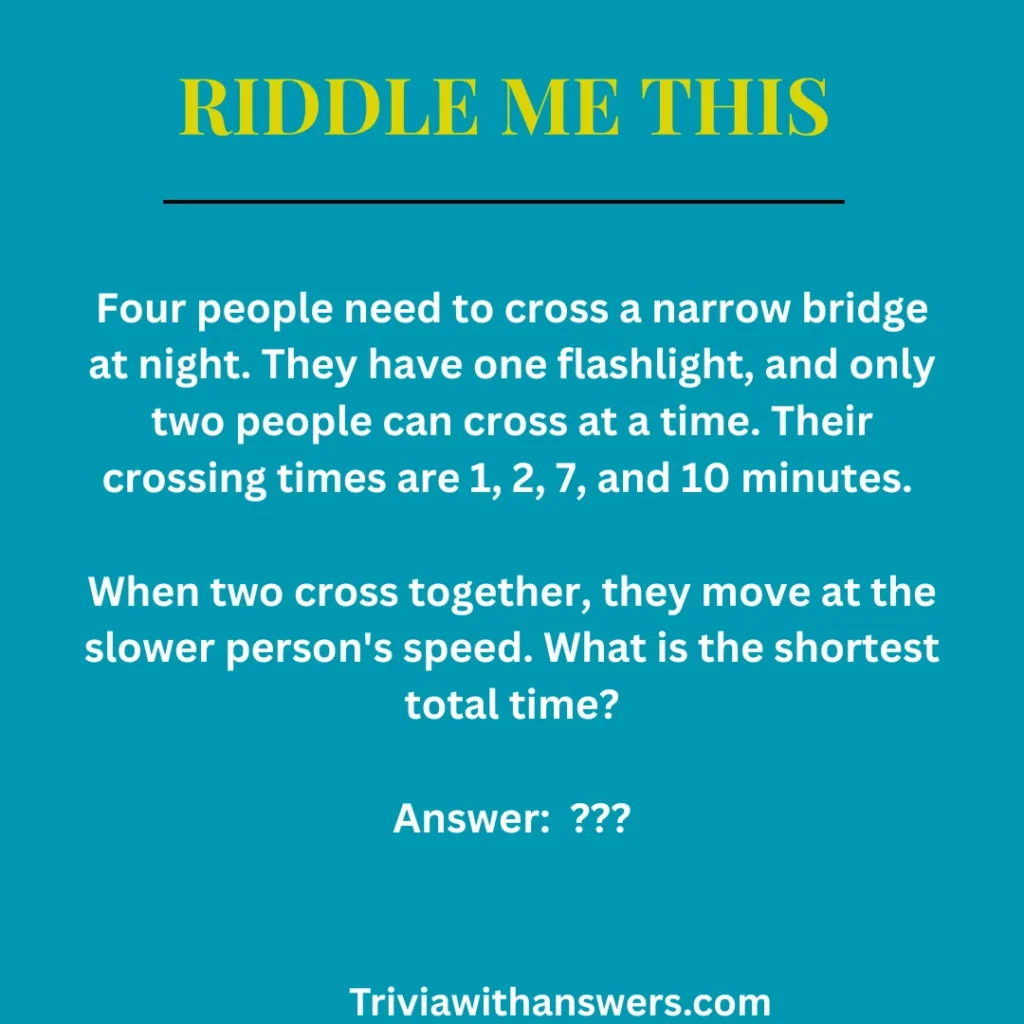
12. Riddle: Four people need to cross a narrow bridge at night. They have one flashlight, and only two people can cross at a time. Their crossing times are 1, 2, 7, and 10 minutes. When two cross together, they move at the slower person’s speed. What is the shortest total time?
Answer: 17 minutes. The two fastest cross first (2 minutes), the fastest returns (1 minute), the two slowest cross (10 minutes), the second-fastest returns (2 minutes), and the two fastest cross again (2 minutes). Total: 17 minutes.
13. Riddle: A detective finds a locked office with no broken windows. A person is unconscious inside, and the floor is wet. The only other object nearby is a broken glass. What important detail should the detective investigate before assuming someone attacked the person?
Answer: The source of the broken glass and water. A glass container or a fishbowl may have broken, and the wet floor alone does not establish that a crime occurred. More evidence is needed to determine what happened.
14. Riddle: Five people each shake hands with every other person exactly once. How many handshakes occur?
Answer: 10 handshakes. Each of the five people could shake hands with four others, giving 20 handshakes if counted from both ends. Dividing by two gives 10 unique handshakes.
15. Riddle: A farmer must transport a fox, a chicken, and a bag of grain across a river. His boat carries only him and one item at a time. The fox cannot be left alone with the chicken, and the chicken cannot be left alone with the grain. How can he transport everything safely?
Answer: Take the chicken across first. Return alone, take the fox across, and bring the chicken back. Take the grain across, return alone, and finally take the chicken across again.
16. Riddle: A building has ten floors. An elevator starts on the ground floor with nobody inside. Three people enter, two leave, and five more enter. If four people leave on the sixth floor, how many people are in the elevator afterward?
Answer: Two. Three enter, two leave, and five enter, leaving six people. Four then leave, so two remain.
17. Riddle: A family has two parents and four children. Each child has the same two parents, but every child claims to have a different number of siblings. What could explain this?
Answer: The children may be counting half-siblings from different households, or they may be using different definitions of sibling. The stated facts don’t establish that all four children have exactly the same sibling relationships outside this household.
18. Riddle: A person enters a competition and finishes ahead of the person who was in third place. The person does not finish first or second. What position do they finish in?
Answer: Third place is impossible under the usual ranking rules because finishing ahead of the third-place person means taking at least third place. The conditions are inconsistent unless a special rule, such as a tie or disqualification, applies.
19. Riddle: A drawer contains red, blue, and green socks. You cannot see inside it. What is the minimum number of socks you must take to guarantee a matching pair by color?
Answer: Four socks. With three colors, the first three could all be different. The fourth must match one of them.
20. Riddle: A clock takes five seconds to strike six times. Assuming the strikes occur at equal intervals, how long does it take to strike twelve times?
Answer: 11 seconds. Six strikes create five intervals, so each interval lasts one second. Twelve strikes create eleven intervals.
Extremely Hard Wordplay Riddles
These riddles rely on the flexibility of language. A word might have several meanings, or a familiar phrase might hide the clue you need.
21. Riddle: I can be drawn, crossed, followed, or erased. I may separate two places or guide someone toward a destination. What am I?
Answer: A line.
22. Riddle: I have a head and a tail, but no body. I can be flipped, but I cannot walk away. What am I?
Answer: A coin.
23. Riddle: I can be sharp without a blade, pointed without a finger, and make someone uncomfortable without touching them. What am I?
Answer: A question.
24. Riddle: I can be opened, closed, broken, or kept. I may contain a promise, but I am not always written down. What am I?
Answer: An agreement.
25. Riddle: I can be raised in a room, lowered in a voice, and changed without moving a single object. What am I?
Answer: The volume.
26. Riddle: I can be passed around without being handed over, caught without a net, and spread without being painted. What am I?
Answer: A rumor.
27. Riddle: I can be charged without electricity, cleared without water, and held without arms. What am I?
Answer: A debt.
28. Riddle: I can be cold without ice, hard without stone, and broken without making a sound. What am I?
Answer: An attitude.
29. Riddle: I have roots but no soil, branches but no leaves, and can grow larger without becoming alive. What am I?
Answer: A family tree.
30. Riddle: I can be taken, given, made, or lost. Sometimes I am all someone needs to feel better, yet I cannot be purchased in a store. What am I?
Answer: A break.
Hard Number Riddles and Mathematical Brain Teasers
You don’t need to be a mathematics expert to solve these number riddles. You do need to pay attention to patterns, operations, and the difference between what a question suggests and what it actually states.
31. Riddle: I am a three-digit number. My tens digit is twice my hundreds digit, and my ones digit is three less than my tens digit. My digits add up to 12. What number am I?
Answer: 462. The hundreds digit is 4, the tens digit is 6, and the ones digit is 2. Their sum is 12.
32. Riddle: A number becomes four times larger when you move its last digit to the front. The number has two digits. What is the number?
Answer: There is no two-digit number that satisfies this exact condition. If the original number is (10a+b) and the rearranged number is (10b+a), the condition requires (10b+a=4(10a+b)), or (6b=39a). That has no solution with nonzero digits from 1 to 9.
33. Riddle: A father is three times as old as his son. In 12 years, he will be twice as old as his son. How old are they now?
Answer: The father is 36 and the son is 12. In 12 years, they will be 48 and 24, so the father will be twice his son’s age.
34. Riddle: I am a positive number. Multiply me by myself, then subtract me. The result is 20. What number am I?
Answer: 5. Five squared is 25, and 25 minus 5 equals 20.
35. Riddle: A baker makes 48 cookies. He puts them into boxes of equal size, using more than two boxes but fewer than ten. No cookies are left over, and each box contains more than five cookies. How many boxes could he use?
Answer: Four boxes, with 12 cookies each, or six boxes, with eight cookies each. Both arrangements satisfy the conditions.
36. Riddle: What is the smallest positive whole number that leaves a remainder of 1 when divided by 2, 3, and 4?
Answer: 13. It leaves remainders of 1 when divided by 2, 3, and 4.
37. Riddle: A number is doubled, then increased by 8. The result equals the number multiplied by 3 and reduced by 7. What is the number?
Answer: 15. The equation is (2x+8=3x-7), so (x=15).
38. Riddle: A rectangle has a perimeter of 30 units. Its length is three times its width. What are its dimensions?
Answer: The width is 3.75 units and the length is 11.25 units. Since twice the sum of the dimensions is 30, their sum is 15. The width is 3.75, and the length is 11.25.
39. Riddle: Three consecutive positive whole numbers have a product of 210. What are they?
Answer: 5, 6, and 7. Their product is (5 \times 6 \times 7=210).
40. Riddle: I am a two-digit number. My digits add up to 11. Reversing my digits makes the new number 27 smaller than the original. What number am I?
Answer: 74. The digits add up to 11, and reversing 74 gives 47, which is 27 less than 74.
Tricky Riddles About Everyday Objects
Ordinary objects can make surprisingly difficult riddles. These puzzles describe familiar items through their functions, shapes, or unusual characteristics.
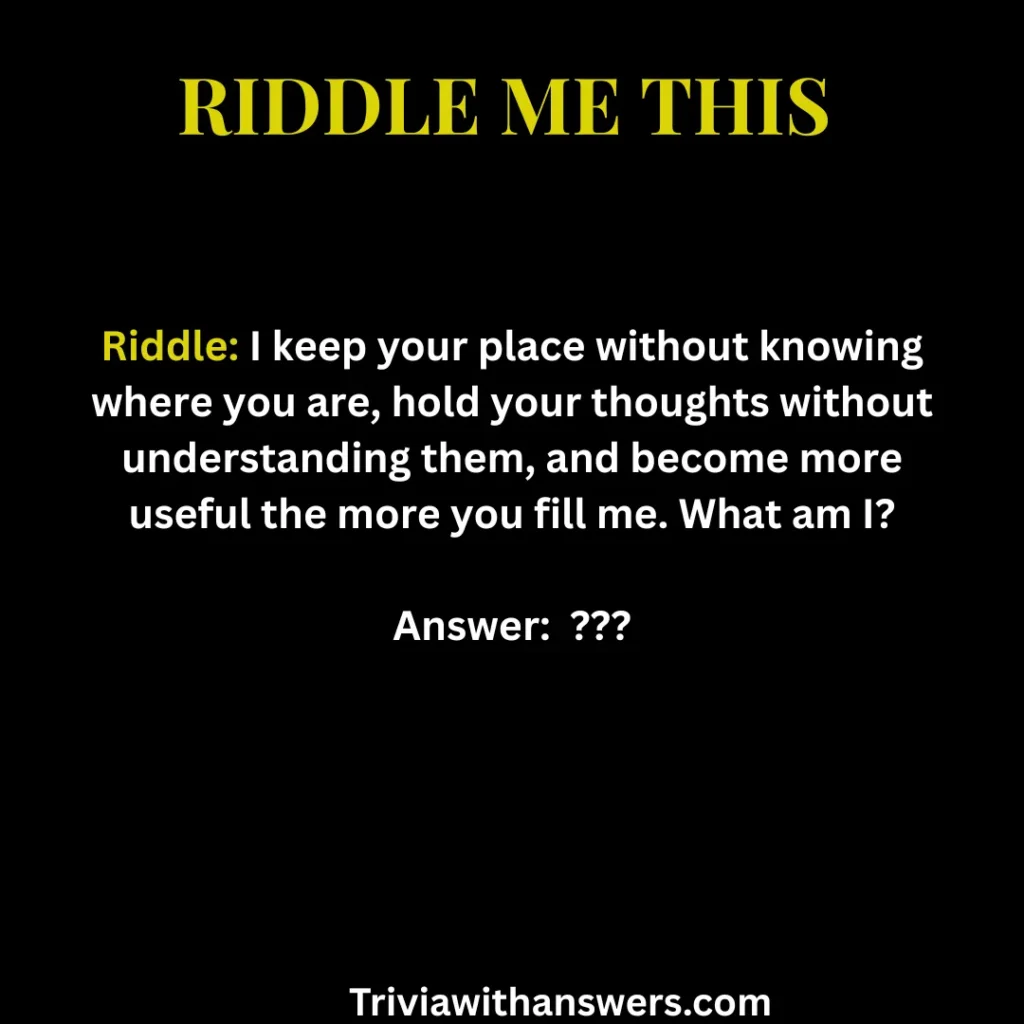
41. Riddle: I keep your place without knowing where you are, hold your thoughts without understanding them, and become more useful the more you fill me. What am I?
Answer: A notebook.
42. Riddle: I have a face that never smiles, numbers that never speak, and hands that never touch. What am I?
Answer: A clock.
43. Riddle: I can protect you from rain but become useless if you forget me at home. I open like a flower but have no roots. What am I?
Answer: An umbrella.
44. Riddle: I have teeth but cannot chew, travel through hair but never eat, and work best when pulled from one end to the other. What am I?
Answer: A comb.
45. Riddle: I can make a room brighter without producing any light of my own. I can show you the world outside while keeping the weather out. What am I?
Answer: A window.
46. Riddle: I can hold thousands of words but remain silent until someone gives me a voice. I can be carried in one hand or fill an entire room. What am I?
Answer: A book. Its words can be read aloud, and a book can be small enough to hold or large enough to dominate a room.
47. Riddle: I have a neck but no head, a body but no bones, and a mouth that can pour without speaking. What am I?
Answer: A bottle.
48. Riddle: I can unlock a door, start an engine, or open a conversation, yet I am not always made of metal. What am I?
Answer: A key.
49. Riddle: I can carry a person’s weight without walking, have legs without knees, and provide a seat without asking anyone to sit. What am I?
Answer: A chair.
50. Riddle: I grow shorter as I work, leave a trail behind me, and can disappear completely while helping someone else create something permanent. What am I?
Answer: A pencil.
Very Hard Riddles About Nature and the World
Nature offers endless material for challenging riddles. These puzzles focus on weather, landscapes, living things, and natural processes.
51. Riddle: I travel without a vehicle, change shape without scissors, and sometimes disappear completely when the sun takes control. What am I?
Answer: A patch of frost.
52. Riddle: I can cross an entire landscape without taking a single step. I carry no passengers, yet I can move leaves, clouds, and dust. What am I?
Answer: The wind.
53. Riddle: I fall without being pushed, disappear without leaving a hole, and can cover a whole neighborhood in white. What am I?
Answer: Snow.
54. Riddle: I begin as something invisible, gather strength in the air, and announce my arrival with a flash before delivering a rumble. What am I?
Answer: A thunderstorm.
55. Riddle: I am surrounded by land, yet I am not an island. I can be deep or shallow, calm or rough, and contain creatures that breathe underwater. What am I?
Answer: A lake.
56. Riddle: I can stand for centuries without growing taller, hold rings that record the past, and provide shelter without building a roof. What am I?
Answer: A tree.
57. Riddle: I appear when light meets tiny droplets, display several colors, and vanish when the conditions change. What am I?
Answer: A rainbow.
58. Riddle: I can be born from a seed, survive without moving, and produce thousands of descendants without ever meeting them. What am I?
Answer: A plant.
59. Riddle: I carve valleys without a chisel, polish stones without sandpaper, and can turn a mountain’s edge into something smooth over time. What am I?
Answer: Flowing water.
60. Riddle: I can be found at the top of a mountain and at the bottom of the sea. I can be hard enough to build with or soft enough to crumble between your fingers. What am I?
Answer: Rock.
Difficult Riddles About People and Human Behavior
Not every hard riddle requires calculations. Sometimes the answer depends on understanding how people communicate, make decisions, and relate to one another.
61. Riddle: A person tells the truth about everything except one subject. When that subject comes up, the person always lies. What is the best way to discover the truth about that subject?
Answer: Independent evidence is needed. Asking the person alone cannot guarantee the truth when every answer about that subject is deliberately false.
62. Riddle: Two friends remember the same conversation differently. Both are certain they are telling the truth. How can both be sincere?
Answer: Human memory is reconstructive. Each person may remember different details or interpret the conversation differently without intentionally lying.
63. Riddle: I can make a stranger feel welcome without opening a door, help a friend feel understood without solving a problem, and disappear if I am not returned. What am I?
Answer: Empathy.
64. Riddle: The more carefully you listen to me, the less you need to speak. I can resolve a disagreement without proving anyone wrong. What am I?
Answer: Active listening.
65. Riddle: I can be shared by many people without being divided, grow stronger through practice, and help strangers work toward the same goal. What am I?
Answer: Teamwork.
66. Riddle: A person has a hundred possible choices but feels unable to choose any of them. What may be causing the problem?
Answer: Decision paralysis. Too many options or fear of making the wrong choice can make choosing more difficult.
67. Riddle: I can be offered in a second, take years to earn, and disappear because of a single broken promise. What am I?
Answer: Credibility.
68. Riddle: I can make someone feel powerful while making their judgment weaker. I can grow when nobody questions me. What am I?
Answer: Overconfidence.
69. Riddle: I allow people to disagree without becoming enemies, and I can protect a relationship without requiring either person to change their beliefs. What am I?
Answer: Mutual respect.
70. Riddle: I cannot change what happened yesterday, but I can change how someone responds tomorrow. What am I?
Answer: A lesson learned from experience.
Extremely Tricky Riddles With Unexpected Answers
These riddles are designed to challenge your first interpretation. Take your time and consider whether the wording contains a hidden assumption.
71. Riddle: A person owns a shop with no doors, no windows, and no customers who enter. Yet the shop sells goods every day. How is that possible?
Answer: It is an online shop. Customers can place orders without entering a physical store.
72. Riddle: A woman walks into a room carrying an empty bag. She leaves the room with the bag still empty, but she has gained something valuable. What might she have gained?
Answer: Knowledge or information. Not every gain is a physical object.
73. Riddle: A message reaches its destination even though every word in it is spelled incorrectly. How is this possible?
Answer: The recipient understands the intended meaning despite the spelling errors.
74. Riddle: A person looks at a calendar and says, “Yesterday was tomorrow, and today is the day before yesterday.” Under what circumstances could this make sense?
Answer: The person is speaking about dates relative to a different reference point, such as describing a past or hypothetical schedule. Without a specified reference point, the statement cannot be interpreted uniquely.
75. Riddle: A race has no finish line, yet one participant is declared the winner. What kind of race could it be?
Answer: A competition judged by another criterion, such as a dance race or a contest in which the winner is chosen by score rather than reaching a finish line.
76. Riddle: A person gives away the only copy of a document but can still show exactly what it says. How?
Answer: The person memorized it or has a separate digital copy or notes containing its contents.
77. Riddle: A traveler arrives at a place before leaving the place where the journey began. How could this happen without time travel?
Answer: The traveler crosses time zones while traveling east or west, so the local clock at the destination can show an earlier time than the clock at departure. The traveler still moves forward in time.
78. Riddle: A person can answer every question in an interview correctly but still fail to get the job. Why?
Answer: The employer may evaluate other factors, such as experience, communication, teamwork, or suitability for the role.
79. Riddle: A locked door opens without a key, a code, or physical force. What could have happened?
Answer: Someone unlocked it from the other side, or the door was released by an automatic mechanism.
80. Riddle: A person spends an entire day doing nothing but becomes exhausted. How is that possible?
Answer: The person may be recovering from illness, dealing with emotional stress, or experiencing fatigue despite not doing physical work.
Hard Riddles About Words, Letters, and Meaning
Words can hide puzzles inside their spelling, pronunciation, and meanings. These riddles reward close attention to language rather than complicated calculations.
81. Riddle: I am a word that describes something that cannot be described completely in words. What kind of word could I be?
Answer: A word such as ineffable, which describes something too great or intense to be expressed adequately in words.
82. Riddle: I can be a statement, a question, or a command, but I become a different thing when you place a question mark after me. What am I?
Answer: A sentence. Punctuation can change how a sentence is interpreted.
83. Riddle: I am a word that can describe a person who is present but not participating, or an object that exists but is not being used. What am I?
Answer: Inactive.
84. Riddle: A single word can mean both an action and the result of that action. What is an example?
Answer: Construction. It can refer to the process of building something or to the structure being built.
85. Riddle: I can be right without being correct, and I can be left without going anywhere. What am I?
Answer: A direction. Right and left can describe positions rather than correctness or movement.
86. Riddle: I can be pronounced differently depending on the sentence, yet my spelling remains unchanged. What am I?
Answer: A heteronym, such as lead, which can rhyme with “bead” when referring to the metal or with “bed” when referring to guiding someone.
87. Riddle: I can make a sentence sound uncertain without changing its basic meaning, and I often appear when someone is choosing their words carefully. What am I?
Answer: A hedge word or phrase, such as “perhaps,” “possibly,” or “it seems.”
88. Riddle: I can turn a statement into its opposite with only one small addition. What am I?
Answer: A negation, such as adding “not” to a statement.
89. Riddle: I can mean something different from the words I contain, especially when the speaker does not intend the literal meaning. What am I?
Answer: An idiom or figurative expression.
90. Riddle: I can be read in two different ways without changing a single letter, and both readings can make sense. What am I?
Answer: An ambiguous sentence. Its structure or wording allows more than one interpretation.
The Hardest Riddles in This Collection
Ready for the final round? These last eleven riddles combine logic, interpretation, patterns, and abstract thinking. Some have precise answers, while others ask you to identify the most reasonable explanation.
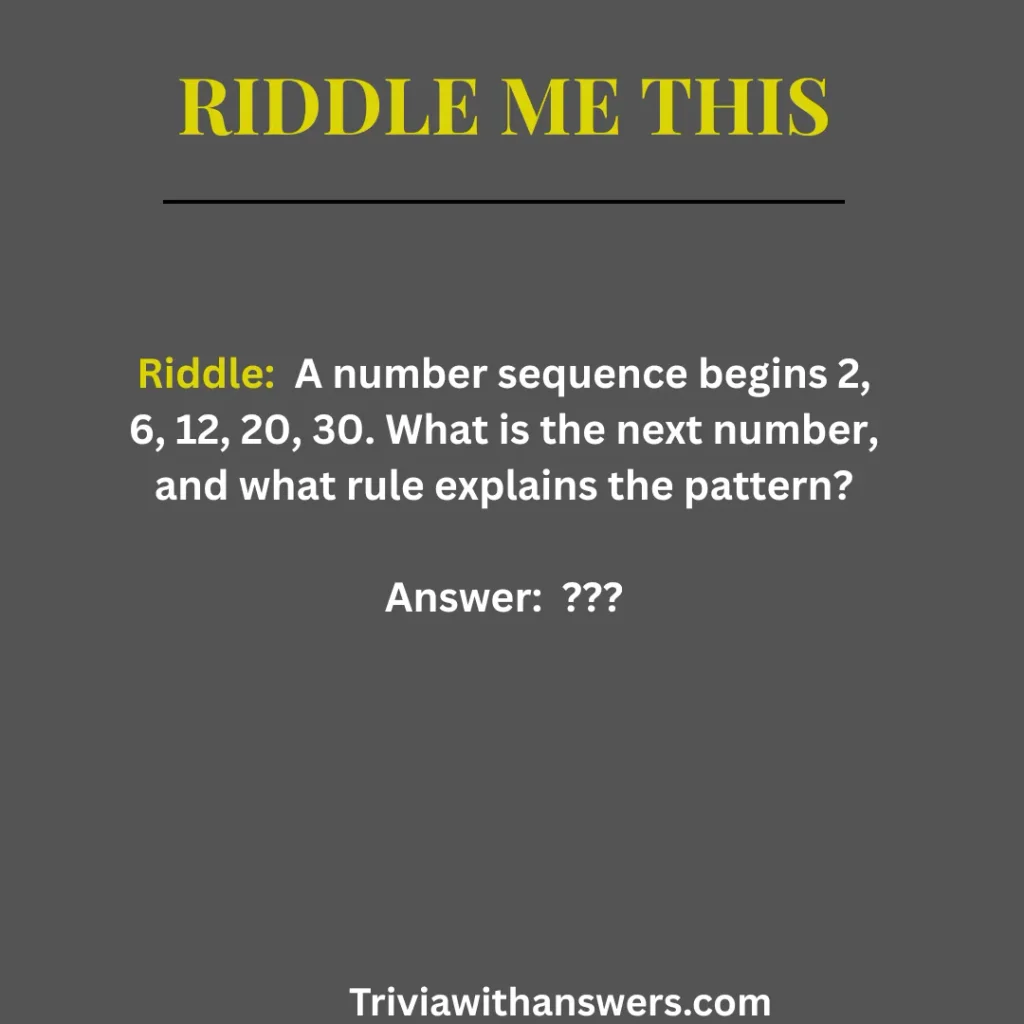
91. Riddle: A number sequence begins 2, 6, 12, 20, 30. What is the next number, and what rule explains the pattern?
Answer: 42. Each term is the product of two consecutive positive integers: (1 \times 2=2), (2 \times 3=6), (3 \times 4=12), and so on. The next is (6 \times 7=42).
92. Riddle: You have two identical-looking containers and a balance scale. One container holds only light objects, and the other holds heavier objects. You may weigh them only once. How can you identify the heavier container?
Answer: Put one container on each side of the balance. The heavier container is on the side that goes down. This assumes the scale can compare the containers in a single weighing.
93. Riddle: A person must choose between three doors. Behind one is a prize; behind the other two are empty rooms. The person chooses a door. A host who knows where the prize is opens one of the other doors to reveal an empty room and offers the person a chance to switch. Should the person switch?
Answer: Yes, assuming the host always opens an empty door and always offers the switch. Switching gives a two-thirds chance of winning, while staying gives a one-third chance.
94. Riddle: A machine produces a sequence of numbers: 1, 4, 9, 16, 25. What number comes next, and why?
Answer: 36. These are consecutive perfect squares: (1^2, 2^2, 3^2, 4^2, 5^2), followed by (6^2=36).
95. Riddle: You have a candle, a fireplace, and a gas stove. You have only one match. What should you light first?
Answer: The match.
96. Riddle: A person says, “Everything I say in this sentence is false.” Can the statement be classified as simply true or false without creating a contradiction?
Answer: No. This is a version of the liar paradox. If the statement is true, it must be false; if it is false, it appears to be true. Ordinary true-or-false classification creates a contradiction.
97. Riddle: A map shows two towns connected by a straight line. A traveler follows the line but never travels directly between the towns. How can both statements be true?
Answer: The line may represent a route on a map rather than a physically straight road. The traveler can follow the mapped route while the actual journey curves around obstacles.
98. Riddle: A person has five identical-looking keys and knows that only one opens a particular lock. What is the most reliable way to identify the correct key if there are no labels or other clues?
Answer: Test the keys one by one in the lock until one works. With no additional information, there is no guaranteed shortcut.
99. Riddle: A puzzle has four possible answers, and each answer says that exactly one of the four answers is correct. How many answers can be correct?
Answer: Exactly one, if the statements are interpreted consistently as each candidate claiming that only one option is correct. If more than one were correct, each would assert that only one is correct, creating a contradiction.
100. Riddle: A person must cross a room without touching the floor, walls, ceiling, or furniture. The room has no water, no rope, and no ladder. What is one possible way to cross?
Answer: Walk across the room while wearing shoes. The puzzle says not to touch the floor with your body, but shoes can make the contact. If “touching” includes shoes, then the conditions need clarification.
101. Riddle: Imagine a library that contains every book that has ever been written and every book that will ever be written. One book in the library describes every other book, including itself. What problem might arise if that book attempts to describe its own description completely?
Answer: Self-reference can create a logical problem. If the book must include an exhaustive account of itself, including that account, it may require an endless chain of descriptions. The puzzle illustrates the difficulty of complete self-reference.
How to Solve Very Hard Riddles More Easily
Struggling with these riddles doesn’t mean you’re bad at puzzles. The hardest riddles are designed to make you question your first assumptions. Instead of guessing quickly, use a few simple strategies to work through the clues.
- Read every word carefully. A single phrase may change the meaning of the entire riddle.
- Look for hidden assumptions. Ask yourself whether the puzzle actually states what you think it states.
- Consider alternative meanings. Words such as “light,” “right,” “key,” and “break” can have several meanings.
- Write down numbers and conditions. For math and logic riddles, working on paper can make complicated relationships easier to see.
- Test your answer against every clue. A clever guess isn’t correct unless it fits the entire riddle.
- Don’t confuse difficulty with ambiguity. Some puzzles have precise solutions, while others need extra assumptions. Recognizing the difference is part of good reasoning.
Most importantly, enjoy the process. Sometimes the best part of a difficult riddle is discovering why your first answer seemed so convincing.
Frequently Asked Questions About Very Hard Riddles
1. What are the hardest riddles to solve?
The hardest riddles are usually those that combine multiple clues, hidden assumptions, wordplay, or several steps of logical reasoning. Mathematical puzzles, lateral-thinking challenges, and carefully constructed paradoxes can be especially difficult because they require you to examine the problem from more than one angle.
2. Are these very hard riddles suitable for adults?
Yes. Many of these riddles are suitable for adults who enjoy challenging puzzles, logic games, and brain teasers. They can be used during game nights, friendly competitions, team-building activities, or simply as a way to challenge yourself.
3. Can kids solve hard riddles?
Older children and teenagers may enjoy many of these riddles, especially those involving patterns, everyday objects, and wordplay. Some puzzles require algebra or abstract reasoning, so younger children may need hints or explanations.
4. What is the difference between a riddle and a brain teaser?
A riddle usually describes something indirectly and asks you to identify the answer. A brain teaser is a broader category that includes logic problems, number sequences, mathematical challenges, and puzzles requiring several steps of reasoning. The two categories often overlap.
5. How can I get better at solving difficult riddles?
Practice regularly, slow down when reading the clues, and consider more than one interpretation before settling on an answer. For numerical puzzles, write down the equations or patterns. For wordplay riddles, think about alternative meanings and expressions. Reviewing the explanation after solving a puzzle can also help you recognize similar tricks later.
6. Can I use these riddles for a party or game night?
Absolutely. You can read them aloud, organize a team competition, or ask everyone to write down their answers before revealing the solutions. Award one point for each correct answer and give bonus points for explaining the reasoning.
7. Why do some riddles have more than one possible answer?
Some riddles are intentionally open-ended, while others leave out information that would establish a unique solution. If two answers fit all the stated clues, the puzzle may need a more precise wording. In a well-constructed logic riddle, the intended answer should satisfy the conditions without relying on unstated assumptions.
Related Articles:
176+ Tricky Halloween Riddles for Adults
123+ Hard Scavenger Hunt Riddles with Answers
125+ Best Riddle Me This Riddles and Answers
115+ Fun and Nostalgic Riddles for Seniors With Answers
Final Thoughts
These 101 very hard riddles with answers offer a mix of logic challenges, mathematical puzzles, wordplay, and unexpected twists. Some reward quick observation, while others require patience and careful reasoning.
Whether you solved most of them or had to check the answers frequently, every puzzle offered a chance to look at a problem differently. Challenge a friend to see how many they can solve, share your favorite riddles at your next gathering, or return to the trickiest ones and see whether they feel easier the second time.
How many riddles did you solve without looking at the answers? Keep your score, challenge someone else, and see who can make it through all 101!