

Looking for workplace trivia questions and answers for your next team meeting? This quiz has 102 questions about office history, workplace terms and acronyms, safety, careers and famous TV workplaces, plus a funny round to lighten the mood.
Every question has four choices and a short explanation, so it works as an icebreaker, a team-building game, a safety refresher or a Friday afternoon break. Use one round at a time, or play the full quiz with teams.
Quick Workplace Facts
- The 40-hour workweek became law in the US through the 1938 Fair Labor Standards Act.
- Ray Tomlinson sent the first networked email in 1971.
- 3M’s Post-it Notes started as a failed attempt at a super-strong glue.
- The modern cubicle grew out of Herman Miller’s Action Office design.
- Labor Day in the US falls on the first Monday in September.
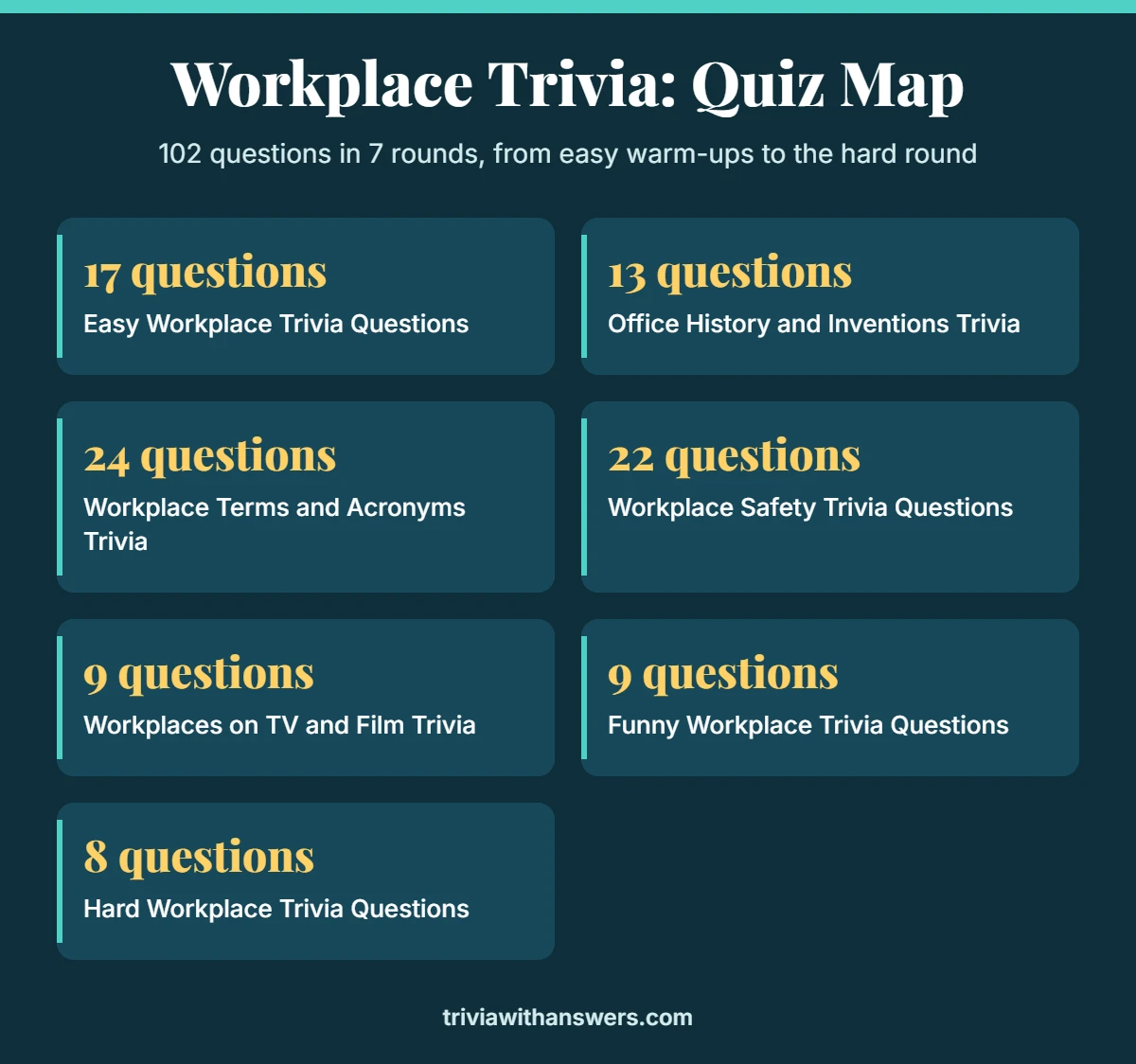
Easy Workplace Trivia Questions
Simple questions to warm up the team.
1. What color hard hat is typically worn by site supervisors or engineers?
- A) Yellow
- B) White
- C) Blue
- D) Green
Show answer
Answer: B) White. Fun Fact: White hats = boss mode. They’re the “captains” of construction sites.
2. What’s the most common cause of office injuries?
- A) Falling off a chair
- B) Paper cuts
- C) Slipping on wet floors
- D) Keyboard rage
Show answer
Answer: C) Slipping on wet floors. Fun Fact: Those yellow “Wet Floor” signs are basically tiny superheroes in disguise.
3. What’s the name of the workplace movement promoting flexible schedules?
- A) WorkSmart
- B) Flexitime
- C) Timeless Work
- D) Freedom Hours
Show answer
Answer: B) Flexitime. Fun Fact: Early birds and night owls finally found common ground — flexibility!
4. What’s the world’s most stressful workplace sound?
- A) Keyboard clicking
- B) Phone ringing nonstop
- C) Printer jam
- D) Boss saying “Got a minute?”
Show answer
Answer: D) Boss saying “Got a minute?”. Fun Fact: It’s never just a minute, is it?
5. What’s the best way to survive a long meeting?
- A) Strategic yawns
- B) Mental vacation
- C) Bring snacks
- D) All of the above
Show answer
Answer: D) All of the above. Fun Fact: Meetings could be emails — but then we’d miss all the snack sharing. Recommended: 131+ Flip Flop Trivia Questions and Answers
6. Coffee is basically the unofficial fuel of every office. Which country drinks the most coffee per capita in the world?
- A) Brazil
- B) United States
- C) Finland
- D) Italy
Show answer
Answer: C) Finland. Finland consistently ranks first in coffee consumption per person, with many people enjoying several cups each day.
7. What’s the unofficial rule about bringing fish for lunch to heat in the office microwave?
- A) Heat it twice
- B) Share it with coworkers
- C) Don’t. Just don’t.
- D) Only eat it outside
Show answer
Answer: C) Don’t. Just don’t. Strong food odors are one of the most common office etiquette complaints.
8. What does “water cooler talk” usually refer to in office culture?
- A) Staff training
- B) Casual conversations and gossip
- C) Weekly meetings
- D) Performance reviews
Show answer
Answer: B) Casual conversations and gossip. Water cooler talk refers to informal chats between coworkers outside of work tasks.
9. What’s the universally accepted signal that someone doesn’t want to be disturbed at their desk?
- A) Closed laptop
- B) Headphones on
- C) Coffee mug on the desk
- D) Standing up
Show answer
Answer: B) Headphones on. Wearing headphones is often a polite signal that someone is focusing and prefers not to be interrupted.
10. Which item is most likely to mysteriously disappear from a shared office kitchen?
- A) Coffee filters
- B) Someone else’s lunch
- C) Paper towels
- D) Sugar packets
Show answer
Answer: B) Someone else’s lunch. Missing lunches are one of the oldest and most common office jokes.
11. What ergonomic accessory supports your wrist while typing?
- A) Mouse pad
- B) Wrist rest
- C) Footrest
- D) Keyboard cover
Show answer
Answer: B) Wrist rest. Wrist rests help improve comfort and reduce strain during long hours of typing.
12. Which productivity method uses 25-minute work sessions followed by short breaks?
- A) Eisenhower Matrix
- B) Pomodoro Technique
- C) Kanban Method
- D) GTD Method
Show answer
Answer: B) Pomodoro Technique. The Pomodoro Technique uses focused 25-minute work sessions separated by short breaks.
13. Which software is most commonly used for spreadsheets in offices?
- A) Microsoft Word
- B) Microsoft Excel
- C) Microsoft PowerPoint
- D) Adobe Acrobat
Show answer
Answer: B) Microsoft Excel. Microsoft Excel is the world’s most widely used spreadsheet application.
14. What is the phenomenon of forgetting why you entered a room called?
- A) Brain fog
- B) Doorway effect
- C) Memory gap
- D) Focus drift
Show answer
Answer: B) Doorway effect. Studies suggest walking through a doorway can briefly interrupt memory and attention.
15. What’s the annual office tradition where coworkers exchange anonymous gifts?
- A) White Elephant
- B) Secret Santa
- C) Holiday Swap
- D) Gift Circle
Show answer
Answer: B) Secret Santa. Secret Santa is a popular holiday tradition in many workplaces.
16. What’s the common name for the afternoon energy crash many workers experience?
- A) Monday Blues
- B) 3 p.m. slump
- C) Coffee crash
- D) Work fatigue
Show answer
Answer: B) 3 p.m. slump. Many people experience a natural dip in energy during the mid-afternoon.
17. Which office tool is used to punch holes in paper?
- A) Stapler
- B) Hole punch
- C) Paper cutter
- D) Binder clip
Show answer
Answer: B) Hole punch. A hole punch creates evenly spaced holes so documents can be placed in binders.
Office History and Inventions Trivia
18. Which office product was invented by a secretary to cover typing mistakes?
- A) Paperclip
- B) Sticky notes
- C) Correction fluid
- D) Highlighter
Show answer
Answer: C) Correction fluid. Bette Nesmith Graham invented the fluid later sold as Liquid Paper in the 1950s.
19. What workplace item did 3M accidentally invent?
- A) Tape dispenser
- B) Sticky notes
- C) Mouse pad
- D) Whiteboard marker
Show answer
Answer: B) Sticky notes. Fun Fact: It was a failed glue experiment — proof that mistakes stick around for good reasons.
20. Which workplace communication tool was originally called “Tiny Speck”?
- A) Microsoft Teams
- B) Zoom
- C) Slack
- D) Discord
Show answer
Answer: C) Slack. Slack began as an internal tool created during the development of a failed video game.
21. The term “cubicle” was popularized by which furniture company in the 1960s?
- A) IKEA
- B) Herman Miller
- C) Steelcase
- D) Office Depot
Show answer
Answer: B) Herman Miller. Herman Miller introduced the Action Office system, which led to the modern office cubicle.
22. Which famous workplace beverage was originally marketed as a tonic containing cocaine?
- A) Pepsi
- B) Dr Pepper
- C) Coca-Cola
- D) Root Beer
Show answer
Answer: C) Coca-Cola. Early Coca-Cola formulas contained coca leaf extract before the ingredient was removed.
23. Who invented the first commercially successful typewriter?
- A) Christopher Latham Sholes
- B) Thomas Edison
- C) Alexander Graham Bell
- D) Henry Ford
Show answer
Answer: A) Christopher Latham Sholes. Sholes and his partners developed it in the 1860s and 1870s.
24. For which machine was the QWERTY keyboard layout first designed?
- A) The typewriter
- B) The telegraph
- C) The computer
- D) The calculator
Show answer
Answer: A) The typewriter. QWERTY was created for early typewriters.
25. Who sent the first networked email in 1971?
- A) Ray Tomlinson
- B) Bill Gates
- C) Tim Berners-Lee
- D) Steve Jobs
Show answer
Answer: A) Ray Tomlinson. Ray Tomlinson sent it between two computers on ARPANET.
26. Which symbol did Ray Tomlinson choose to separate names from computers in email addresses?
- A) @
- B) #
- C) &
- D) %
Show answer
Answer: A) @. The @ symbol is still used in every email address.
27. Who designed the Action Office system that led to the office cubicle?
- A) Robert Propst
- B) Charles Eames
- C) Frank Lloyd Wright
- D) Steve Jobs
Show answer
Answer: A) Robert Propst. Propst designed it for Herman Miller in the 1960s.
28. What was the photocopier company Xerox originally called?
- A) The Haloid Company
- B) Kodak Copy
- C) Copy Corp
- D) Office Systems Inc.
Show answer
Answer: A) The Haloid Company. It became Xerox in 1961.
29. Who founded the video meeting company Zoom?
- A) Eric Yuan
- B) Elon Musk
- C) Mark Zuckerberg
- D) Jeff Bezos
Show answer
Answer: A) Eric Yuan. Eric Yuan founded Zoom in 2011.
30. In which year did video meetings explode as offices closed during the COVID-19 pandemic?
- A) 2016
- B) 2018
- C) 2020
- D) 2022
Show answer
Answer: C) 2020. Millions of people began working from home in 2020.
Workplace Terms and Acronyms Trivia
31. What does “PTO” stand for in workplace lingo?
- A) Paid Time Off
- B) Professional Time Out
- C) Personal Task Option
- D) Please Take Off
Show answer
Answer: A) Paid Time Off. Fun Fact: The happiest email ever sent: “Your PTO request has been approved.”
32. In workplace safety, what does PPE stand for?
- A) People Protect Everyone
- B) Personal Protective Equipment
- C) Professional Performance Evaluation
- D) Protective Policy Enforcement
Show answer
Answer: B) Personal Protective Equipment. Fun Fact: Hard hats and gloves — the superhero suits of real life.
33. What’s the term for working from home?
- A) E-working
- B) Remote work
- C) Deskless duty
- D) Cloud commuting
Show answer
Answer: B) Remote work. Fun Fact: Pajamas became the new business casual in 2020.
34. What popular phrase means working late to meet deadlines?
- A) Pulling double duty
- B) Burning the midnight oil
- C) Hitting the books
- D) Clocking out
Show answer
Answer: B) Burning the midnight oil. The expression dates back to the days when people worked by oil lamp after dark.
35. In many workplaces, what does “TGIF” stand for?
- A) Today’s Great Idea Friday
- B) Thank God It’s Friday
- C) Time Goes In Fast
- D) Take Good Initiative First
Show answer
Answer: B) Thank God It’s Friday. TGIF is a popular phrase celebrating the arrival of the weekend.
36. In workplace email, what does “CC” stand for?
- A) Company Copy
- B) Carbon Copy
- C) Central Contact
- D) Courtesy Communication
Show answer
Answer: B) Carbon Copy. The term comes from carbon paper, which created duplicate copies of typed documents.
37. What term describes browsing social media or shopping online while pretending to work?
- A) Multitasking
- B) Cyberloafing
- C) Teleworking
- D) Networking
Show answer
Answer: B) Cyberloafing. Cyberloafing refers to using work time for personal internet activities instead of job tasks.
38. Which email phrase is often considered politely passive-aggressive?
- A) Thank you!
- B) Per my last email…
- C) Best regards
- D) Have a great day
Show answer
Answer: B) Per my last email…. The phrase is commonly used when reminding someone about information already shared.
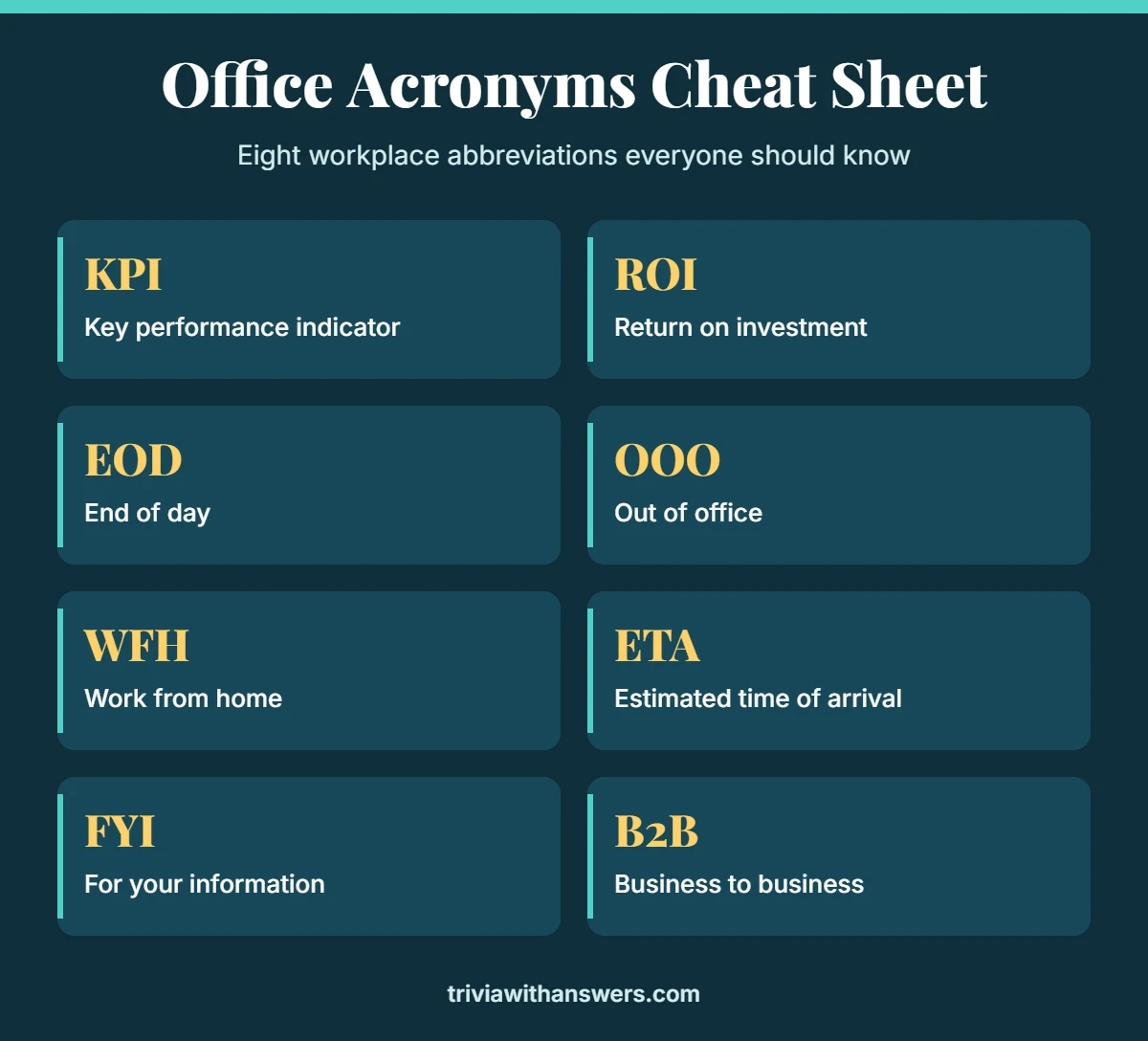
39. What does WFH stand for?
- A) Work from home
- B) Wait for help
- C) Work flex hours
- D) Weekly focus hour
Show answer
Answer: A) Work from home. WFH became an everyday phrase in 2020.
40. What does KPI stand for?
- A) Key performance indicator
- B) Key project item
- C) Known profit index
- D) Keep people informed
Show answer
Answer: A) Key performance indicator. KPIs measure progress toward goals.
41. What does ROI stand for?
- A) Return on investment
- B) Rate of interest
- C) Report of income
- D) Range of impact
Show answer
Answer: A) Return on investment. ROI compares gain with cost.
42. What does EOD mean in a workplace message?
- A) End of day
- B) Every other day
- C) Edge of deadline
- D) End of discussion
Show answer
Answer: A) End of day. Send it by EOD means before the workday ends.
43. What does OOO mean in an email status?
- A) Out of office
- B) On our own
- C) Overtime only
- D) Open office online
Show answer
Answer: A) Out of office. An OOO auto-reply tells people you are away.
44. What does HR stand for?
- A) Human resources
- B) Help request
- C) Hiring record
- D) Head of relations
Show answer
Answer: A) Human resources. HR handles hiring, pay and employee support.
45. What does CEO stand for?
- A) Chief executive officer
- B) Central executive office
- C) Company employee organizer
- D) Chief efficiency officer
Show answer
Answer: A) Chief executive officer. The CEO is the top manager of a company.
46. What does B2B mean?
- A) Business to business
- B) Back to basics
- C) Buy to build
- D) Boss to boss
Show answer
Answer: A) Business to business. B2B companies sell to other businesses.
47. The word deadline originally described what?
- A) A line prison guards would not let prisoners cross
- B) A printing press setting
- C) A railway timetable
- D) A telegraph cutoff
Show answer
Answer: A) A line prison guards would not let prisoners cross. It comes from US Civil War prison camps.
48. What does SWOT stand for in a SWOT analysis?
- A) Strengths, weaknesses, opportunities, threats
- B) Sales, work, operations, targets
- C) Skills, wages, overtime, training
- D) Strategy, wins, objectives, tactics
Show answer
Answer: A) Strengths, weaknesses, opportunities, threats. It is a classic business planning tool.
49. What is onboarding?
- A) Helping new employees settle into a job
- B) Boarding a business flight
- C) Adding people to a group chat
- D) Ordering office supplies
Show answer
Answer: A) Helping new employees settle into a job. Good onboarding helps new hires succeed faster.
50. What is a Gantt chart used for?
- A) Scheduling project tasks over time
- B) Tracking sales by region
- C) Showing an org chart
- D) Measuring employee happiness
Show answer
Answer: A) Scheduling project tasks over time. It is named after engineer Henry Gantt.
51. What does the Peter Principle say?
- A) People are promoted until they reach a job they cannot do well
- B) Work expands to fill the time available
- C) 80% of results come from 20% of effort
- D) Meetings always run late
Show answer
Answer: A) People are promoted until they reach a job they cannot do well. It was described by Laurence J. Peter in 1969.
52. What does Parkinson’s Law say about work?
- A) It expands to fill the time available
- B) It doubles every year
- C) It is always late
- D) It shrinks with more staff
Show answer
Answer: A) It expands to fill the time available. Cyril Northcote Parkinson wrote about it in 1955.
53. What does ETA stand for?
- A) Estimated time of arrival
- B) End of task assignment
- C) Extra time allowed
- D) Expected team action
Show answer
Answer: A) Estimated time of arrival. People use it for deliveries and deadlines.
54. What does FYI mean?
- A) For your information
- B) Finish your item
- C) File your invoice
- D) Follow your instincts
Show answer
Answer: A) For your information. FYI shares information that needs no reply.
Workplace Safety Trivia Questions
A quick safety refresher that works well for training sessions.
55. Hard hats aren’t a fashion statement, but they sure save lives! What’s their main purpose in workplace safety?
- A) Keep your hair clean
- B) Protect your head from falling objects or impacts
- C) Keep you warm
- D) Block loud noises
Show answer
Answer: B) Protect your head from falling objects or impacts. Hard hats help reduce the risk of serious head injuries caused by falling objects and accidental impacts.
56. What safety sign should you look for on a freshly mopped floor?
- A) Exit
- B) Caution: Wet Floor
- C) No Smoking
- D) Authorized Personnel Only
Show answer
Answer: B) Caution: Wet Floor. Wet floor signs warn people about slippery surfaces to help prevent slips and falls.
57. Which body part do safety goggles protect?
- A) Hands
- B) Eyes
- C) Ears
- D) Feet
Show answer
Answer: B) Eyes. Safety goggles protect your eyes from dust, chemicals, flying debris, and other hazards.
58. Before lifting a heavy box, what’s the safest technique?
- A) Bend your back
- B) Bend your knees
- C) Lift quickly
- D) Twist while lifting
Show answer
Answer: B) Bend your knees. Lifting with your legs instead of your back helps prevent strains and back injuries.
59. What’s the main purpose of a workplace fire drill?
- A) Test the fire alarm
- B) Practice safe evacuation
- C) Check attendance
- D) Take a break
Show answer
Answer: B) Practice safe evacuation. Fire drills prepare employees to exit safely and quickly during a real emergency.
60. What color are emergency exit signs in many countries?
- A) Red
- B) Blue
- C) Green
- D) Yellow
Show answer
Answer: C) Green. Green exit signs indicate safe escape routes during emergencies in many regions.
61. What is the large red button used to stop machinery immediately called?
- A) Pause Button
- B) Emergency Stop Button
- C) Reset Button
- D) Power Switch
Show answer
Answer: B) Emergency Stop Button. Emergency stop buttons allow machines to be shut down instantly when a hazard occurs.
62. Why should cords and cables never run across walkways?
- A) They get dirty
- B) They create tripping hazards
- C) They wear out faster
- D) They block Wi-Fi signals
Show answer
Answer: B) They create tripping hazards. Loose cables can easily cause trips, falls, and workplace injuries.
63. What’s the golden rule of chemical safety?
- A) Mix chemicals together
- B) Always read the label before use
- C) Smell the chemical first
- D) Store everything together
Show answer
Answer: B) Always read the label before use. Reading labels helps you understand hazards, handling instructions, and safety precautions.
64. What should you never block in the workplace?
- A) Windows
- B) Fire exits or fire extinguishers
- C) Office desks
- D) Bulletin boards
Show answer
Answer: B) Fire exits or fire extinguishers. Emergency exits and fire equipment must always remain accessible.
65. What’s the best way to protect your hearing in a noisy workplace?
- A) Wear sunglasses
- B) Wear earplugs or earmuffs
- C) Talk louder
- D) Cover your ears with your hands
Show answer
Answer: B) Wear earplugs or earmuffs. Hearing protection reduces the risk of long-term hearing damage caused by loud noise.
66. If you spill something in a shared workspace, what should you do?
- A) Ignore it
- B) Clean it up or report it immediately
- C) Walk around it
- D) Wait for someone else
Show answer
Answer: B) Clean it up or report it immediately. Promptly cleaning or reporting spills helps prevent slips and injuries.
67. What’s the first thing you should do if you discover a workplace hazard?
- A) Ignore it
- B) Report it to your supervisor or safety officer
- C) Take a photo and leave
- D) Wait until the next meeting
Show answer
Answer: B) Report it to your supervisor or safety officer. Reporting hazards quickly helps prevent accidents before someone gets hurt.
68. When using a ladder, what does the 3-point rule mean?
- A) Stand on the top step
- B) Keep three points of contact at all times
- C) Use three ladders together
- D) Climb with both hands full
Show answer
Answer: B) Keep three points of contact at all times. Keeping two hands and one foot—or two feet and one hand—on the ladder improves stability.
69. What’s one of the safest ways to prevent slips in wet work areas?
- A) Walk faster
- B) Use anti-slip mats or proper footwear
- C) Wear smooth-soled shoes
- D) Ignore the wet area
Show answer
Answer: B) Use anti-slip mats or proper footwear. Slip-resistant footwear and anti-slip mats greatly reduce the risk of falls.
70. What’s the proper way to handle a minor cut at work?
- A) Ignore it
- B) Clean it, cover it, and report it
- C) Wash it only
- D) Keep working without treatment
Show answer
Answer: B) Clean it, cover it, and report it. Proper first aid helps prevent infection and ensures the injury is documented if required.
71. Why is it important to take regular breaks during the workday?
- A) To avoid work completely
- B) To prevent fatigue and stay alert
- C) To finish work later
- D) To reduce meetings
Show answer
Answer: B) To prevent fatigue and stay alert. Regular breaks improve concentration, reduce stress, and help maintain productivity throughout the day. Read More : 145+ Epic Simpsons Trivia Questions & Answers
72. What does OSHA stand for?
- A) Occupational Safety and Health Administration
- B) Office Safety and Hiring Act
- C) Official Standards for Healthy Areas
- D) Organization of Safe Hazard Areas
Show answer
Answer: A) Occupational Safety and Health Administration. OSHA sets and enforces US workplace safety rules.
73. Which class of fire extinguisher is used on electrical fires in the US?
- A) Class A
- B) Class B
- C) Class C
- D) Class K
Show answer
Answer: C) Class C. Class C extinguishers are rated for live electrical equipment.
74. What does the PASS method for using a fire extinguisher stand for?
- A) Pull, aim, squeeze, sweep
- B) Point, alert, spray, step
- C) Push, activate, shoot, stop
- D) Pull, alert, spray, save
Show answer
Answer: A) Pull, aim, squeeze, sweep. It is the standard way to use most extinguishers.
75. What is an AED used for?
- A) Restoring a normal heart rhythm in cardiac arrest
- B) Testing air quality
- C) Measuring noise
- D) Opening locked doors
Show answer
Answer: A) Restoring a normal heart rhythm in cardiac arrest. AED stands for automated external defibrillator.
76. What does an SDS document provide?
- A) Hazard information about chemicals
- B) Staff work schedules
- C) Sales data
- D) Desk setup steps
Show answer
Answer: A) Hazard information about chemicals. SDS stands for Safety Data Sheet.
Workplaces on TV and Film Trivia
77. Which classic sitcom is set in the office of a paper company in Scranton, Pennsylvania?
- A) Parks and Recreation
- B) Brooklyn Nine-Nine
- C) The Office (U.S.)
- D) Friends
Show answer
Answer: C) The Office (U.S.). The Office follows the hilarious daily lives of employees at the fictional Dunder Mifflin Paper Company.
78. Which Dolly Parton hit became the ultimate 9-to-5 work anthem?
- A) Jolene
- B) Islands in the Stream
- C) 9 to 5
- D) Coat of Many Colors
Show answer
Answer: C) 9 to 5. Dolly Parton’s “9 to 5” became an iconic song celebrating—and poking fun at—the working world.
79. In The Office, which paper company do the characters work for?
- A) Dunder Mifflin
- B) Sabre
- C) Vance Refrigeration
- D) Wernham Hogg
Show answer
Answer: A) Dunder Mifflin. Dunder Mifflin has its branch in Scranton.
80. Who is the regional manager played by Steve Carell in The Office?
- A) Michael Scott
- B) Dwight Schrute
- C) Jim Halpert
- D) David Wallace
Show answer
Answer: A) Michael Scott. Michael Scott is famous for his awkward office antics.
81. In which fictional town is Parks and Recreation set?
- A) Pawnee, Indiana
- B) Scranton, Pennsylvania
- C) Springfield
- D) Stars Hollow
Show answer
Answer: A) Pawnee, Indiana. Leslie Knope works in Pawnee’s parks department.
82. Which 1999 comedy features a stapler-loving employee named Milton?
- A) Office Space
- B) Horrible Bosses
- C) The Internship
- D) Clerks
Show answer
Answer: A) Office Space. Milton’s red stapler became a pop culture icon.
83. Which TV drama is set at the Sterling Cooper advertising agency?
- A) Mad Men
- B) Suits
- C) Succession
- D) Billions
Show answer
Answer: A) Mad Men. It follows ad man Don Draper in the 1960s.
84. Which comic strip pokes fun at office life with a pointy-haired boss?
- A) Dilbert
- B) Garfield
- C) Peanuts
- D) Calvin and Hobbes
Show answer
Answer: A) Dilbert. Scott Adams created it in 1989.
85. In Brooklyn Nine-Nine, which precinct do the detectives work in?
- A) The 99th
- B) The 9th
- C) The 12th
- D) The 101st
Show answer
Answer: A) The 99th. The show’s name comes from the 99th Precinct.
Funny Workplace Trivia Questions
Just for laughs. Some of these have more than one right answer in real life.
86. Which modern workplace phrase means doing only the work required without taking on extra duties?
- A) Job hopping
- B) Quiet quitting
- C) Silent working
- D) Office retreat
Show answer
Answer: B) Quiet quitting. Quiet quitting means fulfilling your job responsibilities without consistently going above and beyond.
87. What famous principle suggests that 80% of results come from 20% of efforts?
- A) Murphy’s Law
- B) Pareto Principle
- C) Parkinson’s Law
- D) Newton’s Law
Show answer
Answer: B) Pareto Principle. The Pareto Principle is widely used in business and productivity to identify high-impact work.
88. What term describes a project that never seems to end?
- A) Priority project
- B) Zombie project
- C) Evergreen task
- D) Ghost assignment
Show answer
Answer: B) Zombie project. A zombie project keeps returning even after everyone thinks it’s finished.
89. Which color is commonly associated with urgent reminder sticky notes?
- A) Blue
- B) Green
- C) Red
- D) Purple
Show answer
Answer: C) Red. Red is commonly used to grab attention and highlight urgent tasks.
90. What’s the common phrase for a meeting that wasn’t really necessary?
- A) Quick catch-up
- B) A meeting that should’ve been an email
- C) Team briefing
- D) Strategy session
Show answer
Answer: B) A meeting that should’ve been an email. The phrase humorously describes meetings that could have been handled with a simple email.
91. What does the workplace acronym “ASAP” stand for?
- A) Always Stay Ahead Professionally
- B) As Soon As Possible
- C) All Systems Are Prepared
- D) Active Schedule and Planning
Show answer
Answer: B) As Soon As Possible. ASAP is commonly used to request that something be completed quickly.
92. What famous office prank involves placing a stapler inside gelatin?
- A) Keyboard prank
- B) Jell-O stapler prank
- C) Coffee cup prank
- D) Sticky note prank
Show answer
Answer: B) Jell-O stapler prank. The prank became famous after appearing on The Office television series.
93. Which workplace buzzword means people working together effectively?
- A) Productivity
- B) Synergy
- C) Efficiency
- D) Delegation
Show answer
Answer: B) Synergy. Synergy refers to teamwork where the combined effort produces better results.
94. What phrase describes taking a short mental break during the workday?
- A) Coffee break
- B) Brain breaks
- C) Desk escape
- D) Mini vacation
Show answer
Answer: B) Brain breaks. Short brain breaks can help improve focus, creativity, and productivity.
Hard Workplace Trivia Questions
Careers, labor history and business facts for the office trivia champion.
95. Which company is the largest private employer in the United States?
- A) Walmart
- B) Amazon
- C) Apple
- D) McDonald’s
Show answer
Answer: A) Walmart. Walmart employs about 1.6 million people in the US.
96. How many hours is the standard full-time workweek in the US?
- A) 30
- B) 35
- C) 40
- D) 50
Show answer
Answer: C) 40. The 40-hour week became standard in the 20th century.
97. Which US president signed the 1938 Fair Labor Standards Act?
- A) Franklin D. Roosevelt
- B) Harry Truman
- C) Herbert Hoover
- D) Woodrow Wilson
Show answer
Answer: A) Franklin D. Roosevelt. The law set a minimum wage and paved the way for the 40-hour week.
98. Which carmaker introduced a five-day, 40-hour workweek for factory workers in 1926?
- A) Ford
- B) General Motors
- C) Chrysler
- D) Dodge
Show answer
Answer: A) Ford. Henry Ford believed rested workers were more productive.
99. In which month is Labor Day celebrated in the United States?
- A) May
- B) July
- C) September
- D) November
Show answer
Answer: C) September. It falls on the first Monday in September.
100. On which date is International Workers’ Day celebrated in many countries?
- A) May 1
- B) June 1
- C) March 8
- D) October 1
Show answer
Answer: A) May 1. It is also known as May Day.
101. Which company was founded in a Palo Alto garage in 1939, often called the birthplace of Silicon Valley?
- A) Hewlett-Packard
- B) Apple
- C) Google
- D) Intel
Show answer
Answer: A) Hewlett-Packard. The HP garage is now a historic landmark.
102. In which country did more than 60 companies take part in a famous four-day workweek trial in 2022?
- A) United Kingdom
- B) Japan
- C) Brazil
- D) Canada
Show answer
Answer: A) United Kingdom. Most companies chose to continue after the trial.
How Did You Score?
- 0 to 26: New hire. Grab a coffee and try again.
- 27 to 51: Team player. You know the office basics.
- 52 to 77: Department star. Your coworkers should be impressed.
- 78 to 102: Employee of the month. You know the workplace inside out.
Playing in teams? Give one point per answer and double points in the hard round.
Tips for Running Workplace Trivia
- Keep it short: one round of 10 to 15 questions fits a coffee break.
- Mix departments on each team so people meet new coworkers.
- Use the safety round as a quick, friendly training refresher.
- For remote teams, share the questions on screen in a video call.
- Offer small prizes like a gift card, an extra break or bragging rights.
Workplace Trivia FAQs
What are good trivia questions for work?
Good work trivia mixes easy general questions, office history, workplace terms, safety and pop culture about famous TV workplaces, so everyone can join in.
How do you run trivia at work?
Split people into small teams, read questions aloud or share them on screen, keep score and limit each round to 10 or 15 minutes.
Is trivia good for team building?
Yes. Trivia gets coworkers talking, mixes teams and creates a fun shared experience without much preparation.
How many questions should workplace trivia have?
About 20 to 30 questions is right for a 30-minute session. A full game night can use 50 or more.
Can workplace trivia be played remotely?
Yes. Share the questions in a video call and let teams answer in chat or breakout rooms.
Practice Exercise: Quiz Yourself
Ready to see how much you remember? This practice exercise picks 10 random questions from this article. Choose an answer to get instant feedback, then try again with a fresh set.
Practice Exercise: Test Yourself
Final Thoughts
A quick round of workplace trivia is one of the easiest ways to break the ice and bring a team together. We hope these 102 workplace trivia questions and answers make your next meeting or team event a lot more fun.
Want more? Add a round of pop culture trivia for your next team social, and see the official workplace safety guidance from OSHA.
1 thought on “102 Workplace Trivia Questions and Answers for Work (2026)”